










Sigma targets 25-30% aerospace EBITDA margin in FY28 via India
Key highlights
- Sigma targets a 25% to 30% aerospace EBITDA margin in FY28.
- Sigma’s planned production model retains 30% in the UK and moves 70% to India.
- Q2 FY27 operational EBITDA rose to Rs 82.28 crore from Rs 61 crore in Q1 FY27.
- Sri City began production in September 2026 and is targeted to reach 50% to 60% utilisation by end-FY28.
powered by IRIS
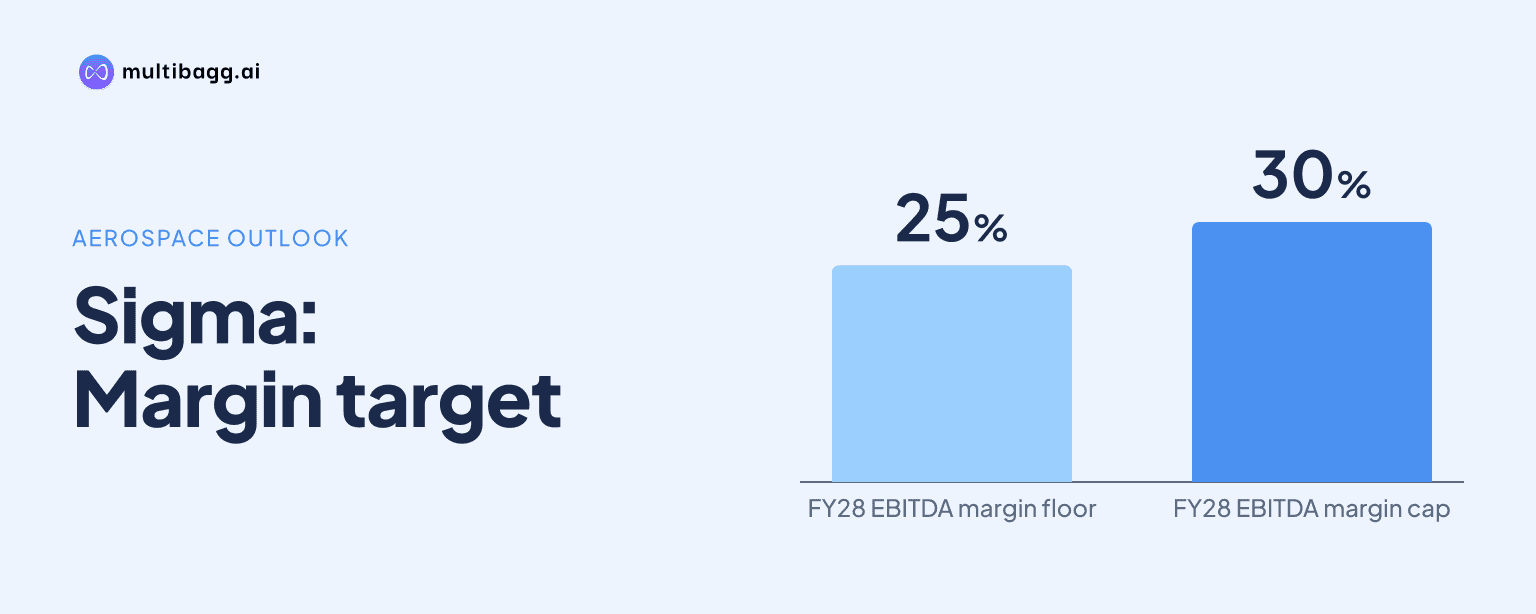
Sigma Advanced Systems Limited targets a 25% to 30% aerospace earnings before interest, tax, depreciation and amortisation (EBITDA) margin in FY28, management said on November 6, 2026, through automation in the United Kingdom and a model that ultimately moves 70% of relevant production to India while retaining 30% in the UK.
Know Sigma Advanced System inside out
Results, valuation, peers and who's buying, in one view.
What aerospace margin does Sigma target for FY28?
Sigma targets a 25% to 30% aerospace EBITDA margin in FY28, according to management’s response to an analyst question on the Q2 FY27 call. Management said the target reflects both UK automation and shifting work to India, while retaining a UK operating base of nearly 500-plus employees and associated infrastructure.
The FY28 objective follows Sigma’s FY27 group guidance of about Rs 1,900 crore to Rs 2,000 crore of revenue at about 20% EBITDA margin. Management expects select manufacturing transfers to India to add 200 to 400 basis points to EBITDA margin by the end of FY27, followed by another 400 to 600 basis points by the end of FY28. A basis point is one-hundredth of a percentage point.
The reported consolidated result shows the nearer-term margin movement management is seeking to extend. Revenue from operations rose to Rs 417 crore in Q2 FY27 from Rs 374 crore in Q1 FY27, while operational EBITDA increased to Rs 82.28 crore from Rs 61 crore. The Q2 operational EBITDA margin was 19.7%, although the company did not disclose a standalone aerospace margin for either quarter.
The aerospace target is management’s forward-looking objective, not a reported FY28 result. Management linked it to production economics and utilisation rather than to a disclosed aerospace revenue estimate, and said it generally gives only one or two quarters of forward outlook rather than FY28 operating projections.
How will Sigma move aerospace production to India?
Sigma plans for 70% of the relevant aerospace production to be done in India and 30% to remain in the UK once the model is fully implemented. Management described this as the eventual manufacturing mix for products that can be transferred, rather than a stated share of total consolidated revenue or a precise FY28 revenue transfer target.
The company’s Sri City facility began production in September 2026 and had started shipping parts to the UK and onward to customers. Management said the facility had 10% to 15% utilisation shortly after operations began and expected utilisation to rise by around 10% each quarter. It expects Sri City to reach 50% to 60% utilisation by the end of FY28 and full utilisation in FY29.
Sigma said it did not need new orders to fill the India factory because it already has contracts being executed through its UK operations. This reduces the strategy’s dependence on winning entirely new aerospace programmes before using Indian capacity, although the pace of transfer still depends on customer requirements and the operational flow of approved parts.
The India facility is structured as a subcontractor to Sigma’s UK aerospace operations. Management said the aerospace profit and loss account will continue to be reported through Sigma UK, even when India manufactures the parts. That reporting design means the consolidated or UK-reported results may capture the benefit of India production, rather than presenting it as a separate India aerospace revenue stream.
Got a follow-up? Ask IRIS
Why will Sigma retain manufacturing in the UK?
Sigma will retain 30% of the relevant production in the UK because its UK platform has direct customer contracts, defence work that cannot be transferred, and commitments for replacement work. Management said roughly 25% to 30% of UK revenue comes from defence business that is highly restricted and cannot be moved to another country.
The retained UK operations include work for Lockheed Martin, Airbus and BAE Systems, according to management. Sigma also said it is a direct Tier 1 supplier to original equipment manufacturers, or OEMs, including Rolls-Royce, GE, Airbus and Boeing, rather than a supplier to lower-tier subcontractors. The company said its contracts are directly with these customers.
For some contracts, customers have agreed that production transferred from the UK to India will be matched by an equivalent amount of UK work. Management said these backfill commitments are already contractual for both UK companies and that additional requests for quotation and new aerospace orders are also arriving. This mechanism is intended to preserve UK capacity as work moves to India.
The UK base also remains part of Sigma’s automation plan. Management said it has invested in equipment, palletisation and other automation intended to permit 24-hour, seven-day machine operation on selected equipment. It reported that on-time-in-full delivery performance at the acquired UK businesses improved from 65% to about 97% over recent quarters after investments in equipment, inventory, raw materials and supply chains.
What evidence supports Sigma’s margin-expansion plan?
Sigma’s evidence is an improvement in UK operational delivery, a Q2 FY27 group EBITDA margin of 19.7%, and production beginning at Sri City in September 2026. Management said UK EBITDA margin had improved by at least 200% quarter on quarter from Q3 of the prior fiscal year to Q2 FY27, but it did not provide the underlying UK margin percentages.
The company said the new UK equipment will contribute as more product runs through it over the next few quarters. Management also said adequate capital expenditure had already been made to provide capacity for the next few years across its manufacturing facilities, so it does not expect additional capacity capital expenditure. This is a management statement on installed capacity, rather than a guarantee of future output or margin.
Aerospace execution in the UK is expected to grow at 15% to 20% year on year, while management expects the new Sri City facility to ramp by about 15% per quarter. It described the aerospace order book as long-term, executable work with delivery visibility of five to seven years, and said existing UK factories are already running programmes without a gap between the order book and present execution.
The key limitation is that Sigma did not disclose the value of work set to move to India by FY28, the aerospace segment’s starting EBITDA margin, or the absolute savings from automation. The 25% to 30% target therefore depends on execution of approved transfers, UK backfill, machine automation and Sri City’s utilisation ramp rather than on a quantified segment bridge disclosed on the call.
Conclusion
Sigma’s stated FY28 aerospace margin target rests on a dual-location operating model: UK customer access, restricted defence work and automated manufacturing are retained, while suitable higher-volume work shifts to India. The Q2 FY27 increase in operational EBITDA to Rs 82.28 crore from Rs 61 crore in Q1 provides group-level evidence of improving profitability, but does not independently prove the aerospace target.
The next items to watch are management’s quarterly disclosures on the amount of work transferred to India, Sri City utilisation and UK automation benefits. Management expects Sri City to reach 50% to 60% utilisation by the end of FY28, while its FY27 guidance calls for a 200 to 400 basis-point margin improvement before a further 400 to 600 basis-point increase by the end of FY28.