










Sigma insources shells and nears full ammunition supply
Key highlights
- Sigma recognised about 85% of M107 shell-order revenue in Q1 and Q2 FY27, with the remaining 15% completed in October.
- Sigma said Q2 FY27 ammunition capacity utilisation in India was about 20%.
- Sigma reported Q2 FY27 revenue of Rs 417 crore, compared with Rs 374 crore in Q1 FY27.
- Management expects the MIL course-correction partnership to translate into fuse supply within six to 18 months.
powered by IRIS
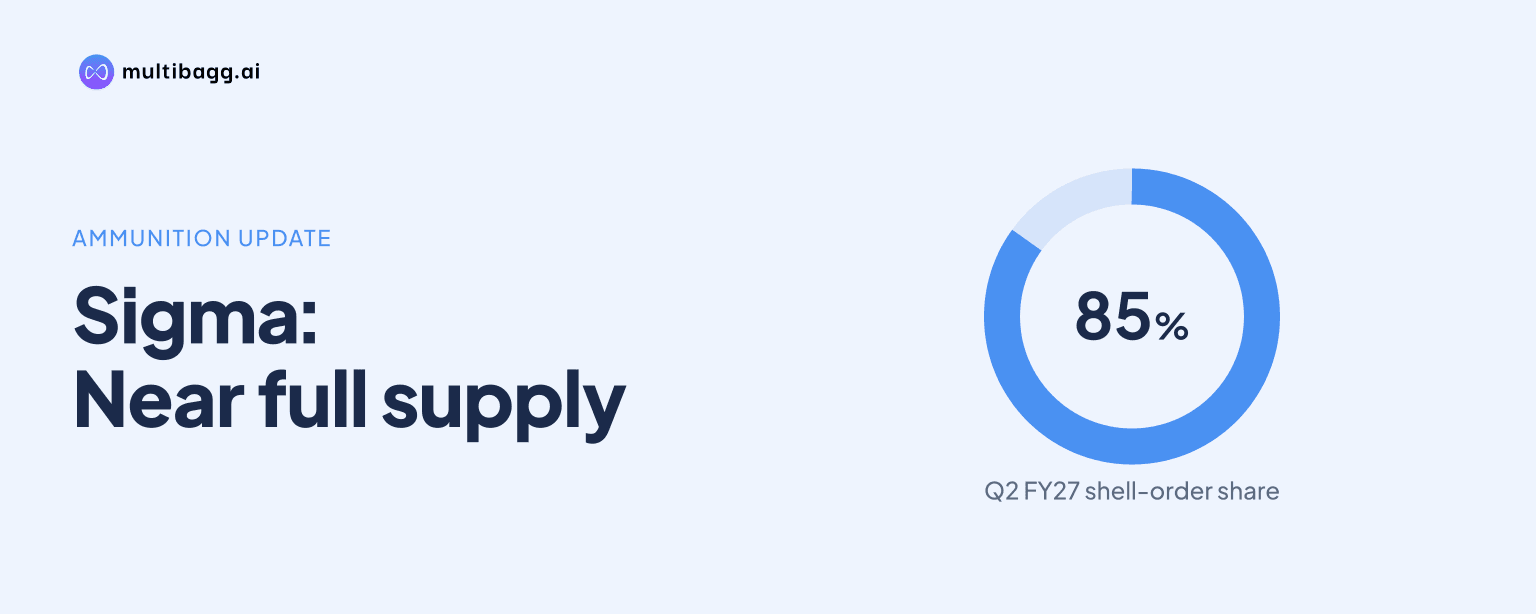
In Q2 FY27, Sigma Advanced Systems Limited said it had recognised about 85% of revenue from a 40,000-unit M107 shell order by H1, had begun international deliveries, and was insourcing shell production except forging while building capability to supply the full ammunition system other than explosives.
Know Sigma Advanced System inside out
Results, valuation, peers and who's buying, in one view.
How far has Sigma moved into artillery ammunition?
Sigma has moved beyond fuses into shell bodies and says it can now provide the whole ammunition system except the explosive component. Management distinguished between fuses, which combine the fuse and filling, and shells, which are separate components within the same ammunition platform. The company said its announced orders remain component-specific rather than orders for a complete ammunition solution.
The progression is material because Sigma described artillery ammunition as an export-focused activity in which it has moved from fuses to shell bodies, then to advanced products and solutions. In the November 6, 2026 call, management said repeat orders from international customers reflected delivery performance. It also said Sigma had entered a collaboration with Munitions India Limited, or MIL, for course-correction technology.
What has Sigma delivered under the M107 shell order?
Sigma said approximately 85% of revenue from the M107 shell order had been recognised in Q1 and Q2 FY27, with the remaining 15% completed in October and expected to appear in Q3 results. The order, announced on June 8 according to an analyst on the call, covered 40,000 basic M107 shells for export and had a six-month delivery timeline ending in December.
Management said Sigma had started delivering shells to international customers and that deliveries met their quality-conformance expectations. It linked this execution to repeat orders, without disclosing customer names, quantities for other shell orders or a revenue value for the 40,000-unit contract. Sigma also said M107 sales were slightly lower in Q2 than in Q1, yet defence-export margins expanded between the two quarters.
How is Sigma bringing shell production in house?
Sigma said it had already insourced much of the shell-production process at its Sri City facility and made significant further progress during Q2 FY27. Management said Q1 involved relatively more outsourcing, whereas Q2 brought more work inside its operations. Its stated end-state is to perform every process other than forging in house.
Forging remains outside Sigma's production chain because it buys forgings from suppliers in India, then completes the remaining processes itself. Management specifically attributed defence-export margin expansion on M107 shells to supply-chain changes and the growing share of in-house work. That statement describes the mechanism behind the margin movement, but the call did not quantify the M107 margin in either Q1 or Q2.
Does Sigma have capacity for the ammunition ramp-up?
Sigma said its ammunition capacity utilisation in India was about 20% during the Q2 FY27 call, leaving unused capacity for production growth over the next few years. Management said the relevant capital expenditure had already been invested and that no additional capital expenditure was planned for current facilities. The disclosed shell ramp is therefore intended to use existing infrastructure rather than depend on a newly announced plant.
The Sri City site began aerospace production in September 2026, but management also identified it as the location where shell work has been increasingly insourced. Across the wider India operation, aerospace capacity utilisation was about 15%, while defence electronics was operating on a single shift. These figures show that the ammunition programme is being developed alongside aerospace and electronics operations.
Got a follow-up? Ask IRIS
What does the MIL collaboration add to Sigma's ammunition offer?
Sigma said its memorandum of understanding with MIL for course-correction technology is exclusive and is based on technology supplied through European partners. Management said the technology had been in testing since 2017 by its joint-venture partner in India and had been filled, tested and deployed in combat outside India by the European partner. Sigma said it had indigenised that technology for the MIL partnership.
Management expects the MIL partnership to translate into fuse supply within six to 18 months. That timing is an expectation, not an order forecast, and the call did not disclose volumes, revenue or production capacity associated with potential supply. The arrangement extends Sigma's artillery offering from physical shell components towards correction functionality within the ammunition system.
How does the ammunition ramp fit Sigma's FY27 financial plan?
Sigma reported Q2 FY27 revenue from operations of Rs 417 crore, up from Rs 374 crore in Q1, while operational earnings before interest, tax, depreciation and amortisation, or EBITDA, rose to Rs 82.28 crore from Rs 61 crore. Management reported a 19.7% Q2 operational EBITDA margin and said defence-export shell margins improved as production was brought in house.
Management is targeting FY27 revenue of about Rs 1,900 crore to Rs 2,000 crore and an EBITDA margin of about 20%. It said aerospace, defence exports and domestic defence should all contribute to the second-half ramp, while newly announced orders worth Rs 3,915 crore from July 1 to the call date were expected to begin contributing in Q3 and Q4. Sigma also said defence exports accounted for about Rs 2,700 crore of its overall order book.
Conclusion
Sigma's disclosed artillery progress is a change in manufacturing scope rather than simply an increase in fuse sales. By recognising 85% of the M107 order's revenue by H1 FY27, beginning international shell deliveries and shifting from outsourced work towards in-house processing, Sigma connected execution of a specific export order with its stated aim of supplying almost the entire ammunition system.
The next points to watch are Q3 recognition of the final 15% of M107-order revenue, further margin movement as in-house production rises, and progress on the MIL collaboration. Management expects the MIL arrangement to convert into fuse supply within six to 18 months, while its FY27 plan calls for Rs 1,900 crore to Rs 2,000 crore of revenue and about a 20% EBITDA margin.