










Sigma Advanced Systems Ltd adds Rs 2,315 crore defence orders
Key highlights
- Sigma disclosed four artillery-related and anti-drone orders totalling Rs 2,315 crore.
- The North American 155mm base bleed artillery-shell order is worth Rs 1,013 crore.
- Indrajaal Ranger, Sigma’s AI-powered anti-drone patrol vehicle, secured Rs 155 crore of orders.
- Defence export and domestic defence revenue totalled Rs 121 crore in Q2FY27, versus Rs 296 crore from aerospace.
powered by IRIS
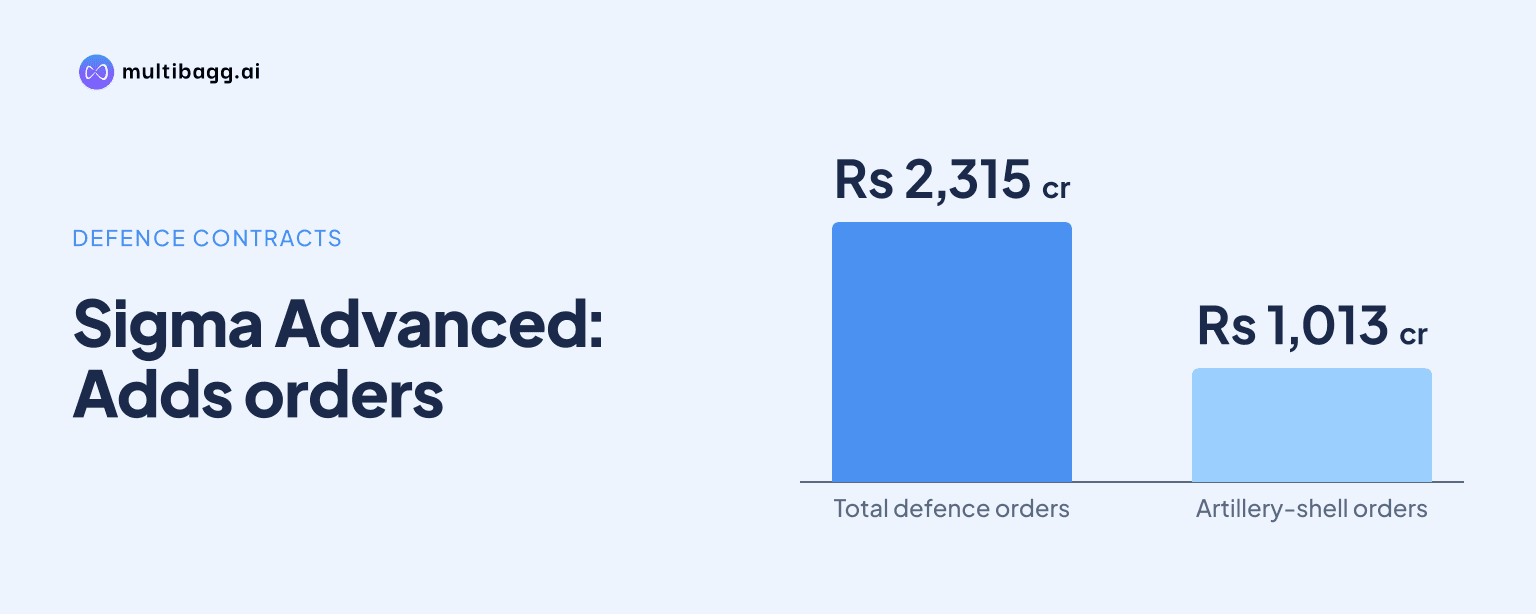
Sigma disclosed Rs 2,315 crore of defence orders in its Q2FY27 update, comprising Rs 2,160 crore of artillery-related products and Rs 155 crore of Indrajaal Ranger orders. The largest disclosed contract was a Rs 1,013 crore North American order to manufacture and supply 155mm base bleed artillery shells.
Know Sigma Advanced System inside out
Results, valuation, peers and who's buying, in one view.
What defence orders did Sigma disclose in Q2FY27?
Sigma disclosed four orders totalling Rs 2,315 crore: Rs 1,013 crore for 155mm base bleed artillery shells, Rs 973 crore for Base Bleed Units, Rs 174 crore for specialised ancillary subsystems, and Rs 155 crore for Indrajaal Ranger vehicles. The Rs 1,013 crore order came from a North American customer and specifically covers the manufacturing and supply of artillery shells.
In October 2026, Sigma announced the Rs 174 crore specialised ancillary subsystem order and the Rs 973 crore Base Bleed Unit order. The presentation places these announcements alongside the North American artillery-shell contract and says the order set positions Sigma as a complete-solution supplier to customers. The Rs 2,315 crore total includes the Rs 155 crore anti-drone vehicle orders, rather than representing artillery-related orders alone.
How do Sigma’s new orders extend its defence offering?
Sigma’s disclosed products extend from artillery ammunition and related units to an artificial intelligence, or AI-powered, indigenous anti-drone patrol vehicle. Sigma describes Indrajaal Ranger as intended for border security, urban policing and very important person, or VVIP, protection. Its Rs 155 crore of orders provide the identifiable vehicle component within the Rs 2,315 crore disclosed total.
The Rs 1,013 crore contract concerns 155mm base bleed artillery shells, while the Rs 973 crore order is for Base Bleed Units and the Rs 174 crore order is for specialised ancillary subsystems. These products cover shells, units and supporting subsystems within the disclosed artillery-related order set. The presentation does not disclose delivery schedules, quantities, customer names beyond the North American customer, or revenue-recognition periods for the four orders.
Sigma also reported defence activity alongside a larger aerospace business in Q2FY27. Defence export revenue was Rs 74 crore and domestic defence revenue was Rs 47 crore, compared with Rs 296 crore from aerospace. The orders add defence product categories, while aerospace remained the largest reported revenue vertical during the quarter.
How large are Sigma’s defence revenue and orderbook segments?
Sigma reported Rs 121 crore of combined defence revenue in Q2FY27, comprising Rs 74 crore from defence exports and Rs 47 crore from domestic defence, against consolidated operating revenue of Rs 417 crore. Aerospace contributed Rs 296 crore, and the three vertical figures add to the reported total.
Sigma presents different annual earnings before interest, tax, depreciation and amortisation, or EBITDA, margin ranges by vertical. Defence exports are shown at 22% to 28% and domestic defence at 25% to 30%, compared with 12% to 14% for aerospace. These are company-presented annual margin ranges and do not establish the margin on the newly disclosed orders.
Sigma states that its total orderbook exceeds Rs 10,000 crore. Aerospace accounts for 70% to 75% of that orderbook with typical contract lengths of five to seven years, while defence exports represent 20% to 25% with typical lengths of 1.5 to two years. Domestic defence represents 3% to 4% with typical lengths of one to two years, making the stated export defence share larger than the domestic defence share.
Got a follow-up? Ask IRIS
What operating steps and targets accompany Sigma’s expansion?
Sigma said its Sri City aerospace facility commenced production, shipped its first batch to Sigma UK, and completed the initial stages of Rolls-Royce source-change approval. The company dates the start of Sri City operations to September 2026. That process concerns the aerospace supply chain, rather than a disclosed production plan for the Rs 2,315 crore defence orders.
For aerospace, Sigma reported an existing Long-Term Agreement, or LTA, with Rolls-Royce valued at about Rs 3,800 crore and a further LTA worth £125 million, which Sigma approximates at Rs 1,600 crore. Sigma also acquired Bromford Precision Solutions Limited in the United Kingdom, an action the presentation says strengthens its position in the global aerospace ecosystem and Rolls-Royce supply chain.
Management’s operational plan includes transferring work to India through dual sourcing, using delegatory approvals to expedite work transfers, and deploying capital expenditure in UK facilities for automation and process optimisation. Management targets EBITDA improvement of 2% to 4% by the end of FY27 and another 4% to 6% by the end of FY28. These are stated objectives, and the presentation provides no separate financial target for the artillery or Indrajaal Ranger orders.
Sigma’s consolidated operating revenue increased 11% from Rs 374 crore in Q1FY27 to Rs 417 crore in Q2FY27. In the detailed quarterly table, profit before tax rose from Rs 49 crore to Rs 70 crore and profit after tax, excluding share of profit or loss from associates, increased from Rs 38 crore to Rs 52 crore. The presentation’s headline chart lists Q2FY27 operational EBITDA as Rs 82.2 crore, while its detailed table lists Rs 86 crore, so the two disclosed EBITDA presentations are not identical.
Conclusion
Sigma’s Q2FY27 update combines Rs 2,315 crore of identified orders across artillery-related products and an AI-powered counter-drone vehicle with a defence revenue base of Rs 121 crore in the quarter. The disclosed contracts broaden the stated product set beyond either export artillery shells or domestic defence subsystems alone, while aerospace remained the largest reported revenue and orderbook vertical.
The next disclosed milestones are execution-related: Sri City began operating in September 2026, its first batch has been shipped to Sigma UK, and Rolls-Royce source-change approval remains at its initial stages. Investors can also track management’s stated target of 2% to 4% EBITDA improvement by the end of FY27, followed by another 4% to 6% by the end of FY28, alongside any future disclosure on delivery timing for the Rs 2,315 crore orders.