










Sigma targets up to 10 percentage points EBITDA improvement by FY28
Key highlights
- Sigma targets 2-4 percentage points of EBITDA improvement by end-FY27 and another 4-6 percentage points by end-FY28.
- Sri City commenced operations in September 2026 and shipped its first batch to Sigma UK.
- Sigma reported Rolls-Royce long-term agreements worth about Rs 5,400 crore in aggregate.
- Sigma's detailed Q2FY27 table reports revenue of Rs 417 crore and operational EBITDA of Rs 86 crore.
powered by IRIS
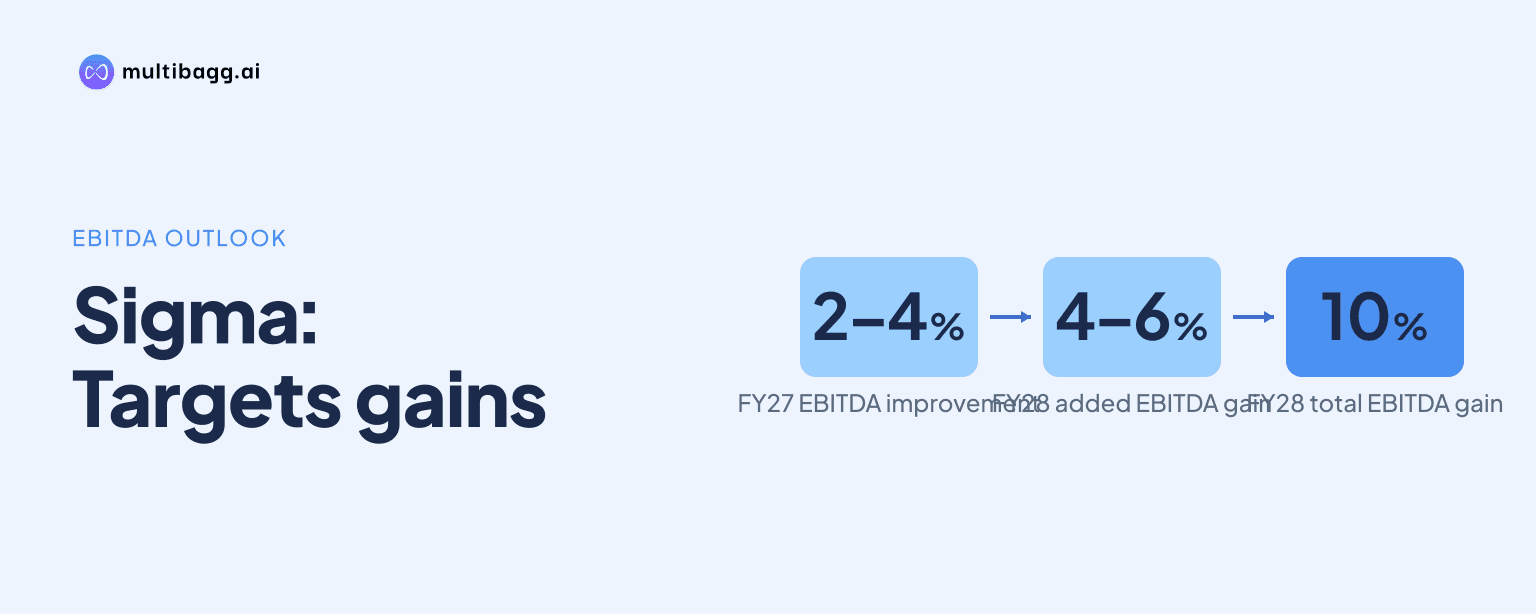
Sigma Advanced Systems Ltd targets up to 10 percentage points of EBITDA improvement by the end of FY28, comprising 2-4 percentage points by end-FY27 and a further 4-6 percentage points by end-FY28. The plan relies on transferring aerospace work to India, dual sourcing, and automation and process optimisation at UK facilities after Sri City began operations in September 2026.
Know Sigma Advanced System inside out
Results, valuation, peers and who's buying, in one view.
How will Sigma improve EBITDA by FY28?
Sigma plans to improve earnings before interest, tax, depreciation and amortisation, or EBITDA, by transferring eligible work to its lower-cost Indian manufacturing base while retaining UK operations. Management has set a target of 2-4 percentage points of EBITDA improvement by the end of FY27 and another 4-6 percentage points by the end of FY28. At the upper ends of both ranges, this totals 10 percentage points.
The operational mechanism is dual sourcing between the UK and India. Sigma states that dual sourcing is intended to support margin expansion through work transfer to India, while delegatory approvals are intended to expedite that process. The plan covers its aerospace capabilities in precision machining, fabrications, assemblies and treatments, rather than a separately disclosed cost-reduction programme.
Sigma also plans capital expenditure at its UK facilities for automation and process optimisation. During Q2FY27, it reported targeted investment in UK capital expenditure and working-capital requirements that it expects to unlock further efficiencies. The presentation does not provide the investment amount, an annual rupee saving, or a starting EBITDA-margin target against which the FY27 and FY28 improvements will be measured.
How do Sigma's UK acquisitions support the plan?
Sigma is using UK acquisitions to add aerospace capabilities and customer access that can support the India work-transfer model. In 2025, Sigma acquired UK-based Nasmyth to enter the components and sub-assembly value chain and gain access to the UK and European Union markets. In 2026, it acquired AS Strategic to strengthen its position in European and North American aerospace and defence markets.
Sigma also acquired UK-based Bromford Precision Solutions Limited in 2026. Sigma describes Bromford as consolidating its position in the global aerospace ecosystem and the Rolls-Royce supply chain, making it directly relevant to the proposed transfer of approved aerospace work to India. The acquisition adds to a dual manufacturing footprint that Sigma describes as spanning the UK and India.
The UK platform is linked to Rolls-Royce long-term agreements. Sigma reported an existing Rolls-Royce long-term agreement valued at about Rs 3,800 crore and a new agreement worth about Rs 1,600 crore, or about Rs 5,400 crore in aggregate. It also aims to expand its value-chain presence into forgings and composites, strengthen its UK and European presence, and establish a US footprint, although it gives no date for the US plan.
Got a follow-up? Ask IRIS
Has Sigma begun transferring aerospace work to India?
Sigma has begun the operational steps for aerospace work transfer: Sri City commenced operations in September 2026, shipped its first batch to Sigma UK, and completed the initial stages of Rolls-Royce source-change approval. These milestones provide the disclosed operating basis for management's FY27 and FY28 EBITDA-improvement targets.
Source-change approval is central because it determines whether production can move within the aerospace supply chain for Rolls-Royce programmes. Sigma states that it will use delegatory approvals to accelerate transfers to India, but it reports only completion of the initial approval stages. It does not disclose final approval timing, production volumes transferred, or the share of UK revenue that could be manufactured at Sri City.
The strategy does not describe a replacement of UK manufacturing with Indian production. Sigma reports more than 350,000 square feet of facilities and more than 800 full-time-equivalent employees across its dual footprint. The first Sri City batch was shipped to Sigma UK, indicating that the initial disclosed model connects Indian output to the UK platform rather than identifying direct Sri City deliveries to Rolls-Royce.
What do Sigma's Q2FY27 figures show?
Sigma's detailed consolidated table shows revenue from operations rising 11% from Rs 374 crore in Q1FY27 to Rs 417 crore in Q2FY27, while operational EBITDA rose from Rs 61 crore to Rs 86 crore. EBITDA margin increased from 16.3% to 20.6%, and profit after tax, or PAT, rose from Rs 38 crore to Rs 52 crore over the same quarters.
The presentation's financial-highlights panel reports a different Q2FY27 operational EBITDA figure of Rs 82.2 crore and an operating EBITDA margin of 19.7%. Both the highlights panel and detailed table report Q1FY27 operational EBITDA of Rs 61 crore and a 16.3% margin, but the presentation does not explain why its Q2FY27 figures differ.
The detailed table also shows cost of goods sold declining from Rs 148 crore in Q1FY27 to Rs 141 crore in Q2FY27 while revenue increased by Rs 43 crore. Employee-benefit expense increased from Rs 88 crore to Rs 103 crore, and other expenses rose from Rs 78 crore to Rs 87 crore. As Sri City began operations in September 2026, the quarterly margin movement should not be treated as a disclosed outcome of the later work-transfer plan.
Conclusion
Sigma's margin-expansion plan combines UK aerospace acquisitions, Rolls-Royce programme access, a September 2026 production start at Sri City, and efficiency investment in UK facilities. Management's stated objective is 2-4 percentage points of EBITDA improvement by end-FY27 and a further 4-6 percentage points by end-FY28, with dual sourcing and approved work transfer serving as the main mechanisms.
The next disclosed milestones to watch are progress beyond the initial Rolls-Royce source-change approval stages and the planned deployment of UK automation and process-optimisation capital expenditure. Further disclosure of transferred volumes, final approval timing, or the measurement base for the FY27-FY28 target would show how quickly the plan is translating into reported operating results.