










Sigma Q2 operating EBITDA rose 35% as margin reached 20.6%
Key highlights
- Sigma’s financial highlights reported Q2FY27 operational EBITDA of Rs 82.2 crore, up 35.06% quarter-on-quarter.
- The detailed consolidated table reported Q2FY27 EBITDA margin of 20.6%, up from 16.3% in Q1FY27.
- Q2FY27 revenue from operations rose to Rs 417 crore from Rs 374 crore in Q1FY27.
- Sigma stated that its order book exceeded Rs 10,000 crore, with aerospace representing 70% to 75%.
powered by IRIS
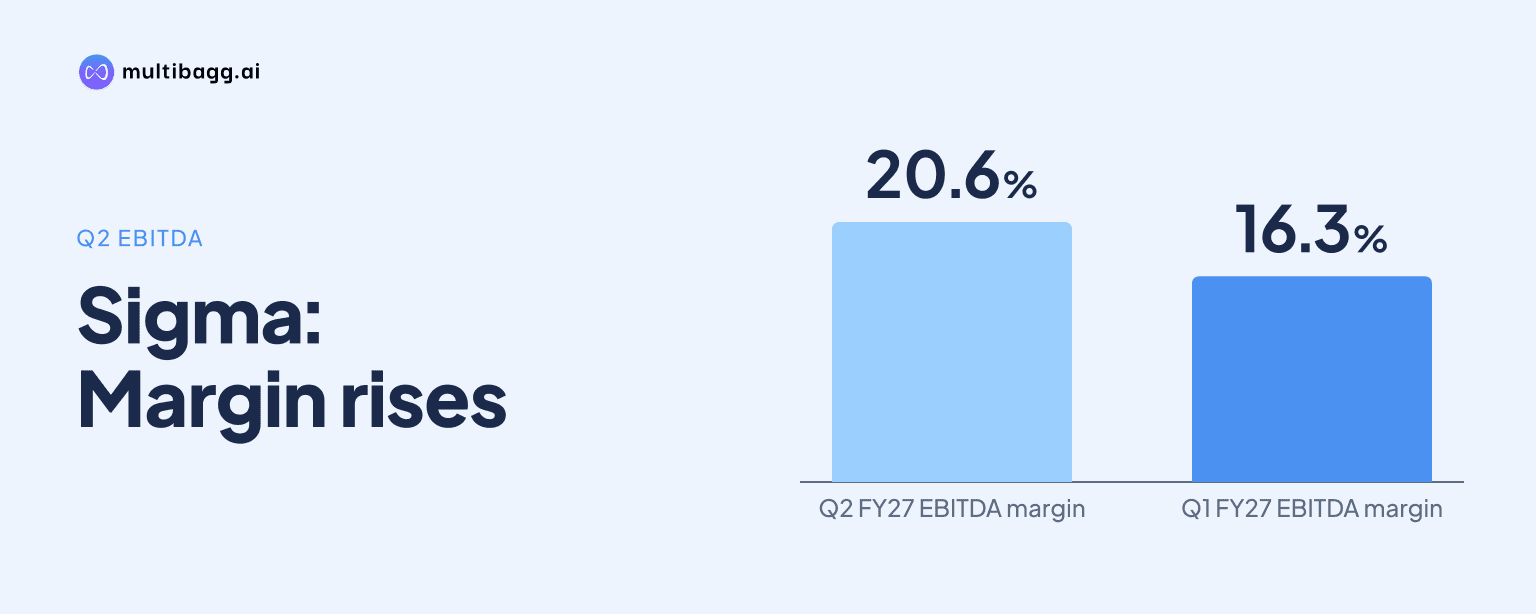
Sigma Advanced Systems Ltd reported Q2FY27 operational EBITDA of Rs 82.2 crore, up 35.06% quarter-on-quarter in its financial highlights, while the detailed consolidated table showed EBITDA margin of 20.6%, compared with 16.3% in Q1FY27. The presentation also gives a different detailed Q2 EBITDA figure of Rs 86 crore.
Know Sigma Advanced System inside out
Results, valuation, peers and who's buying, in one view.
How did Sigma’s Q2FY27 earnings change from Q1FY27?
Sigma’s Q2FY27 revenue from operations increased to Rs 417 crore from Rs 374 crore in Q1FY27, while the presentation’s financial-highlights panel showed operational EBITDA rising 35.06% to Rs 82.2 crore from Rs 61 crore. Management’s Q2 commentary similarly cited operational revenue of Rs 417.07 crore and operational EBITDA of Rs 82.28 crore. The commentary described the revenue increase as 11.43% quarter-on-quarter.
The detailed consolidated financial-performance table presents a different operational EBITDA number for Q2FY27: Rs 86 crore, against Rs 61 crore in Q1FY27. On that table’s figures, EBITDA margin increased by 4.3 percentage points, from 16.3% to 20.6%. Its financial-highlights panel instead gives a Q2FY27 operational EBITDA margin of 19.7%, alongside the Rs 82.2 crore EBITDA figure. Sigma does not explain the difference between the Rs 82.2 crore and Rs 86 crore measures, or between the 19.7% and 20.6% margins, in the supplied presentation.
The improvement extended below EBITDA in the detailed table. Profit before tax rose to Rs 70 crore in Q2FY27 from Rs 49 crore in Q1FY27, and profit after tax, or PAT, increased to Rs 52 crore from Rs 38 crore. PAT margin rose to 12.68% from 10.16%. The table notes that PAT excludes the share of profit or loss from associates.
What drove Sigma’s EBITDA-margin expansion in Q2FY27?
Sigma’s detailed table indicates that lower cost of goods sold, or COGS, was the principal offset to higher employee and other expenses. COGS declined to Rs 141 crore in Q2FY27 from Rs 148 crore in Q1FY27, even as revenue from operations rose by Rs 43 crore to Rs 417 crore. That combination coincided with the detailed table’s reported margin increase to 20.6%.
Employee benefit expenses increased to Rs 103 crore from Rs 88 crore, and other expenses increased to Rs 87 crore from Rs 78 crore. Together, those two expense categories rose by Rs 24 crore quarter-on-quarter, whereas COGS fell by Rs 7 crore. The detailed table therefore shows that the reduction in COGS and the higher revenue base outweighed the increases in employee and other costs during Q2FY27.
Other items also changed after operational EBITDA. Other income increased to Rs 7 crore from Rs 5 crore, depreciation rose to Rs 15 crore from Rs 8 crore, interest expense declined to Rs 7 crore from Rs 8 crore, and exceptional items were Rs 1 crore versus Rs 2 crore. Tax rose to Rs 18 crore from Rs 11 crore as profit before tax increased to Rs 70 crore.
Got a follow-up? Ask IRIS
Which business verticals supplied Sigma’s Q2FY27 revenue?
Sigma generated Rs 296 crore of its Rs 417 crore Q2FY27 operating revenue from aerospace, compared with Rs 74 crore from defence exports and Rs 47 crore from domestic defence. Aerospace was therefore the largest reported vertical by revenue for the quarter. The three vertical amounts add to the presentation’s stated Q2FY27 total of Rs 417 crore.
The presentation assigns different annual EBITDA-margin ranges to the three verticals. Aerospace is shown at 12% to 14%, defence exports at 22% to 28%, and domestic defence at 25% to 30%. These are annual margin ranges by vertical, rather than reported Q2FY27 margins, so they do not establish the profitability contribution made by each vertical in the quarter.
Sigma stated that its order book exceeded Rs 10,000 crore. Aerospace represented 70% to 75% of that order book and had a typical project length of five to seven years, while defence exports represented 20% to 25% with a typical length of 1.5 to two years. Domestic defence accounted for 3% to 4%, with typical contracts lasting one to two years.
What developments could affect Sigma’s next operating periods?
Sigma disclosed several orders and capacity developments that management linked to its next growth phase. The company cited an existing Rolls-Royce long-term agreement, or LTA, worth about Rs 3,800 crore and a new LTA worth approximately Rs 1,600 crore. It also reported Rs 1,013 crore of North American export orders for manufacturing and supplying 155 millimetre base-bleed artillery shells.
In October 2026, Sigma announced a Rs 174 crore order for specialised ancillary subsystems and a Rs 973 crore order for Base Bleed Units. It also said it had secured Rs 155 crore of orders for Indrajaal Ranger, described as an artificial-intelligence-powered indigenous anti-drone patrol vehicle. These disclosed orders are separate business developments; the presentation does not specify their revenue-recognition schedules.
The Sri City aerospace facility commenced production in September 2026, with the first batch shipped to Sigma UK and the initial stages of Rolls-Royce source-change approval completed. Sigma also reported targeted investment in capital expenditure and working-capital requirements for UK facilities. Management said those investments are expected to unlock further efficiencies, but did not quantify the expenditure in the supplied material.
Conclusion
Sigma’s Q2FY27 presentation shows operating profit increasing faster than revenue, with revenue rising to Rs 417 crore and the financial-highlights measure of operational EBITDA increasing 35.06% to Rs 82.2 crore. The detailed table shows margin reaching 20.6%, supported by a Rs 7 crore reduction in COGS despite Rs 24 crore of combined increases in employee and other expenses. The presentation, however, does not reconcile its financial-highlights EBITDA and margin figures with those in the detailed table.
The next issue to watch is execution of Sigma’s disclosed capacity and work-transfer plans. Management targets EBITDA improvement of 2% to 4% by the end of FY27 and another 4% to 6% by the end of FY28 through dual sourcing, transfer of work to India, and UK automation and process optimisation. Progress at Sri City, including Rolls-Royce source-change approval, is a disclosed operational milestone relevant to that plan.