










Signpost India H1 profit rises 11% as cash flow triples
Key highlights
- H1 FY27 revenue rose 5.6% to ₹286.8 crore and profit after tax increased 11.3% to ₹34.5 crore.
- H1 FY27 cash from operations tripled to ₹61.4 crore from ₹20.1 crore.
- Q2 FY27 revenue was ₹134.5 crore, while EBITDA margin declined to 21.1% from 25.7%.
- Fund-based debt was ₹195 crore at 30 September 2026 and debt to equity improved to 0.61 times.
powered by IRIS
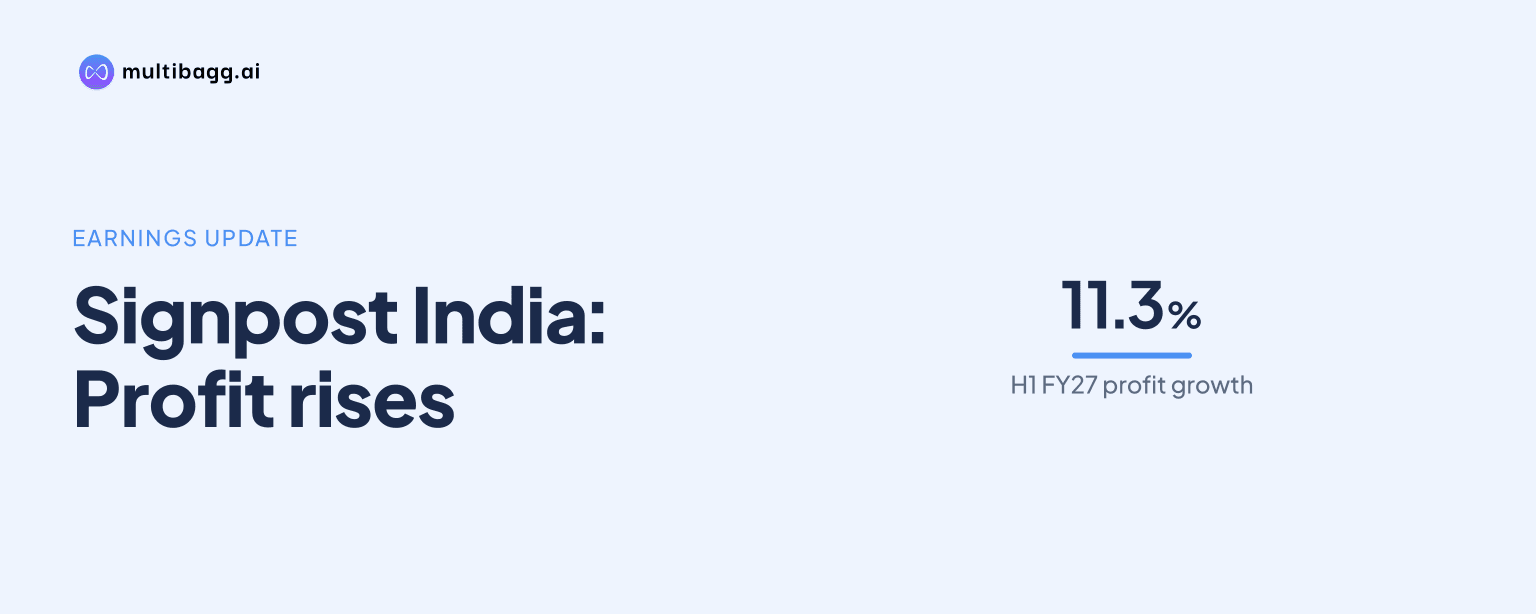
Signpost India Limited reported unaudited consolidated H1 FY27 profit after tax of ₹34.5 crore, up 11.3% year on year, while cash from operations tripled to ₹61.4 crore from ₹20.1 crore. Revenue rose 5.6% to ₹286.8 crore for the half year ended 30 September 2026, despite near-flat second-quarter revenue.
Know Signpost India inside out
Results, valuation, peers and who's buying, in one view.
How did Signpost India perform in H1 FY27?
Signpost India increased H1 FY27 revenue and profit, while operating earnings and margins declined. Revenue from operations rose to ₹286.8 crore from ₹271.7 crore in H1 FY26, and profit after tax increased to ₹34.5 crore from ₹31 crore. The profit after tax margin improved to 12% from 11.4%, while earnings per share rose to ₹6.45 from ₹5.79.
Operating earnings before interest, tax, depreciation and amortisation, or EBITDA, fell 5.1% to ₹62.8 crore from ₹66.2 crore. The EBITDA margin declined to 21.9% from 24.4%. Gross profit still increased 2% to ₹110.4 crore from ₹108.2 crore, but gross margin narrowed to 38.5% from 39.8%.
The half-year comparison is affected by a depreciation-method change from 1 April 2026. Signpost India moved from the written-down-value method to the straight-line method for property, plant and equipment over the remaining useful life prescribed under the Companies Act, 2013. The company said depreciation for FY27 is therefore not directly comparable with the corresponding FY26 periods.
Why was Signpost India’s Q2 revenue nearly flat?
Signpost India recorded Q2 FY27 revenue of ₹134.5 crore, only 0.4% above ₹134 crore a year earlier, because Navratri began on 11 October rather than 22 September in the previous year. The later festival shifted a large share of festive advertising campaigns into Q3, while large corporate advertisers also reduced second-quarter budgets, particularly affecting agency-led business.
The shift in billing coincided with a lower quarterly gross margin. Q2 gross profit declined 7% to ₹51.6 crore from ₹55.5 crore and gross margin fell to 38.3% from 41.4%. Cost of services rose 6% to ₹83 crore, mainly reflecting fixed fees for long-tenure media rights and newly added transit assets that did not decline when campaign revenue shifted to Q3.
Q2 EBITDA fell 17.4% to ₹28.4 crore from ₹34.4 crore, reducing the margin to 21.1% from 25.7%. Employee costs increased to ₹13.9 crore from ₹11.2 crore following annual increments and hiring, while other expenses decreased 7% to ₹9.2 crore. Q2 profit after tax nevertheless stood at ₹15.8 crore against ₹15.7 crore, with the margin unchanged at 11.7%.
Got a follow-up? Ask IRIS
Which Signpost India revenue channels expanded?
Signpost India said Q2 digital revenue rose 38% and direct-client revenue increased 44%. Digital represented 34% of quarterly revenue and direct clients accounted for 73%, while management said restrained spending by large corporate advertisers had most affected agency-led business during the quarter.
The company operates about 10,850 media nodes across 32 cities and has 31 lakh square feet of display area. Its Captura advertising technology platform combines campaign planning, scheduling and proof-of-play reporting. Management said the rising digital and direct-client mix made revenue more measurable and reduced reliance on intermediaries.
Signpost India opened Majestic Canvas, a 16,000-square-foot projection installation at Nadaprabhu Kempegowda, or Majestic, Metro station in Bengaluru. Bangalore Metro Rail Corporation Limited has allowed projected advertising on the same platforms. The format is within Signpost India’s Bengaluru Metro concession, which runs to 2034.
What changed in Signpost India’s cash flow and balance sheet?
Signpost India generated ₹61.4 crore of cash from operations in H1 FY27, compared with ₹20.1 crore in H1 FY26. Trade receivables declined by ₹44.2 crore to ₹273.1 crore, making lower receivables a reported contributor to the increase in operating cash generation.
The company invested ₹48 crore, mainly in new transit-media assets, during H1 FY27. Cash and bank balances increased to ₹35.3 crore on 30 September 2026 from ₹24 crore on 31 March 2026, despite the investment programme.
Fund-based debt was ₹195 crore on 30 September 2026, broadly unchanged from ₹196.1 crore on 31 March 2026. Net worth was ₹321.7 crore, compared with ₹250.9 crore a year earlier, and debt to equity improved to 0.61 times from 0.68 times. Crisil Ratings upgraded Signpost India’s long-term rating to A-/Stable in April 2026.
What does Signpost India expect in the second half?
Signpost India management said it remains confident of double-digit FY27 revenue growth and expects a stronger second half in revenue and profitability. Management identified the full festive season in Q3, Bengaluru Metro, the Mumbai premium bus fleet, Kolkata Streetscape and event-led Nashik projects as the main drivers.
In Kolkata, 40% to 45% of Streetscape media was live and earning revenue at the time of the 3 November 2026 announcement, helped by Durga Puja bookings. Signpost India said the project is due for completion by March 2027. The Bengaluru Metro network and Mumbai premium bus fleet were also described as ramping up.
Management said marquee event-led projects in Nashik are expected to begin from February and continue into the first quarter of FY28. These are management’s forward-looking expectations, and the filing notes that actual outcomes may differ because of risks and uncertainties.
Conclusion
Signpost India’s first-half release shows profit and cash generation rising faster than revenue, alongside lower gross and EBITDA margins. The contrast came from Q2, when campaign timing left revenue almost unchanged at ₹134.5 crore while fixed media-right costs, employee costs and new-asset expenses continued.
The next disclosed milestones are Q3 festive campaign billing, the ramp-up of Bengaluru Metro and the Mumbai premium bus fleet, and Kolkata Streetscape’s planned March 2027 completion. Management also expects Nashik projects from February to carry into Q1 FY28, providing the next reported measures of execution against its stronger-second-half expectation.