










Simplex Castings Keeps Capex at Rs 25 Crore for Scale-Up
Key highlights
- Simplex Castings will retain planned capex at Rs 25 crore and direct additional funding to working capital.
- Management estimates two-and-a-half to three months of work-in-process could require about Rs 80 crore.
- Heavy-structure fabrication capacity is planned to rise from 500 tonnes to 1,500 tonnes per month.
- Simplex Castings reported a pending order book of roughly Rs 150 crore and a pipeline above Rs 100 crore.
powered by IRIS
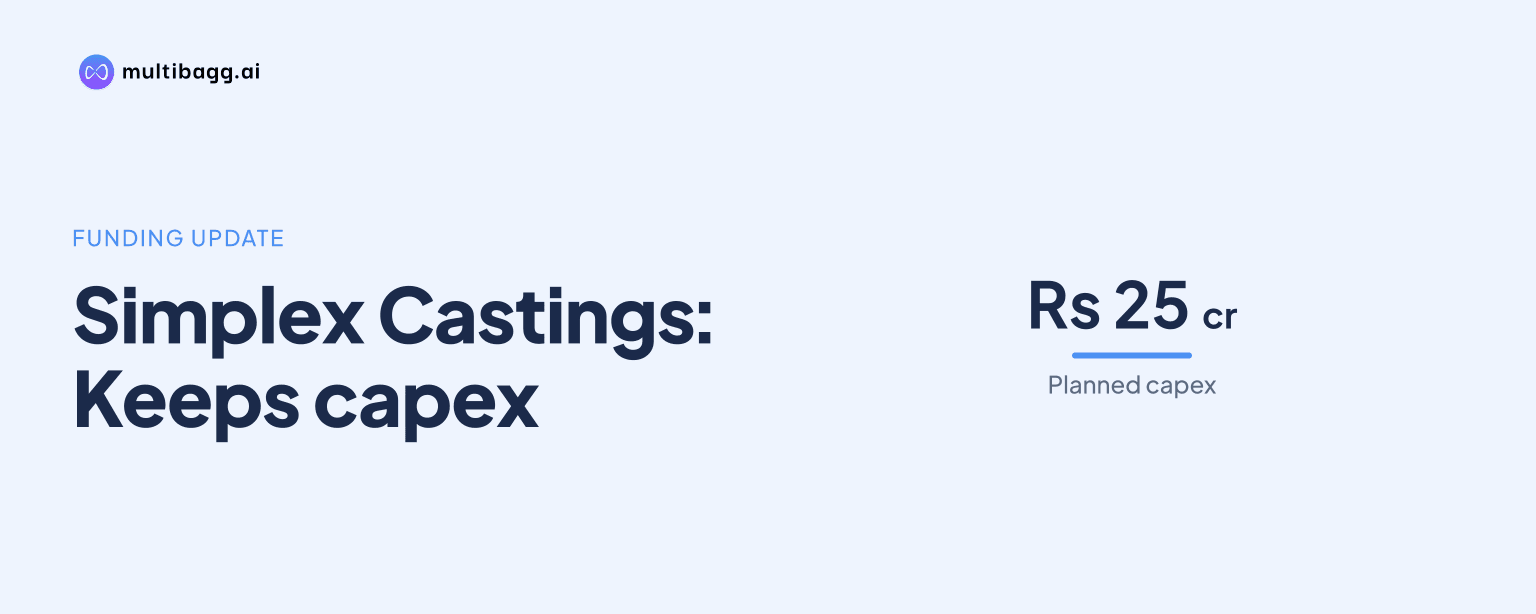
Simplex Castings Limited will keep planned capital expenditure at Rs 25 crore and allocate additional fundraising to working capital for its Rs 500 crore scale-up, because management estimates that two-and-a-half to three months of work-in-process could require about Rs 80 crore.
Know Simplex Castings inside out
Results, valuation, peers and who's buying, in one view.
Why is Simplex Castings putting additional funds into working capital?
Simplex Castings is directing incremental funds to working capital because inventory in process will rise with revenue as it moves from Rs 300 crore, Rs 330 crore and Rs 350 crore toward Rs 400 crore and its Rs 500 crore target. Management said its original Rs 50 crore funding plan split Rs 25 crore each between capital expenditure and working capital, but the additional funds raised will not increase the capex allocation.
Management estimated that two-and-a-half to three months of work-in-process alone could reach about Rs 80 crore. It said this inventory should rise as output increases because work in process is subsequently dispatched, while some recent inventory build-up was linked to inspections and related factors that management expects to clear within a few months.
Simplex Castings also described interim liquidity arrangements for its current financial-year revenue target of more than Rs 300 crore. It has registered on bill-discounting platforms for thermal-power projects involving Larsen & Toubro and Bharat Heavy Electricals Limited, while long-term orders with price-variation clauses are intended to limit the effect of raw-material price inflation.
What will Simplex Castings' Rs 25 crore capex add?
Simplex Castings will use the Rs 25 crore plan for machines, sheds and heavy cranes at its fabrication equipment shop. The company has a foundry, including machine and computer numerical control facilities, and a fabrication equipment shop, with each unit on 15 acres; management said the first foundry-side capex phase had already been completed.
The second phase is intended to expand crane-served covered space in the fabrication shop from about 20%-25% of the area to roughly 50%-60%. Management has planned three sheds and expects two to be completed in the current financial year, while the full installation will become operational in stages.
The plan would triple heavy-structure capacity from 500 tonnes to 1,500 tonnes a month and lift equipment capacity from 200 tonnes to 300-350 tonnes a month. Management said work can continue through existing gantry facilities before the sheds are commissioned, and that capacity additions from the two sheds were considered in its guidance.
How does Simplex Castings plan to reach Rs 500 crore?
Simplex Castings says the existing capex programme is sufficient for its Rs 500 crore target, supported by power, steel and railways. Management expects heavy-structure fabrication for power plants alone to generate turnover of more than Rs 150 crore, while it seeks to expand railway products and retain its established steel-plant business over the next three to four years.
In steel, management said casting requirements for all four or five coke-oven batteries then being built in India had come to Simplex Castings. It cited four more batteries planned at Bokaro, Bhilai and two at IISCO in the following year, estimating an opportunity of about Rs 120 crore for coke-oven doors at Rs 25 crore to Rs 30 crore per battery.
The nearer-term order base was roughly Rs 150 crore, with a pipeline exceeding Rs 100 crore, according to management. It said the major portion of the pending order book should be executed in the current financial year, and average execution across its mix of orders is about three to four months.
Got a follow-up? Ask IRIS
What could delay Simplex Castings' railway expansion?
The delayed Indian Railways wagon order is the principal timing issue for Simplex Castings' larger bogie opportunity. Management said the expected order, described as about 1 lakh wagons over two-and-a-half to three years, had moved to the next quarter; Simplex Castings benefits indirectly when wagon builders subsequently purchase bogies.
Simplex Castings has Research Designs and Standards Organisation approval for railway bogies, but management said bulk demand depends on the wagon order being released. In the interim, it is pursuing smaller private-sector opportunities, including potential orders of 100-150 bogies for private rakes rather than a larger 200-unit requirement.
Management's contingency plan includes products with recurring railway demand that are not tied to wagon-building cycles, such as couplers, suspension tubes and austempered ductile iron wedges. It also said fabrication equipment approvals from Bharat Heavy Electricals Limited could allow thermal-power work to fill a gap if railway products are delayed.
How are margins and utilisation expected to change?
Simplex Castings attributed a reported 280-basis-point improvement in earnings before interest, tax, depreciation and amortisation margin, both sequentially and year on year, to niche products. Management specifically cited coke-oven-door and spare orders, while outsourcing production of some smaller castings reduced other expenses.
Management did not commit to maintaining recent profitability levels. It said profit after tax margin had historically reached a maximum of 7%-8% even in better years and identified 8%-10% as the range it aims to maintain, although it expects enhanced working capital and higher revenue to provide some operating leverage.
Existing-capacity utilisation is rising and management targets 80%-90% by the next financial year. For the current financial year's second-half execution, it indicated a 40% contribution in the third quarter and 60% in the fourth quarter while maintaining confidence in revenue above Rs 300 crore.
Conclusion
Simplex Castings' capital-allocation decision prioritises the cash tied up in a larger production base rather than a bigger capex budget. The unchanged Rs 25 crore expansion is designed to lift structural fabrication capacity from 500 tonnes to 1,500 tonnes a month, while additional funds support the work-in-process needed for management's Rs 500 crore scale-up target.
The next points to watch are completion of two of the three planned sheds in the current financial year, staged commissioning of the wider fabrication project and release of the delayed wagon order expected in the next quarter. Management also needs to develop railway products into bulk business within one-and-a-half to two years, with thermal fabrication and steel orders identified as alternatives if railway timing slips.