










SIS cash flow turns negative as ₹273 crore hits working capital
Key highlights
- SIS reported negative operating cash flow of ₹99.2 crore in Q2 FY27, versus positive ₹87.7 crore in Q1 FY27.
- Working capital consumed ₹273.5 crore in Q2 FY27, including ₹216.3 crore in Security Solutions – International.
- SIS net debt rose to ₹1,025.6 crore in September 2026 from ₹807.1 crore in June 2026.
- Security Solutions – International DSO rose to 57 days from 48 days at the end of June 2026.
powered by IRIS
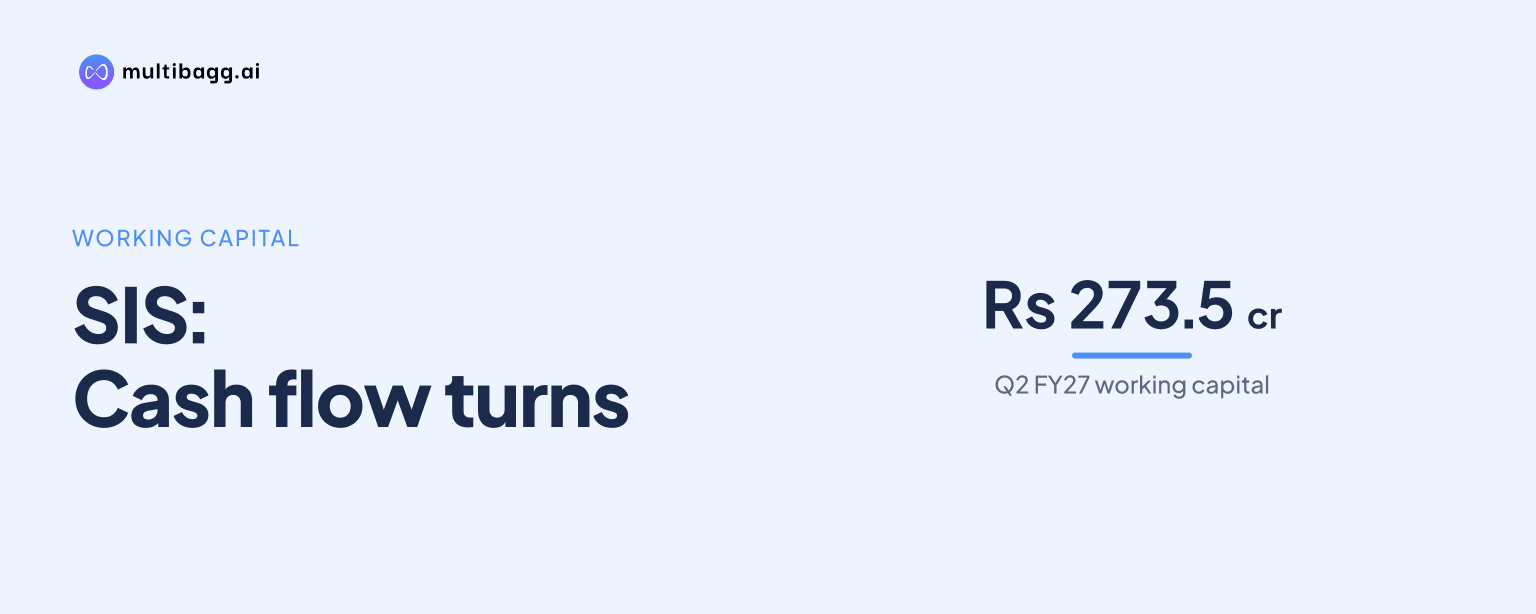
SIS Group Enterprises reported negative operating cash flow of ₹99.2 crore in Q2 FY27 after a ₹273.5 crore working-capital outflow, chiefly in Security Solutions – International, outweighed ₹235.6 crore of cash profit. SIS converted negative 44.4% of earnings before interest, tax, depreciation and amortisation (EBITDA) into operating cash flow, versus 42.3% in Q1 FY27, while net debt reached ₹1,025.6 crore.
Know SIS inside out
Results, valuation, peers and who's buying, in one view.
Why did SIS operating cash flow turn negative?
SIS operating cash flow turned negative because a ₹273.5 crore working-capital outflow and ₹61.35 crore of taxes paid exceeded the quarter's ₹235.6 crore cash profit. Net operating cash flow was therefore negative ₹99.2 crore in Q2 FY27, compared with positive ₹87.7 crore in Q1 FY27 and ₹10.6 crore in Q2 FY26.
Operating cash flow (OCF) represented negative 44.4% of consolidated EBITDA in Q2 FY27, a reversal from 42.3% in Q1 FY27 and 6.3% in Q2 FY26. The presentation's KPI series shows that OCF-to-EBITDA was 107.0% in FY26 and averaged 64% across FY21 to Q2 FY27, compared with the latest quarterly outcome of negative 44.4%.
The consolidated cash-flow figures are after inter-company eliminations, so segment amounts do not directly add to every consolidated line. Nevertheless, the segment comparison identifies Security Solutions – International as the principal source of the working-capital movement, with a ₹216.3 crore outflow, versus ₹32.0 crore in Security Solutions – India and ₹24.6 crore in Facility Management Solutions.
Did delayed international collections drive the cash outflow?
Yes. SIS said delayed collections from some large Security Solutions – International accounts temporarily increased days sales outstanding (DSO), a measure of average collection days, to 57 days in Q2 FY27. This was nine days above 48 days at the end of June 2026 and three days above 54 days at the end of September 2025, alongside the segment's ₹216.3 crore working-capital outflow.
Security Solutions – International recorded negative operating cash flow of ₹179.0 crore despite generating ₹73.5 crore of cash profit in Q2 FY27. Its OCF-to-EBITDA ratio was negative 248.5%, contrasting with 56.7% for Security Solutions – India and 40.7% for Facility Management Solutions during the same quarter.
The collection issue occurred as Security Solutions – International reported quarterly revenue of ₹2,019.6 crore, up 25.7% year on year and 1.9% quarter on quarter on a reported basis. On a constant-currency basis, its revenue grew 6.3% year on year and 1.3% sequentially, while EBITDA rose 34.8% to ₹72.0 crore and the EBITDA margin increased to 3.6% from 3.3% a year earlier.
Security Solutions – India moved in the other direction on collections, with DSO declining to 73 days from 74 days at the end of June 2026 and 76 days at the end of September 2025. The segment generated ₹64.2 crore of operating cash flow on ₹2,144.1 crore of revenue, compared with the negative ₹179.0 crore operating cash flow in Security Solutions – International.
Got a follow-up? Ask IRIS
How did weaker cash conversion affect SIS debt?
SIS net debt increased to ₹1,025.6 crore at the end of Q2 FY27 from ₹807.1 crore at the end of Q1 FY27, and net debt to last-twelve-month EBITDA increased to 1.24 times from 1.05 times. Management attributed the increase primarily to a working-capital outflow of about ₹273 crore, largely in Security Solutions – International, and buyback payouts of ₹92 crore.
The net-debt bridge for 1 July 2026 to 30 September 2026 records ₹273.6 crore of working-capital use, ₹61.4 crore of taxes paid and ₹37.2 crore of capital expenditure. These cash uses were partly offset by ₹205.5 crore of cash profit and ₹64.3 crore of investment realisations; the bridge also includes ₹32.9 crore of lease-liability movement.
The balance-sheet table rounds September 2026 net debt to ₹1,026 crore, while the cash-flow table and bridge give ₹1,025.6 crore. India represented ₹769 crore of September net debt and international operations ₹256 crore, while gross debt rose ₹54 crore and cash and cash equivalents declined ₹165 crore during the quarter.
Did SIS earnings growth offset the cash-flow decline?
No. SIS reported Q2 FY27 revenue of ₹4,816.0 crore, EBITDA of ₹223.3 crore and profit after tax of ₹110.8 crore, but working capital and taxes produced negative ₹99.2 crore of operating cash flow. Revenue rose 28.1% year on year, EBITDA increased 32.7%, and profit after tax rose 37.1%, showing that the cash outcome diverged from reported earnings in the quarter.
Consolidated EBITDA margin reached 4.6% in Q2 FY27, compared with 4.5% in Q2 FY26 and Q1 FY27. Facility Management Solutions recorded a 5.7% margin, up from 5.2% a year earlier; Security Solutions – International reached 3.6% from 3.3%; and Security Solutions – India remained at 5.3%.
Finance costs increased to ₹58.7 crore in Q2 FY27 from ₹36.8 crore in Q2 FY26. SIS attributed this in part to ₹8.9 crore of interest on lease liabilities for a new multi-year office lease and ₹8.2 crore of acquisition-related finance cost; reported depreciation and amortisation was ₹67.9 crore, including ₹18.7 crore on right-of-use assets.
SIS reported return on capital employed of 16.5% in Q2 FY27, down from 16.9% in Q1 FY27 but above 14.3% in Q2 FY26. Return on equity was 16.0%, compared with 15.8% in Q1 FY27 and 14.5% in Q2 FY26; the presentation states that these measures are adjusted for specified acquisition-related, impairment and gratuity items.
Conclusion
SIS combined higher revenue, EBITDA and profit with a negative cash-flow outcome in Q2 FY27. The ₹273.5 crore working-capital outflow, including ₹216.3 crore in Security Solutions – International, drove operating cash flow to negative ₹99.2 crore, while net debt increased to ₹1,025.6 crore and net debt to EBITDA reached 1.24 times.
The next disclosed issue to watch is collection from the large Security Solutions – International accounts that lifted DSO to 57 days from 48 days in June 2026. Management describes the effect as temporary and says it is pursuing margin-improvement initiatives through FY27, while some Australian client-price revisions lag the 4.75% minimum-wage increase effective 1 July 2026; the presentation does not provide a collection timetable or DSO target.