










SIS says labour-code repricing has started lifting India margins
Key highlights
- SIS reported Q2 FY27 revenue of Rs 4,816 crore, up 28.1% year on year.
- SIS India EBITDA margin rose to 5.4% in Q2 FY27 from 5.2% in Q4 FY26.
- SIS Facility Management Solutions EBITDA margin increased to 5.7% from 5.2% a year earlier.
- SIS net debt rose to Rs 1,025.6 crore in Q2 FY27 from Rs 807.1 crore in Q1 FY27.
powered by IRIS
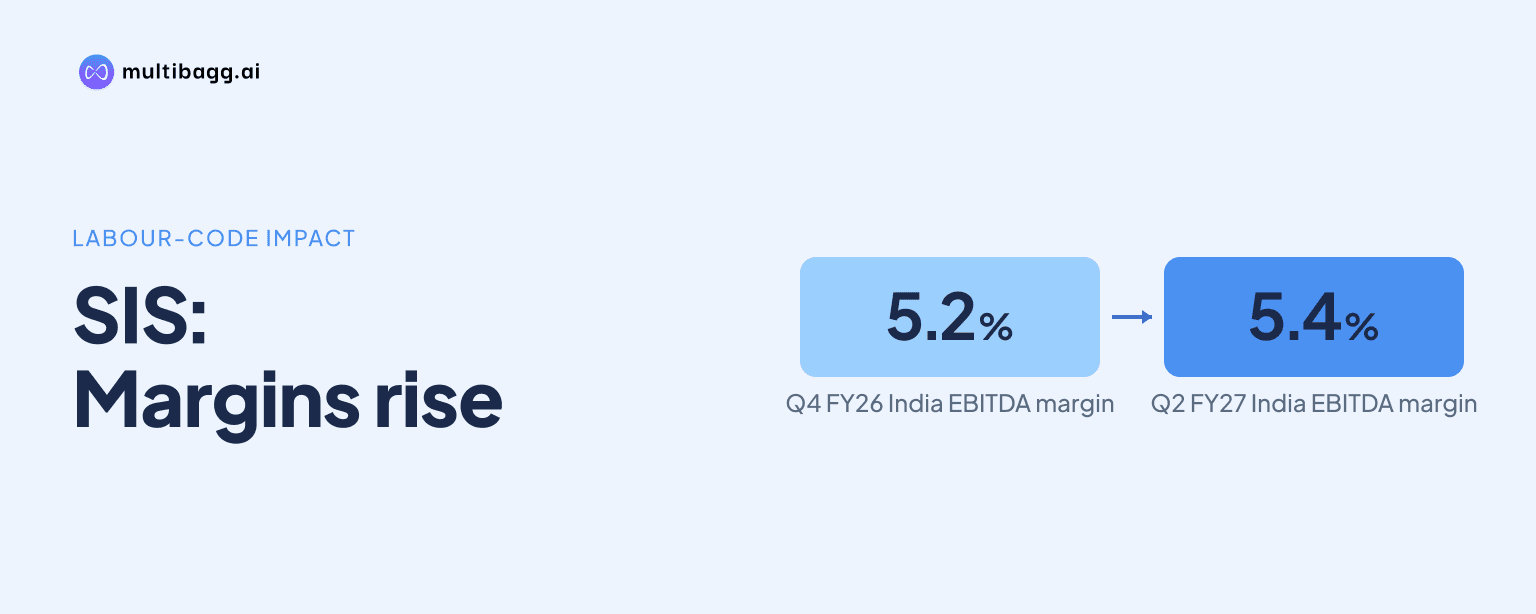
In Q2 FY27, SIS Limited said labour-code repricing lifted its India earnings before interest, tax, depreciation and amortisation (EBITDA) margin to 5.4% from 5.2% in Q4 FY26, as it fully passed higher wage and statutory costs to customers. Management said the major portion of the benefit remains ahead.
Know SIS inside out
Results, valuation, peers and who's buying, in one view.
What did SIS report in Q2 FY27?
SIS reported consolidated revenue of Rs 4,816 crore in Q2 FY27, up 28.1% year on year from Rs 3,758.5 crore and 4.6% from Rs 4,603.6 crore in Q1 FY27. Consolidated EBITDA increased 32.7% year on year to Rs 223.3 crore, faster than revenue, and the EBITDA margin rose to 4.6% from 4.5% in both Q2 FY26 and Q1 FY27.
Reported profit after tax (PAT) was Rs 110.8 crore, 37.1% above Rs 80.7 crore in Q2 FY26 and 8.9% above Rs 101.7 crore in Q1 FY27. For H1 FY27, revenue rose 28.9% to Rs 9,419.6 crore, EBITDA increased 34.4% to Rs 430.4 crore, and PAT grew 22.3% to Rs 212.4 crore.
The consolidated outcome included costs beyond the India repricing effect. Earnings before tax rose 17.8% year on year to Rs 122 crore, while depreciation increased 26.0% to Rs 60 crore and finance costs increased 37.3% to Rs 50.1 crore in the consolidated results table. SIS attributed higher charges partly to acquisitions, while its detailed commentary also cited a new multi-year office lease in Security Solutions International.
How is labour-code repricing affecting SIS margins?
SIS said New Labour Codes supported India margin gains after their introduction, with India EBITDA rising 13.8% over the six months from Q4 FY26 to Rs 151.5 crore in Q2 FY27. India EBITDA margin increased by 20 basis points, or 0.2 percentage points, to 5.4% from 5.2%, with contributions from Security Solutions India and Facility Management Solutions.
The mechanism is customer repricing for higher wages and statutory costs. SIS said major minimum-wage revisions in Haryana and Uttar Pradesh supported price increases alongside volume growth, while Karnataka, Haryana, Uttar Pradesh and Uttarakhand had raised minimum wages. Security Solutions India revenue rose 7.0% quarter on quarter, excluding APS its year-on-year revenue growth was 15.7%, and Facility Management revenue increased 5.5% sequentially.
The rollout remains incomplete. The Centre notified Code on Wages (Central) Rules on 8 May 2026, and SIS began its internal Labour Code compliance programme on 1 June 2026. State Model Rules had not yet been published, and management said further benefit depends on state notifications, minimum-wage revisions and the industry's movement towards compliance.
Got a follow-up? Ask IRIS
Which SIS segments showed the largest margin movement?
Facility Management Solutions recorded the largest year-on-year segment margin increase in Q2 FY27. Its EBITDA margin rose 50 basis points to 5.7% from 5.2% in Q2 FY26 and from 5.5% in Q1 FY27, which SIS attributed to cost discipline and Labour Code-linked rate revisions. Segment revenue grew 7.6% year on year and EBITDA grew 17.8%.
Security Solutions India reported EBITDA margin of 5.3%, unchanged from Q2 FY26 but 20 basis points above 5.1% in Q1 FY27. Revenue increased 38.9% year on year and 7.0% quarter on quarter, while EBITDA rose 37.2% year on year and 10.4% sequentially. These figures indicate that the stated India margin improvement was not confined to Facility Management.
Security Solutions International also improved, with its EBITDA margin reaching 3.6% from 3.3% a year earlier and 3.5% in Q1 FY27, but SIS did not link that segment to Labour Code rate revisions. On a constant-currency basis, international revenue grew 6.3% year on year and EBITDA rose 14.2%, compared with reported revenue growth of 25.7%.
What other Q2 FY27 factors should readers track?
Cash flow and leverage moved in the opposite direction to operating profit during Q2 FY27. Consolidated operating cash flow was negative Rs 99.2 crore, compared with positive Rs 87.7 crore in Q1 FY27, and operating cash flow as a share of EBITDA shifted to negative 44.4% from positive 42.3%. SIS attributed this mainly to a Rs 216.3 crore working-capital outflow in Security Solutions International.
Net debt rose to Rs 1,025.6 crore at the end of Q2 FY27 from Rs 807.1 crore at the end of Q1 FY27, raising net debt to last-12-month EBITDA to 1.24 times from 1.05 times. SIS cited a Rs 273 crore working-capital outflow and Rs 92 crore of buyback payouts, while gross debt increased to Rs 2,047 crore from Rs 1,993 crore.
Lease accounting also affects earnings comparisons. SIS said Indian Accounting Standard 116 moves certain rent costs into depreciation and finance cost: Q2 FY27 reported EBITDA was Rs 223.3 crore, versus Rs 200.5 crore excluding that standard's effect. Reported PAT was Rs 110.7 crore, compared with Rs 115.6 crore on the pre-Indian Accounting Standard 116 basis that SIS uses for like-for-like operating assessment.
Conclusion
SIS's Q2 FY27 results show that labour-code-linked customer repricing coincided with a 20-basis-point rise in India EBITDA margin from Q4 FY26 and a 50-basis-point year-on-year increase in Facility Management Solutions margin. Consolidated EBITDA growth of 32.7% exceeded revenue growth of 28.1%, although working-capital outflows, higher debt and lease-related reporting effects remained part of the quarterly picture.
The next point to watch is the state-by-state rollout of the Labour Code framework. As of SIS's 4 November 2026 update, State Model Rules were pending publication, while management expected further state minimum-wage revisions. Its expectation that most repricing benefit remains ahead depends on those notifications and continued pass-through of higher wage and statutory costs to customers.