










Siyaram's raises FY27 growth outlook to 14%-15% despite costs
Key highlights
- Siyaram's raised FY27 revenue-growth guidance to 14%-15% after H1 FY27 total income increased 15.6% to Rs 1,293 crore.
- Q2 FY27 total income rose 15.1% to Rs 827 crore, while profit after tax fell to Rs 75 crore from Rs 87 crore.
- Siyaram's said it had cumulatively raised prices by about 4%-6% over the preceding six months.
- ZECODE and DEVO contributed about Rs 65 crore in H1 FY27 and are targeted to generate about Rs 160 crore in FY27.
powered by IRIS
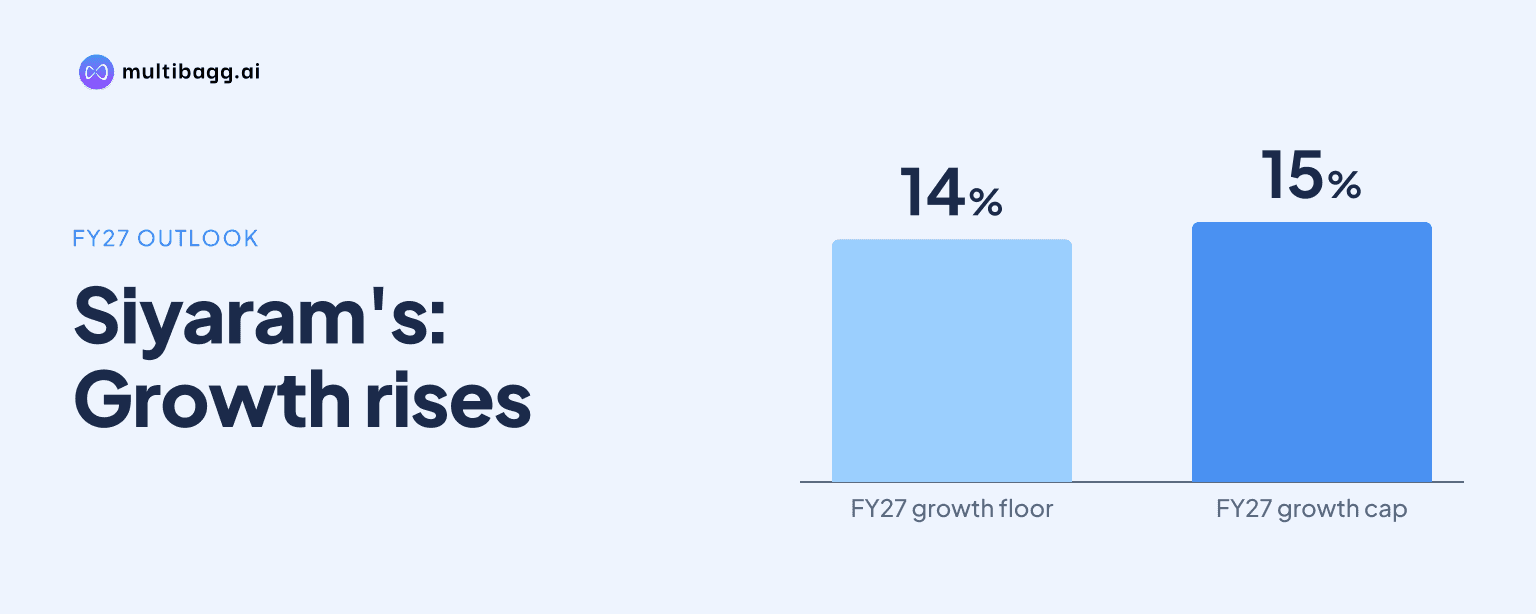
Siyaram Silk Mills Limited raised its FY27 revenue-growth guidance to 14%-15% after total income increased 15.6% year on year to Rs 1,293 crore in H1 FY27. Management expects festive-season consumption to lift Q3 demand, even as higher raw-material prices have affected gross margin and earnings before interest, tax, depreciation and amortisation, or EBITDA.
Know Siyaram Silk Mills inside out
Results, valuation, peers and who's buying, in one view.
Why did Siyaram's raise its FY27 revenue-growth guidance?
Siyaram's raised its FY27 revenue-growth guidance to 14%-15% because H1 FY27 income growth was already within that range and management expects the festive season to support Q3 sales. Total income was Rs 1,293 crore for the half year ended September 30, 2026, compared with Rs 1,118 crore in H1 FY26. Management said a larger portion of festive-led consumption would be reflected in the following quarter.
Management also linked the revised outlook to progress in ZECODE and DEVO, its retail formats, and to an expected improvement in channel demand as dealer inventory clears. Retail movement had picked up as the festive season began, while wholesale and channel sales tend to follow with a lag. Management said the combination of H1 growth, festive demand and retail progress supports its 14%-15% full-year expectation.
Demand across the textile and apparel sector remained broadly stable in H1 FY27 despite uneven monsoon conditions and raw-material inflation, management said. Raksha Bandhan and Onam supported retail activity, while Tier-2 and Tier-3 markets remained important for the Fabrics segment. Management said rural demand, which had been weak about two years earlier, had recovered over the past year and continued to improve in FY27.
How did Siyaram's Q2 and H1 FY27 financial performance compare?
Siyaram's total income rose 15.1% to Rs 827 crore in Q2 FY27 and 15.6% to Rs 1,293 crore in H1 FY27, while Q2 profit after tax fell to Rs 75 crore from Rs 87 crore. The Q2 FY26 income comparison of Rs 719 crore excludes Rs 24 crore of non-recurring other income, according to the chief financial officer. Q2 FY27 EBITDA increased to Rs 131 crore from Rs 121 crore a year earlier.
The revenue increase did not translate into higher Q2 profit after tax as management cited raw-material inflation as the main pressure on gross margin and EBITDA. Fabrics accounted for 77% of Q2 FY27 revenue, Garments for 16%, and Yarn and others for 7%. The segment mix leaves earnings exposed primarily to input-cost movements affecting the Fabrics business.
For H1 FY27, Siyaram's reported EBITDA of Rs 170 crore and profit after tax of Rs 86 crore alongside Rs 1,293 crore of total income. Its debt-equity ratio was 0.58 as of September 30, 2026. The board approved a first interim dividend of Rs 4 per equity share of face value Rs 2 for FY27, although the call did not disclose a payment date.
Got a follow-up? Ask IRIS
How is raw-material inflation affecting Siyaram's margins and prices?
Raw-material pricing was the principal reason for the decline in Siyaram's gross margin and EBITDA margin, management said. Commodity prices and demand-supply conditions can shift quickly, but a branded consumer business selling through channels cannot immediately match each input-cost move through retail prices. Management therefore described its pricing response as gradual rather than immediate.
Siyaram's said it had cumulatively raised prices by about 4%-6% over the preceding six months as of the October 28, 2026 call. Management did not disclose a category-level or quarter-specific split for those increases. It said geopolitical tensions continued to make raw-material costs uncertain and that prices could correct if conditions settle, limiting the case for excessive price action.
Management said ZECODE and DEVO would have a maximum 150-basis-point EBITDA drop during FY27 and expressed confidence in meeting that guidance. A basis point is one-hundredth of a percentage point. The company did not disclose its current gross margin, EBITDA margin, or a standalone retail EBITDA figure, so the financial effect of each format cannot be separately measured from the call.
What does retail expansion add to Siyaram's FY27 plan?
Siyaram's said ZECODE and DEVO together contributed about Rs 65 crore to H1 FY27 topline and are targeted to generate about Rs 160 crore for the full year. Management said ZECODE supplied the larger part of H1 retail revenue but did not provide format-level sales. It cautioned against a quarter-on-quarter reading because Q1 included a strong April wedding season.
The company had 61 stores across the two formats, including 38 ZECODE stores and 23 DEVO stores, against its FY27 target of 70. It opened 17 stores in H1 FY27. Management said it was confident of reaching 70 stores but would retain that target because several build-to-suit properties are at different construction stages and may face opening delays.
ZECODE had roughly 19-20 stores in Bengaluru and nearby areas, 10-12 elsewhere in Karnataka, 3-4 in Hyderabad and 2-3 in Chennai. Management said further ZECODE openings would largely be in Hyderabad and Chennai, alongside additional opportunities in Bengaluru. DEVO is expected to have about 22-25 stores by FY27-end, with stores concentrated in Delhi, Uttar Pradesh, Punjab and Rajasthan.
Management said most expansion in the following year would likely be in ZECODE, while DEVO reaches a store base that can be operated as a regional cluster. It plans to provide a more concrete following-year store target at the end of FY27. Siyaram's also said it would wait until the end of March to share more retail metrics because the current festive season is the first with a meaningful combined store base, compared with fewer than 20 stores in the prior festive season.
Conclusion
Siyaram's revised FY27 outlook combines 15.6% H1 income growth, expected Q3 festive demand and a Rs 160 crore retail-revenue target. The offset is input-cost pressure: Q2 income rose to Rs 827 crore and EBITDA increased to Rs 131 crore, but profit after tax declined to Rs 75 crore as management said higher raw-material prices affected margins.
The next factors to watch are festive-season sales, progress from 61 stores toward the 70-store FY27 target, and whether gradual price increases of 4%-6% offset raw-material costs. Management plans to give a more concrete following-year expansion target at the end of FY27 and said additional retail performance metrics may be shared after March.