










Siyaram's retail stays offline as backend systems build
Key highlights
- Siyaram's estimates Rs 1-1.5 crore of CAPEX and Rs 70-80 lakh of inventory per retail store.
- Siyaram's has kept e-commerce for ZECODE and DEVO out of its immediate plan.
- First-half CAPEX was about Rs 51 crore against a full-year indication of about Rs 100 crore.
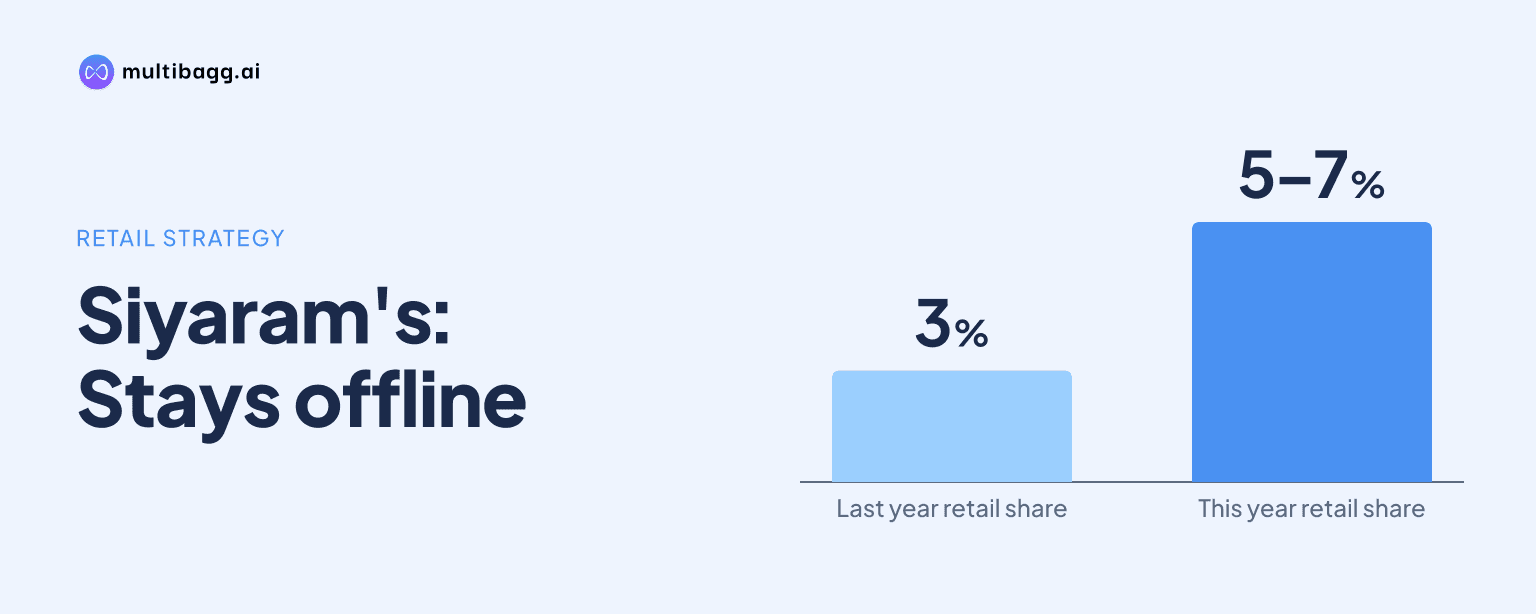
- Retail represented about 3% of turnover last year and could rise to 5%-7% this year, according to management.
powered by IRIS
Siyaram's is keeping ZECODE and DEVO offline while it builds warehouse, supply-chain and information-technology systems, with management estimating Rs 1-1.5 crore of capital expenditure and Rs 70-80 lakh of inventory per store. Management said current retail expansion is funded through internal accruals and e-commerce is not in the immediate plan.
Know Siyaram Silk Mills inside out
Results, valuation, peers and who's buying, in one view.
Why is Siyaram's delaying e-commerce for ZECODE and DEVO?
Siyaram's has consciously kept e-commerce and a website out of the immediate plan because its retail operations are about two years old or less. Management said it is operating two new retail brands, ZECODE and DEVO, while building their physical-store model, and does not want to divert focus across too many initiatives at the same time.
Management said online retail is not excluded permanently because consumers engage with direct-to-consumer brands across formats. However, it described e-commerce as being on the back burner until it can be implemented properly, rather than added while warehouse, information-technology and supply-chain processes are still being established.
The offline strategy is also tied to regional clustering. DEVO began in northern India, with stores in Delhi, the National Capital Region, Uttar Pradesh, Punjab and Rajasthan, while ZECODE began in southern India and remains focused there. Management said it intends to build these clusters before communicating further geographic expansion.
How is Siyaram's limiting investment in retail stores?
Siyaram's is limiting retail investment by opening stores at a manageable scale while it tests the operating model. Management said retail operations are new to the company, although its textile background provides product expertise, and that a smaller initial scale allows operational errors and changes to have less effect on cost and profitability.
Management estimated capital expenditure, or CAPEX, for furniture and security deposits at Rs 1-1.5 crore per store. It also estimated that an outlet needs Rs 70-80 lakh of inventory, describing the budget as conservative and tightly managed.
The company has also indicated a limit on the consolidated earnings effect from the project. Management said it had guided for a 150-basis-point reduction in earnings before interest, tax, depreciation and amortisation, or EBITDA, from retail in the first year and remained within that level. It gave a similar indication for the second year, while not disclosing store-level profitability for every outlet.
What operating model is Siyaram's creating for its formats?
Siyaram's is creating separate operating models for ZECODE and DEVO because they target different consumers, price points and categories. Management described ZECODE as a fast-fashion business that is less cyclical and seasonal, while DEVO operates in ethnic wear; each format has its own team and setup.
ZECODE's larger stores are generating better outcomes than smaller outlets, according to management. The format carries menswear, womenswear, childrenswear, beauty products, footwear and fragrances, and management said larger floor plates allow a fuller display and better customer presentation, although mall locations can require compromises on size.
Management said some ZECODE stores had reached store-level EBITDA positivity earlier than expected, but did not disclose a count. It said it does not provide that metric outlet by outlet because volumes remain small, while reporting that the first half of the current year was much better than the first half of the previous year.
The improvement was not limited to older stores, according to management. Siyaram's said it is applying learning on locations and store size to newer openings, aiming to improve the quality of subsequent stores while supply-chain and backend systems are developed alongside the customer-facing network.
Got a follow-up? Ask IRIS
Can Siyaram's fund its retail expansion internally?
Siyaram's said all current growth is being funded through internal accruals, with annual cash flow from its established business significantly above the present requirement for retail expansion. Management said this funding approach supports entry into fast fashion and ethnic wear without undue pressure on the company's bottom line.
Cumulative CAPEX in the first half was about Rs 51 crore, against management's full-year indication of about Rs 100 crore. Management said it expected to remain in line with the full-year figure, providing a comparison between spending in the first half and the planned annual amount.
Management said the company has paid dividends every year and that payouts have increased over time, but did not promise a future dividend level. It said the board decides dividends and shareholder returns each quarter, while the present retail plan remains within internal cash generation.
For the current year, management has targeted about 70 stores by year-end and said those stores would be internally funded. It has not yet set a store-opening or funding plan for the following year, meaning management said it would determine the financing structure after devising the next expansion plan.
How material could retail become to Siyaram's turnover?
Siyaram's said retail accounted for about 3% of company turnover last year and could rise to 5%, 6% or 7% in the current year. Management referred to Rs 160 crore while discussing that increase, indicating an expected rise in retail's contribution even as it maintains a conservative store-opening approach.
Management's retail growth approach differs from the market exposure of the traditional fabric business. It said the fabric business is particularly relevant to Tier-2 and Tier-3 markets, where rural demand was weak about two years ago but recovered over the last year and continued into the current year.
The newer retail network is more metro-oriented, with most stores in Bengaluru, Chennai and Hyderabad, while traditional fabric operations have greater exposure to smaller cities. Management said it could not determine whether Tier-2 and Tier-3 markets were growing faster than larger cities because the two businesses have different geographic mixes.
Management has raised revenue-growth guidance to 14%-15%, citing first-half growth of about 14%-15%, the festive season moving into the third quarter and confidence in retail execution. It also retained EBITDA guidance of about 14% before the 150-basis-point retail impact, while saying raw-material costs were the largest contributor to EBITDA pressure.
Conclusion
Siyaram's is prioritising operational discipline over a rapid omnichannel rollout. ZECODE and DEVO remain offline as the company builds warehouses, information-technology systems and supply chains, while per-store investment is held to Rs 1-1.5 crore of CAPEX and Rs 70-80 lakh of inventory. Internal accruals currently fund the programme, and retail could rise from about 3% of turnover last year to 5%-7% this year, according to management.
The next point to watch is progress toward management's target of about 70 stores by year-end, which it expects to fund internally. Investors can also monitor whether Siyaram's provides a next-year rollout and financing plan, as well as any decision to introduce e-commerce after the backend and store model are further established.