










Steamhouse cuts net debt ratio to 0.16x after IPO repayment
Key highlights
- Steamhouse reported net debt-to-equity of 0.16x at the end of H1 FY27, versus 1.57x in FY26.
- Management said trade payables were almost zero after early payments funded by IPO proceeds.
- H1 FY27 EBITDA rose to Rs 55.62 crore from Rs 33.56 crore in H1 FY26.
- Steamhouse is targeting about 13.25 lakh tonnes of steam sales in FY27, up 25% from 10.66 lakh tonnes in FY26.
powered by IRIS
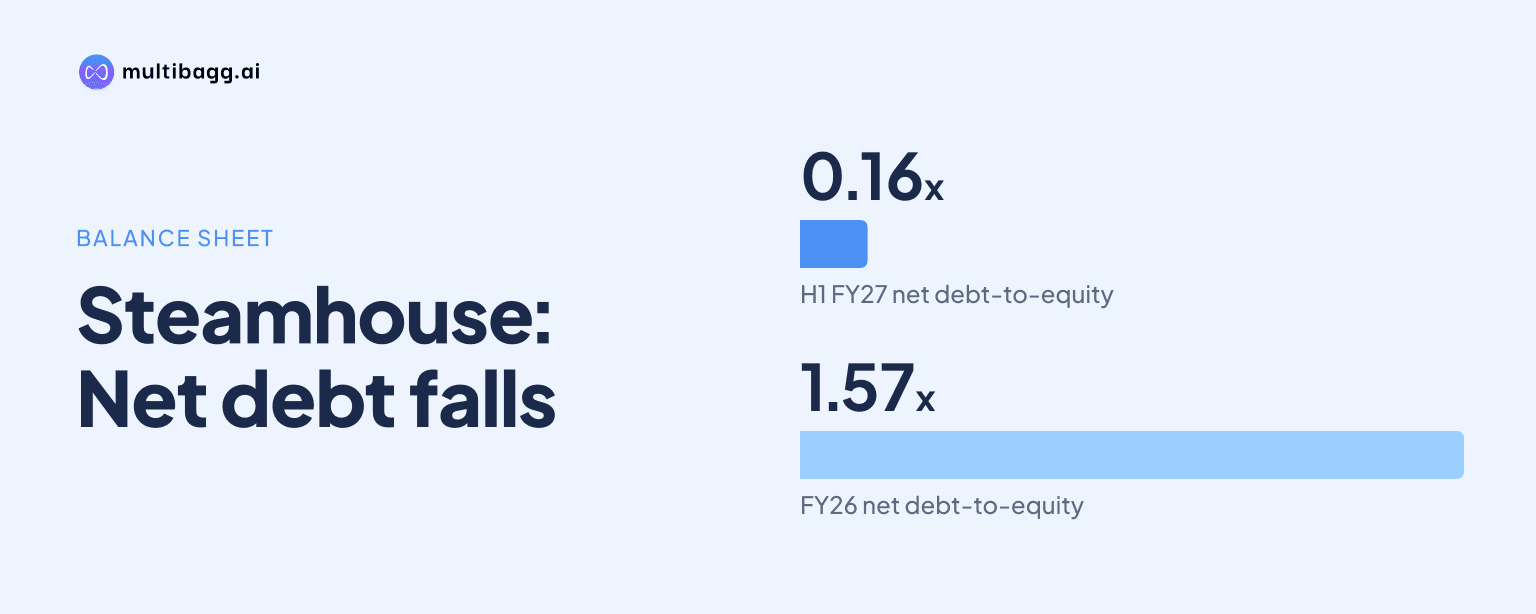
Steamhouse India Limited reduced its net-debt-to-equity ratio to 0.16x at the end of the first half (H1) of financial year 2027 (FY27), from 1.57x in FY26, after using initial public offering (IPO) proceeds to repay loans and settle creditors early, management said. Those creditor payments produced negative operating cash flow during FY27.
Know Steamhouse India inside out
Results, valuation, peers and who's buying, in one view.
How did Steamhouse change its debt and creditor position?
Steamhouse reduced leverage through IPO-funded loan repayment and early settlement of creditors. Net debt-to-equity was 0.16x at the end of H1 FY27, down from 1.57x in FY26, which management attributed to debt reduction following its capital raise. Management said its capital-allocation priorities remain committed projects, debt and borrowing costs, and liquidity for day-to-day operations.
Steamhouse also used IPO money to pay creditors early. Management said trade payables had decreased drastically and were almost zero at the time of the call. It intends to procure coal mainly on a cash basis, with fuel-creditor balances expected to be either zero or around Rs 5 crore to Rs 10 crore, rather than a substantial balance at a reporting date.
Why was Steamhouse’s operating cash flow negative?
Steamhouse said its negative operating cash flow resulted from a working-capital outflow rather than a stated deterioration in underlying operations. Management said IPO proceeds were used for early creditor payments, reducing trade payables and enabling cash discounts on purchases. It cautioned that operating cash flow could remain negative during FY27 because of this reduction in payables.
Management expects the cash-flow effect to normalise once payables stop declining. It said creditor balances should thereafter remain in single digits, allowing the previous creditor-reduction effect to reverse in operating cash flow. That expectation depends on maintaining the stated cash-purchase approach without rebuilding a significant coal-credit balance.
Cash procurement was also presented as a margin mechanism. Management said earnings before interest, tax, depreciation and amortisation (EBITDA) per tonne and gross profit per tonne increased by more than Rs 300 year on year because cash coal purchases secured a price advantage and waste-to-steam facilities operated at an optimal level. Reported H1 FY27 EBITDA per tonne was Rs 916, compared with Rs 632 in H1 FY26, an increase of Rs 284.
What interest savings does Steamhouse expect after repaying loans?
Steamhouse expects quarterly interest expense to be slightly below Rs 6 crore after IPO-funded repayments take effect. Management said it raised about Rs 130 crore of debt in the quarter ended June, part of which was repaid from IPO proceeds after the IPO on September 17. Because that debt carried interest during the second quarter (Q2) FY27, management said the reduction should be visible from Q3 FY27.
The reported Q2 FY27 operating results improved year on year even as the expected interest benefit had not yet fully appeared. Revenue rose to Rs 128 crore from Rs 124.94 crore, EBITDA increased to Rs 24.68 crore from Rs 14.24 crore, and profit after tax rose to Rs 7.77 crore from Rs 2.91 crore. Profitability therefore grew faster than revenue in the quarter.
Sequentially, Q2 FY27 EBITDA was lower than the Rs 30.93 crore reported in the first quarter (Q1) FY27, while profit after tax declined from Rs 18.34 crore to Rs 7.77 crore. Management linked the sequential movement to monsoon conditions, including wet coal and higher transmission losses, rather than coal-price pass-through. It said coal-price changes are generally passed through under customer agreements, with a lag of around 15 days.
Got a follow-up? Ask IRIS
Can Steamhouse fund expansion while buying coal for cash?
Steamhouse said it plans to retain operating liquidity while funding committed projects and purchasing coal for cash. This requires balancing lower fuel-creditor balances against capital needs at Ankleshwar Phase 3, Panoli Phase 2 and Dahej GIDC Phase 2. Management said it assesses investments against customer demand, expected utilisation and potential long-term profitability.
Steam sales reached 6.07 lakh tonnes in H1 FY27, up 14.35% from 5.31 lakh tonnes in H1 FY26, while capacity utilisation rose to 41.91% from 37.03%. Management is targeting 25% volume growth in FY27 from 10.66 lakh tonnes sold in FY26, implying about 13.25 lakh tonnes for the current year.
Management said the second half (H2) must deliver about 35% year-on-year volume growth to meet the FY27 target, supported by new facilities and ramp-up at existing sites. It expected Jhagadia to begin selling steam in November and said facilities commissioned during FY27 would contribute for a full year in FY28. These are management targets and depend on commissioning, customer ramp-up and utilisation.
What does the lower debt ratio mean for Steamhouse’s returns?
Steamhouse said lower leverage has not yet translated into higher reported return ratios because IPO equity was raised before all growth projects are fully deployed. At the end of H1 FY27, management reported return on capital employed (ROCE) of 12.97% and return on equity (ROE) of 4.53%; neither measure was annualised. Management said the post-IPO increase in equity moderated these ratios.
Management expects projects to contribute as facilities are commissioned and utilisation rises, but it did not provide a return-ratio target. H1 FY27 EBITDA margin was 21.67%, compared with 14.08% in H1 FY26, while profit after tax reached Rs 26.11 crore from Rs 13.09 crore. Management identified project execution, customer ramp-up and operating performance as variables affecting future returns.
Conclusion
Steamhouse’s balance-sheet change combines a decline in net debt-to-equity from 1.57x in FY26 to 0.16x at the end of H1 FY27 with an intentional reduction in trade creditors. Management attributed the near-term negative operating cash flow to early payments that secured cash discounts and supported a shift to cash coal procurement, while H1 EBITDA rose to Rs 55.62 crore from Rs 33.56 crore.
The next indicators are whether Q3 FY27 interest expense moves below the roughly Rs 6 crore quarterly level management cited, whether creditor balances remain near zero to Rs 10 crore, and whether H2 volume growth reaches the planned 35%. Commissioning and customer ramp-up at new facilities will also determine whether Steamhouse meets management’s 25% FY27 volume-growth target and its expectation of more than 35% volume growth in FY28.