










Steamhouse pursues new plants for separate demand clusters
Key highlights
- Steamhouse targets about 13.25 lakh tonnes of FY27 steam sales, compared with 10.66 lakh tonnes in the prior year.
- Management said existing-facility utilisation rose almost 500 basis points year on year in H1.
- The new Vapi plant is 7 to 8 kilometres from the existing unit and is expected to sell output through a 1.5-kilometre pipeline network.
- Management guided for Rs 1,100 to Rs 1,200 EBITDA per tonne in the next full financial year if four waste-to-steam facilities are operational.
powered by IRIS
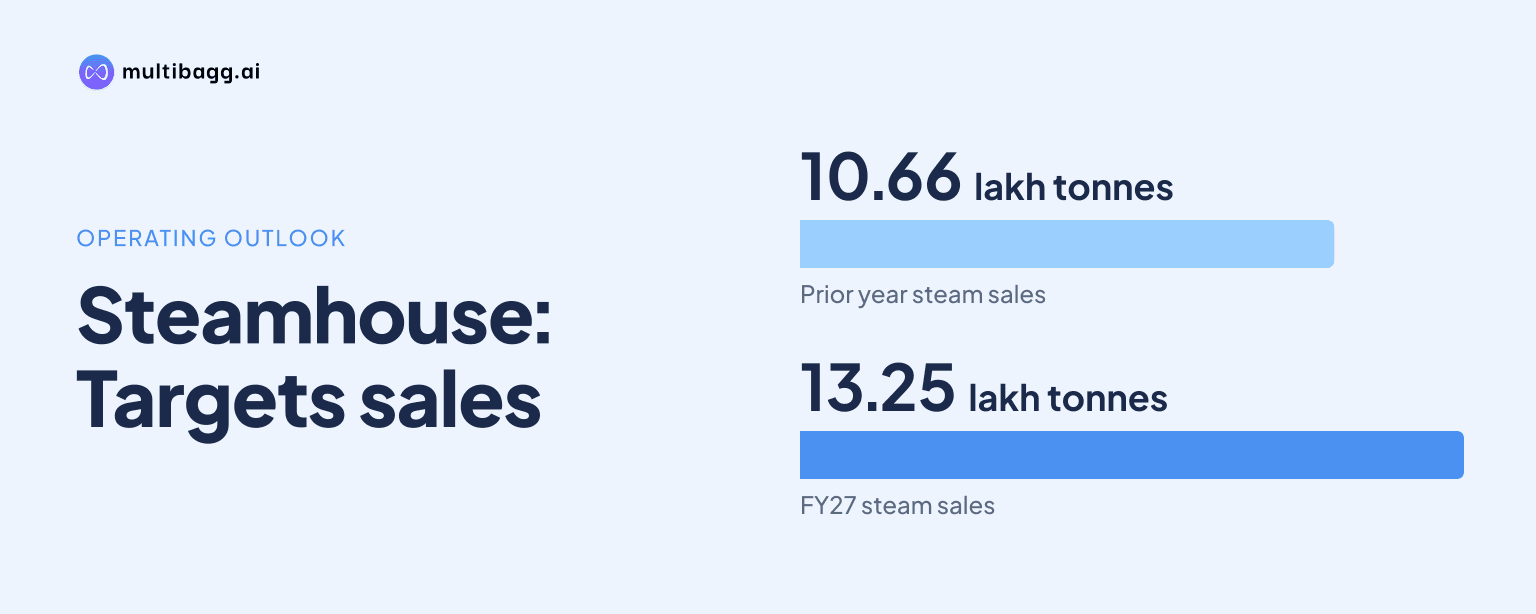
Steamhouse is proceeding with new plants because management says they address separate industrial demand pockets, contracted customers or pipeline constraints rather than duplicate existing supply, while targeting about 13.25 lakh tonnes of steam sales in financial year 2027 (FY27), compared with 10.66 lakh tonnes in the preceding year.
Know Steamhouse India inside out
Results, valuation, peers and who's buying, in one view.
Why is Steamhouse adding capacity at existing clusters?
Steamhouse says its operating facilities were designed to serve future demand in their respective industrial estates, while each new project must be assessed by location and customer access. Management said utilisation at existing facilities improved by almost 500 basis points year on year in the first half (H1), almost 100 basis points sequentially in the second quarter (Q2), and more than 700 basis points year on year in Q2.
Management said growth should come from two sources: deeper penetration at operating sites and capacity being commissioned at new sites. Panoli, commissioned last year, still has scope to ramp up, according to management. It also cited signed agreements with undisclosed marquee customers at existing locations, as well as opportunities created when industrial customers relocate or expand.
Steamhouse is targeting more than 25% volume growth in FY27, from 10.66 lakh tonnes sold in the prior year to around 13.25 lakh tonnes. Management acknowledged that, after H1 growth of about 14%, the plan requires roughly 35% year-on-year volume growth in the second half (H2). It attributed that required H2 acceleration to new facilities, higher utilisation at existing plants and trading opportunities at Dahej Special Economic Zone and Haldia, where pipelines are under construction.
Which clusters will Steamhouse’s new plants serve?
Steamhouse says Vapi, Jhagadia, Pirana and Nandesari are separate opportunities because of geography, customer mix or local demand rather than simply extensions of a single plant’s service area. The Vapi project is within the same Gujarat Industrial Development Corporation (GIDC) area as an operating facility, but management said it is 7 to 8 kilometres away and on the other side of a highway.
Management said a pipeline crossing a National Highways Authority of India road can require approvals lasting around 1.5 to 2 years. Steamhouse therefore chose to build a Vapi plant closer to a customer on the other side of the highway rather than risk losing that business. Management said it expects to sell the new plant’s entire installed output through a 1.5-kilometre pipeline network and sees further demand in that area.
Jhagadia and Pirana are first entries for Steamhouse rather than additions near its existing facilities. Management expected Jhagadia to start selling steam in November, although the transcript did not disclose its capacity. Pirana, in Ahmedabad, is intended predominantly to address the Narol textile cluster across the road, while Nandesari was justified by existing consumption in that market and is almost sold out through revenue tie-ups, according to management.
How does contracted demand support Steamhouse’s projects?
Steamhouse says signed end-customer contracts provide revenue visibility for its three under-construction waste-to-steam facilities. Management said Jhagadia was expected to commence sales in November, while Nandesari Phase 2 and Vapi Phase 3 were expected to start in H2. A third waste-to-steam facility was expected to become operational in the next calendar year.
The projects are intended to change the fuel mix as well as add sales volume. Management said waste-to-steam facilities require capital expenditure of about 1.5 to 1.75 times that of comparable coal-fired projects, but their operating expenditure is about 50% to 55% lower. Management estimates that a stabilised waste-to-steam project can repay its investment in 2.5 to 3.5 years; this is a management estimate rather than a reported project outcome.
Management said coal-fired projects generate earnings before interest, tax, depreciation and amortisation (EBITDA) of Rs 800 to Rs 1,000 per tonne. It did not disclose a corresponding waste-to-steam EBITDA figure, but said it is materially higher because waste replaces much of the coal cost. For the next full financial year, management guided for EBITDA of Rs 1,100 to Rs 1,200 per tonne, assuming four waste-to-steam facilities are operational.
Got a follow-up? Ask IRIS
What could limit Steamhouse’s waste-to-steam expansion?
Steamhouse says the availability and quality of nearby waste are the main limits on replicating the waste-to-steam model. Management said the opportunity exists only where waste can be sourced near an industrial estate with steam demand, meaning the model cannot be deployed at every cluster. It is seeking to combine industrial waste with municipal waste to improve the blended feedstock’s calorific value.
At Vapi, management said the proposed mix can address both industrial waste generated locally and municipal waste from the nearby city. It contrasted this with municipal waste alone, which management said generally has lower calorific value in India. The approach supports the lower operating-cost assumption for waste-to-steam projects, but management did not disclose waste availability, supply contracts or fuel volumes.
Sachin GIDC is an opportunity under evaluation, not a committed project. Management said Steamhouse has reached most chemical and pharmaceutical industries there, while the larger textile cluster is price sensitive because steam forms a high share of customer revenue. It is evaluating a bigger project using industrial and municipal waste that could lower steam costs for textile customers, but provided no final investment decision or commissioning date.
How do weather and fuel costs affect the ramp-up plan?
Steamhouse said Q2 is structurally softer because monsoon conditions make coal wet and raise transmission losses, reducing steam-to-fuel conversion efficiency. Management said it raised steam prices by about 17% to 18% from the first quarter to Q2, while coal prices increased by a similar extent. It said contractual fuel-cost pass-through remained available and attributed the margin pressure to monsoon operating conditions.
Management also cited severe flooding in July across Surat, Vapi, Ankleshwar and Nandesari, where some industrial estates shut down or were inundated. It said a steam supplier also failed to supply for one month, constraining volume growth. Management nevertheless maintained that it was on track for its more than 25% FY27 volume-growth target and for an improvement in EBITDA margin, with drier Q3 and Q4 conditions expected to reduce transmission losses.
Conclusion
Steamhouse’s expansion rationale rests on plant-specific demand, physical pipeline access and pre-contracted waste-to-steam customers rather than a single utilisation measure across the network. The Vapi highway constraint, first projects in Jhagadia and Pirana, and Nandesari revenue tie-ups show how management distinguishes separate clusters while seeking further penetration at operating plants.
The next evidence point is commissioning and ramp-up. Management expects Jhagadia sales to begin in November, Nandesari Phase 2 and Vapi Phase 3 to start in H2, and a third waste-to-steam facility in the next calendar year. It will also need roughly 35% H2 year-on-year volume growth to reach its FY27 target of about 13.25 lakh tonnes.