










Steamhouse says waste-to-steam cuts operating costs 50%-55%
Key highlights
- Steamhouse says waste-to-steam operating expenditure is about 50%-55% lower than for comparable coal-fired projects.
- Waste-to-steam capital expenditure is about 1.5-1.75 times coal-project capital expenditure, with a stated 2.5-3.5-year payback after stabilisation.
- Two waste-to-steam facilities are expected in the second half, while a third is expected in the next calendar year.
- Management guided to next-full-year EBITDA per ton of Rs 1,100 to Rs 1,200.
powered by IRIS
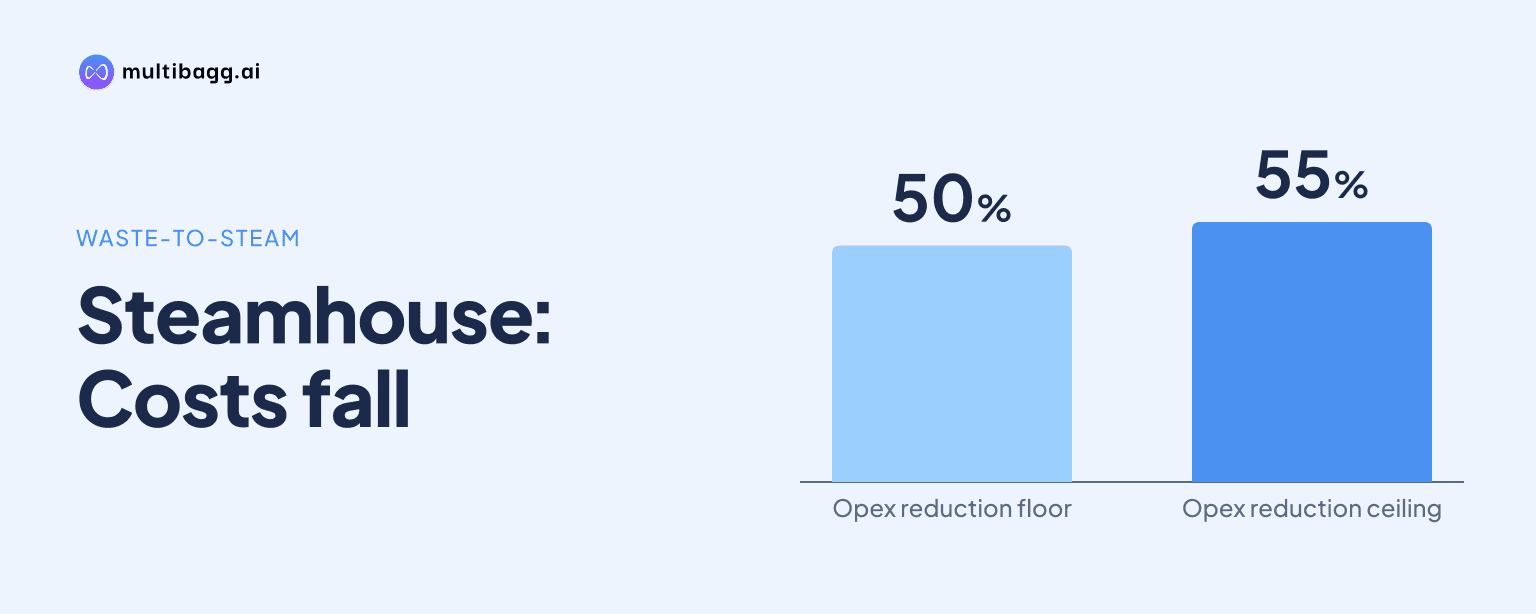
In the earnings call, Steamhouse India Limited said waste-to-steam facilities can reduce operating expenditure by 50%-55% against comparable coal-fired projects, despite requiring 1.5-1.75 times the capital expenditure. Management said the higher-investment projects can achieve payback in 2.5-3.5 years after stabilisation, while three facilities remain under construction.
Know Steamhouse India inside out
Results, valuation, peers and who's buying, in one view.
How do Steamhouse waste-to-steam economics compare with coal projects?
Steamhouse says a waste-to-steam plant costs about 1.5-1.75 times as much to build as a like-for-like coal-fired project of the same capacity, but its operating expenditure is about 50%-55% lower. Management said the resulting payback period is 2.5-3.5 years once a project has stabilised.
The stated operating-cost advantage comes from avoiding coal consumption at the waste-to-steam facility. Management said coal cost is almost nil for these projects because coal is not involved, although it did not provide an absolute construction cost, waste-processing cost, steam selling price or plant-level profit figure.
Steamhouse asked investors to focus on earnings before interest, tax, depreciation and amortisation, or EBITDA, per ton rather than percentage EBITDA margin. Management said changes in coal prices can alter steam sales value because agreements may require price revisions, while absolute EBITDA per ton in the coal-based business would more or less remain in a similar range.
When will Steamhouse's waste-to-steam plants begin generating revenue?
Steamhouse has three waste-to-steam facilities under construction, with two expected to start in the second half and another expected to go live in the next calendar year. Management identified the two nearer-term projects as Nandesari Phase 2 and Vapi Phase 3, and said both were on track for second-half commissioning.
Management said the two projects should lift absolute EBITDA per ton particularly in the fourth quarter once they start generating revenue. That timing matters because management described the second quarter as historically exceptional after monsoon disruption affected industrial activity in Surat, Vapi, Ankleshwar and Nandesari during parts of July.
For the next full year, Steamhouse guided to EBITDA per ton of Rs 1,100 to Rs 1,200. Management said the target assumes “three plus one”, or four, waste-to-steam facilities will be operational during that year, but the call named only three facilities under construction and did not identify the fourth facility or its start-up schedule.
Why does Steamhouse expect EBITDA per ton to rise?
Steamhouse expects lower operating expenditure at waste-to-steam facilities to increase absolute EBITDA per ton from the second half, with the fourth quarter expected to benefit as the two new projects generate revenue. Management also agreed with an analyst that lower finance cost and expanded EBITDA per ton were intended second-half outcomes.
The company linked its per-ton approach to fuel-price pass-through in coal-based steam agreements. Management said investors should not assess performance only through a 43% change in sales value, because higher volumes and fuel prices can both lift revenue without showing the underlying movement in absolute EBITDA per ton.
Steamhouse's volume plan also assumes acceleration in the second half. Management confirmed internal monthly planning for 35% year-on-year volume growth in the second half, after close to 14% growth in the first half, to reach approximately 25% growth for the full year through new capacity and higher utilisation at existing locations.
Got a follow-up? Ask IRIS
What limits Steamhouse's waste-to-steam expansion?
Steamhouse says the limiting factor is the availability of suitable waste near an industrial estate with steam demand, with both waste quantity and waste quality determining whether a project can be developed. Management said the company would seek waste-to-steam opportunities wherever that feedstock-and-demand combination exists, but acknowledged that it cannot be found everywhere.
Steamhouse is seeking to improve fuel quality by combining industrial waste with municipal waste. Management said municipal waste in India generally has lower calorific value, while industrial waste can raise the calorific value of the combined feedstock used in a waste-to-steam plant.
At Vapi, management said this approach could address waste generated by both industries and the nearby city while supplying steam to industrial customers. The company did not disclose the waste mix, calorific value, capacity or capital expenditure for the Vapi waste-to-steam project, so the stated economics remain management's broad comparison rather than a plant-specific calculation.
How does nearby demand affect Steamhouse's new capacity?
Steamhouse said approximately 95% of steam sales volume comes from continuous-usage customers, and management described customer consumption as majorly around the clock. That demand pattern supports continuous plant operation, although the call did not disclose a plant-level load factor or contracted utilisation level for the new waste-to-steam facilities.
The company said its Vapi project is located in the same Gujarat Industrial Development Corporation estate as an operating facility but about 7-8 kilometres away, on the other side of a highway. Management said permission to lay a steam pipeline across a National Highways Authority of India road has historically taken about 1.5-2 years, so it chose to construct a nearby facility instead.
Management said the Vapi project's steam output could be sold through a 1.5-kilometre pipeline network. At Nandesari, Steamhouse said the new facility was almost sold out in terms of revenue tie-ups, while it described Jhagadia and Pirana as new locations and said it does not intend to build projects in saturated markets.
Conclusion
Steamhouse's stated waste-to-steam proposition is lower operating expenditure of 50%-55% against comparable coal-fired capacity, offset by capital expenditure that is 1.5-1.75 times higher. Management connects that trade-off to a 2.5-3.5-year stabilised payback and to its next-full-year EBITDA-per-ton guidance of Rs 1,100 to Rs 1,200.
The next items to watch are second-half commissioning and revenue generation at Nandesari Phase 2 and Vapi Phase 3, followed by the third facility expected in the next calendar year. Management's ability to meet the next-full-year target will also depend on the operational status of the unspecified fourth facility and on securing enough suitable-quality waste near industrial steam demand.