










Steamhouse Una contract lacks committed customer offtake
Key highlights
- Steamhouse has an approximately Rs 311 crore EPC mandate for a 300-tonnes-per-hour Una community boiler.
- Management said no government commitment exists on the quantum of steam offtake at Una.
- Himachal Pradesh Bulk Drug Park Infrastructure Limited will fund the Una project cost.
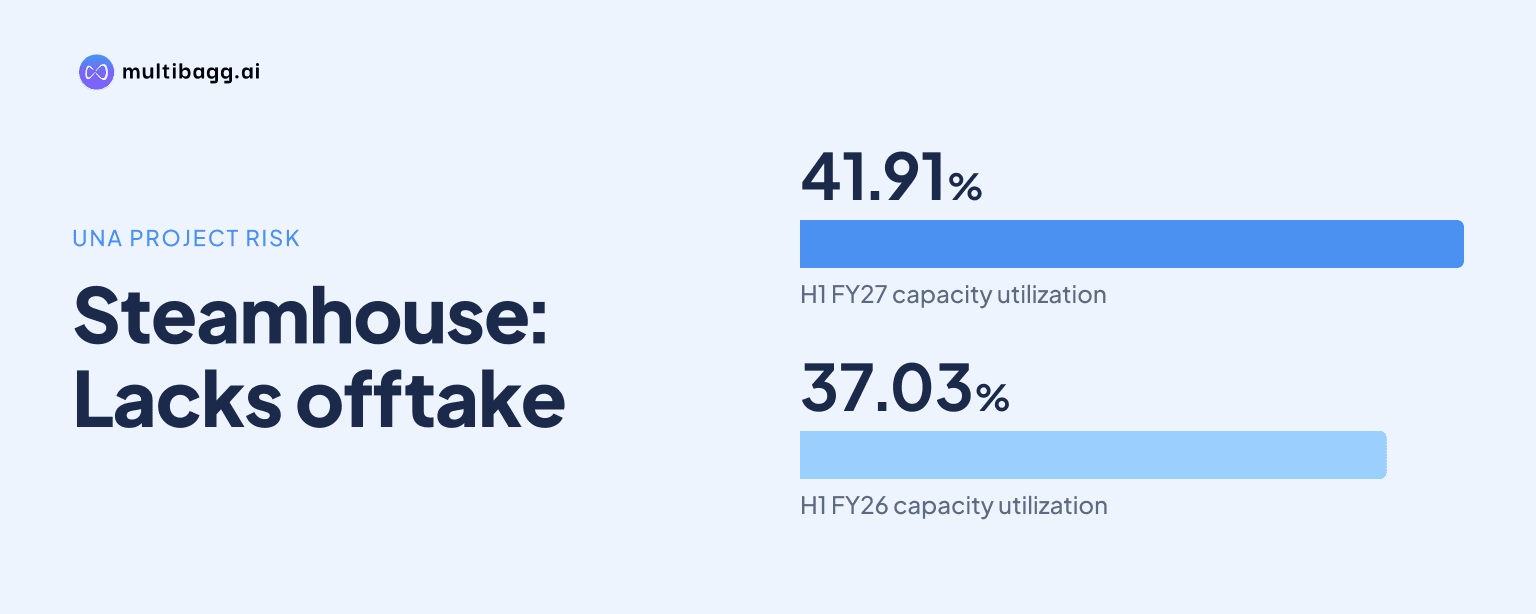
- Steamhouse’s H1 FY27 capacity utilization was 41.91%, versus 37.03% in H1 FY26.
powered by IRIS
Steamhouse India Limited has a Rs 311 crore engineering, procurement and construction mandate for a 300-tonnes-per-hour community boiler in Una, but management said on October 30, 2026 that no government commitment exists on steam offtake volumes. The project is asset-light because Himachal Pradesh Bulk Drug Park Infrastructure Limited will fund its cost.
Know Steamhouse India inside out
Results, valuation, peers and who's buying, in one view.
What is Steamhouse building at Una?
Steamhouse is building a 300-tonnes-per-hour community boiler facility at the Bulk Drug Park in Una, Himachal Pradesh, under an engineering, procurement and construction, or EPC, mandate of approximately Rs 311 crore inclusive of goods and services tax. The community-boiler model centrally generates steam and distributes it to several industrial users through a common pipeline network, rather than requiring each user to install a separate boiler.
Steamhouse will also have long-term operations and maintenance responsibilities after construction. Himachal Pradesh Bulk Drug Park Infrastructure Limited will fund the project cost, management said, so the asset will not require the same capital investment from Steamhouse as its owned steam-generation projects. Management described Una as an opportunity to execute and operate centralized steam infrastructure outside Steamhouse’s established Gujarat markets.
The transcript did not disclose a construction completion date, commissioning date, customer name or contracted steam-sales volume for Una. That leaves the Rs 311 crore EPC mandate distinct from a disclosed operating-volume opportunity. Management’s stated immediate priority is to meet project milestones responsibly and establish an operating record at the 300-tonnes-per-hour facility.
Does Steamhouse have committed steam offtake at Una?
No, Steamhouse said there is no government commitment on the quantum of steam offtake at Una. Chief Financial Officer Vaibhav Gattani said demand will depend on industries setting up facilities in the Una Bulk Drug Park. The disclosed EPC mandate therefore does not establish the eventual plant throughput or the speed at which customers will consume steam.
Management said Himachal Pradesh intends to pitch Una to pharmaceutical companies in Baddi and that officials expect planned incentives to generate interest. This is a stated tenant-development plan, rather than a disclosed customer contract. Steamhouse did not identify an Una tenant, contracted capacity or signed end-customer steam agreement during the October 30 call.
The difference from Jhagadia is clear. Steamhouse said approximately 14.8 tonnes per hour had been contracted at Jhagadia before commissioning, against planned capacity of 30 tonnes per hour. At Una, management disclosed a larger 300-tonnes-per-hour facility but no comparable contracted-capacity figure, so eventual utilization remains dependent on the industrial park’s tenant uptake.
How will Una’s asset-light structure affect Steamhouse’s economics?
Steamhouse said Una’s margin profile will not exactly match its current business because it is not investing in the underlying asset. Chairman and Managing Director Vishal S. Budhia said the final agreement on the pricing mechanism and markup due to Steamhouse was still under negotiation. He also said the cost of steam would be an important determinant of returns.
Management said the government’s intention is to provide reasonably priced steam to industries in the park, while Steamhouse will be mainly an operating partner after construction. Mr. Budhia said profit before tax could potentially be in line with Steamhouse’s current model because the company would not record depreciation on the government-funded asset. That was a management view, not a forecast of profit before tax, earnings before interest, tax, depreciation and amortisation, or EBITDA, per tonne.
For context, management said its coal-fired projects generate EBITDA of between Rs 800 and Rs 1,000 per tonne. It said waste-to-steam projects have materially different economics because waste replaces much of the coal cost. Steamhouse did not disclose Una’s fuel source, coal logistics, customer tariff, revenue share or EBITDA target, so its H1 FY27 EBITDA of Rs 916 per tonne cannot be treated as a forecast for Una.
Got a follow-up? Ask IRIS
Why does customer utilization matter to Steamhouse?
Customer utilization matters because management said higher steam volumes spread fixed infrastructure and operating costs over more tonnes. Steamhouse’s H1 FY27 capacity utilization was 41.91%, up from 37.03% in H1 FY26, while steam sales increased 14.35% to 6.07 lakh tonnes from 5.31 lakh tonnes. Those figures relate to the existing operating network, not to Una.
The financial outcome also improved faster than revenue in the first half. H1 FY27 revenue from operations rose 7.63% to Rs 256.62 crore, while EBITDA increased 65.72% to Rs 55.62 crore and profit after tax rose 99.56% to Rs 26.11 crore. Management attributed the improvement to higher volumes, better utilization and operating efficiencies, which shows why the timing of Una customer additions will matter to its eventual operating contribution.
Q2 FY27 also illustrates the effect of operating conditions on the existing network. Steam sales were 3.02 lakh tonnes, up 12.06% year on year but down 1.36% sequentially amid monsoon conditions and a temporary shutdown at a steam-procurement facility. Q2 EBITDA was Rs 24.68 crore, above Rs 14.24 crore a year earlier but below Rs 30.93 crore in Q1 FY27.
How does Una compare with Steamhouse’s wider expansion pipeline?
Una has less disclosed demand visibility than several projects in Steamhouse’s wider expansion pipeline. Management said three under-construction waste-based facilities had signed contracts with end consumers, and Jhagadia had 14.8 tonnes per hour contracted before its planned commissioning. Una, by comparison, has an EPC and operating mandate but no disclosed offtake agreement.
Steamhouse said it plans to commission Jhagadia with 30 tonnes per hour of capacity and expects facilities coming online through FY27 to support volume growth. Management is targeting more than 25% volume growth in FY27 from FY26 steam sales of 10.66 lakh tonnes, or about 13.25 lakh tonnes. It said volume growth in the following financial year should be above 35% as facilities contribute for a full year and newer customers take steam over the full period.
Management did not separately quantify Una’s contribution to either the FY27 target or its following-year expectation. Its broader approach, as stated on the call, is to add capacity where it sees credible demand and increase utilization progressively. At Una, the disclosed sequence is different: the government-funded plant is being developed while industrial customer adoption remains to be established.
Conclusion
Steamhouse has secured a Rs 311 crore route into Himachal Pradesh’s centralized steam market without funding the project asset itself. However, the economic and operating outcome cannot yet be quantified because no steam offtake commitment has been disclosed, customer demand depends on future park tenants, and the final pricing and markup mechanism remains under negotiation.
The next disclosures to watch are a construction or commissioning schedule, final pricing terms and evidence of customer contracting at Una. Management’s plan is to execute the EPC project and operate the facility over the long term, while its stated FY27 network target is approximately 13.25 lakh tonnes of steam sales.