










Steamhouse H1 EBITDA margin rises 759 basis points year on year
Key highlights
- Steamhouse's H1 FY27 EBITDA margin rose to 21.67% from 14.08%, an increase of 759 basis points.
- H1 FY27 steam sales increased 14.35% year on year to 6,07,459 tons.
- H1 FY27 EBITDA per ton increased 44.93% year on year to approximately Rs 916.
- Q2 FY27 EBITDA was Rs 24.68 crore, below Rs 30.93 crore in Q1 FY27 but above Rs 14.24 crore in Q2 FY26.
powered by IRIS
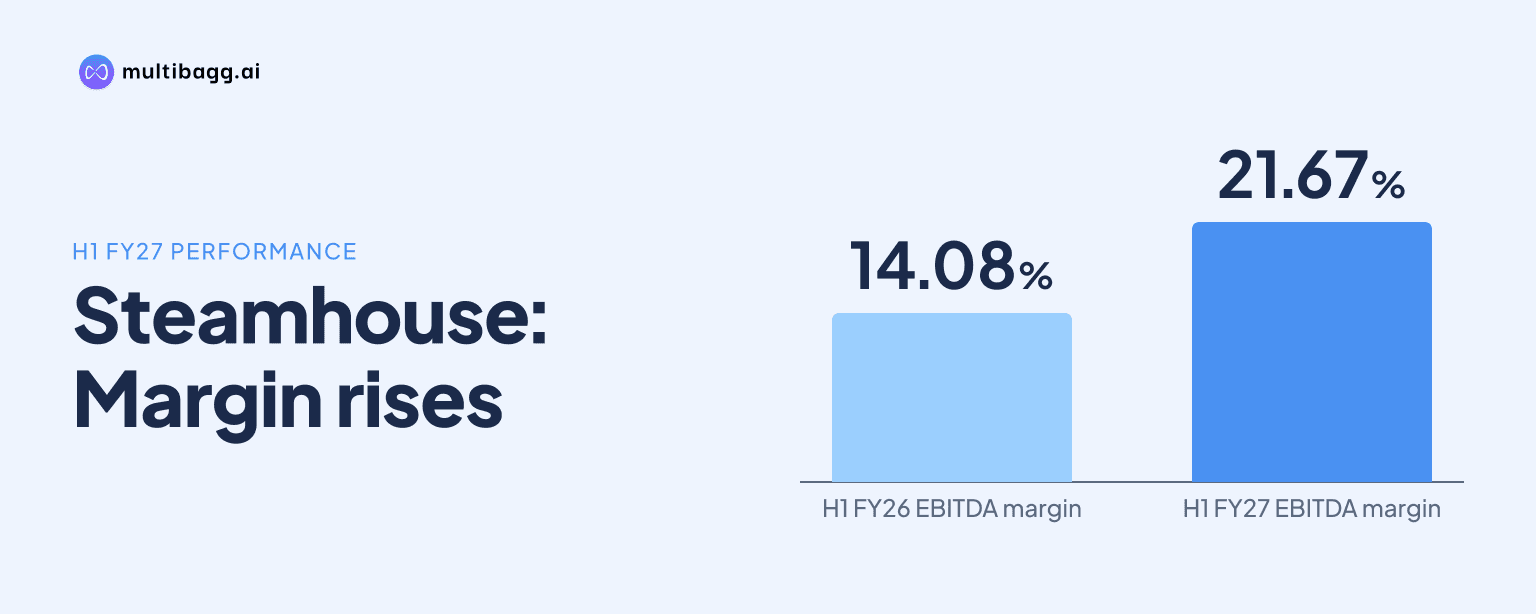
Steamhouse India Limited increased its H1 FY27 EBITDA margin by 759 basis points year on year to 21.67%, with EBITDA per ton rising 44.93% to Rs 916 as steam sales reached 6,07,459 tons. EBITDA grew 65.72% to Rs 55.62 crore, faster than the 7.63% increase in revenue from operations.
Know Steamhouse India inside out
Results, valuation, peers and who's buying, in one view.
Why did Steamhouse's H1 EBITDA margin rise?
Steamhouse's H1 EBITDA margin rose because higher steam volumes, improved capacity utilisation and operating efficiencies lifted earnings faster than revenue. Earnings before interest, tax, depreciation and amortisation, or EBITDA, increased 65.72% year on year to Rs 55.62 crore in H1 FY27, while revenue from operations increased 7.63% to Rs 256.62 crore.
Capacity utilisation reached 41.91% in H1 FY27, compared with 37.03% in H1 FY26, a rise of 4.88 percentage points. Management said that higher volumes across existing facilities spread fixed infrastructure and operating costs over more steam sales. Steam sales increased by 76,219 tons from 5,31,240 tons in H1 FY26 to 6,07,459 tons in H1 FY27.
Profit after tax, or PAT, rose 99.56% to Rs 26.11 crore in H1 FY27, and PAT margin increased to 10.18% from 5.49% a year earlier. Clean EBITDA, a company-reported measure, increased 71.13% to Rs 51.72 crore from Rs 30.22 crore. The reported 759-basis-point EBITDA-margin increase reflects the move from 14.08% in H1 FY26 to 21.67% in H1 FY27.
How did Steamhouse's Q2 performance compare with Q1?
Steamhouse's Q2 FY27 profitability declined from Q1 FY27 despite improving substantially from Q2 FY26, as monsoon-related conditions and operating-cost movements affected the sequential result. Q2 EBITDA was Rs 24.68 crore, down from Rs 30.93 crore in Q1 FY27, while PAT declined from Rs 18.34 crore to Rs 7.77 crore.
The quarter remained ahead of the prior-year period on key measures. Revenue from operations rose 2.4% year on year to Rs 128 crore, EBITDA increased 73.38% from Rs 14.24 crore to Rs 24.68 crore, and EBITDA margin rose to 19.28% from 11.39%. Q2 PAT increased 167.14% from Rs 2.91 crore in Q2 FY26, while PAT margin reached 6.07% compared with 2.33% a year earlier.
Q2 steam sales were 3,01,642 tons, up 12.06% year on year but approximately 1.36% below Q1 FY27. Management attributed the sequential decline partly to lower industrial demand during the monsoon and partly to scheduled maintenance that shut one facility supplying purchased steam for several days. The facility resumed operations after maintenance, according to management.
Got a follow-up? Ask IRIS
What drove Steamhouse's higher earnings per ton?
Steamhouse's H1 EBITDA per ton increased because utilisation, steam volumes and operating efficiencies improved across its network. EBITDA per ton rose 44.93% year on year to approximately Rs 916 in H1 FY27 from Rs 632 in H1 FY26. Management identified fuel utilisation, cost management and performance at individual facilities as continuing operating priorities.
Q2 utilisation was 42.41%, compared with 35.28% in Q2 FY26 and 41.40% in Q1 FY27. This comparison shows that utilisation increased against both periods, while Q2 EBITDA still declined sequentially as monsoon-related operating challenges and cost movements affected the quarter. Management said it remained focused on improving the consistency of margins through efficiency and facility-level performance.
Approximately 99.48% of H1 FY27 revenue came from repeat customers, according to management. Steam supply agreements generally include mechanisms to pass through changes in coal prices, although the mechanism and timing vary by customer. In response to an analyst, management said the pass-through lag was about 15 days and cited a shift from credit purchases of coal to cash purchases as one factor affecting gross profit per ton.
What is Steamhouse targeting after H1 FY27?
Steamhouse is targeting FY27 steam-volume growth of 25% over FY26 and expects FY28 volume growth of more than 35%, according to management. Steamhouse sold 10.66 lakh tons of steam in FY26, and management said facilities due to go live by FY27-end should contribute for the following full financial year, alongside customers added during FY27.
The Jhagadia facility is progressing toward commissioning, with 14.8 tons per hour contracted against planned capacity of 30 tons per hour. Steamhouse is also progressing with Nandesari and Vapi expansions, while Tarapur and Pirana are under construction. Steam purchase and distribution operations at Dahej Special Economic Zone and Haldia are being planned.
At the end of H1 FY27, net debt to equity was 0.16 times, compared with 1.57 times in FY26, following the capital raise. Management reported return on capital employed of 12.97% and return on equity of 4.53%, neither annualised. It said future movement in those ratios would depend on project execution, customer ramp-up and operating performance.
Conclusion
Steamhouse's H1 FY27 result showed profitability expanding faster than revenue, supported by 14.35% growth in steam sales, a 4.88-percentage-point improvement in utilisation and a Rs 284 increase in EBITDA per ton. Q2 showed that seasonal demand, a temporary supply disruption and operating-cost movements can lower earnings sequentially even when year-on-year profitability and utilisation improve.
The next measures to watch are progress toward management's 25% FY27 volume-growth target, commissioning at Jhagadia and execution at Nandesari and Vapi. Management also expects facilities going live by FY27-end to support its expectation of more than 35% volume growth in FY28, while it said interest costs should fall from Q3 after IPO proceeds repaid part of the Rs 130 crore debt raised in the June quarter.