










Steamhouse targets 25% FY27 volume growth, over 35% in FY28
Key highlights
- Steamhouse targets FY27 steam sales of about 13.25 lakh tons, up 25% or more from 10.66 lakh tons in FY26.
- Steamhouse said FY28 steam-volume growth should be upwards of 35% as FY27 facilities contribute for a full year.
- Steamhouse sold 6.07 lakh tons in H1 FY27, up 14.35% year on year from 5.31 lakh tons.
- Steamhouse said it needs roughly 35% year-on-year volume growth in H2 FY27 to meet its full-year target.
powered by IRIS
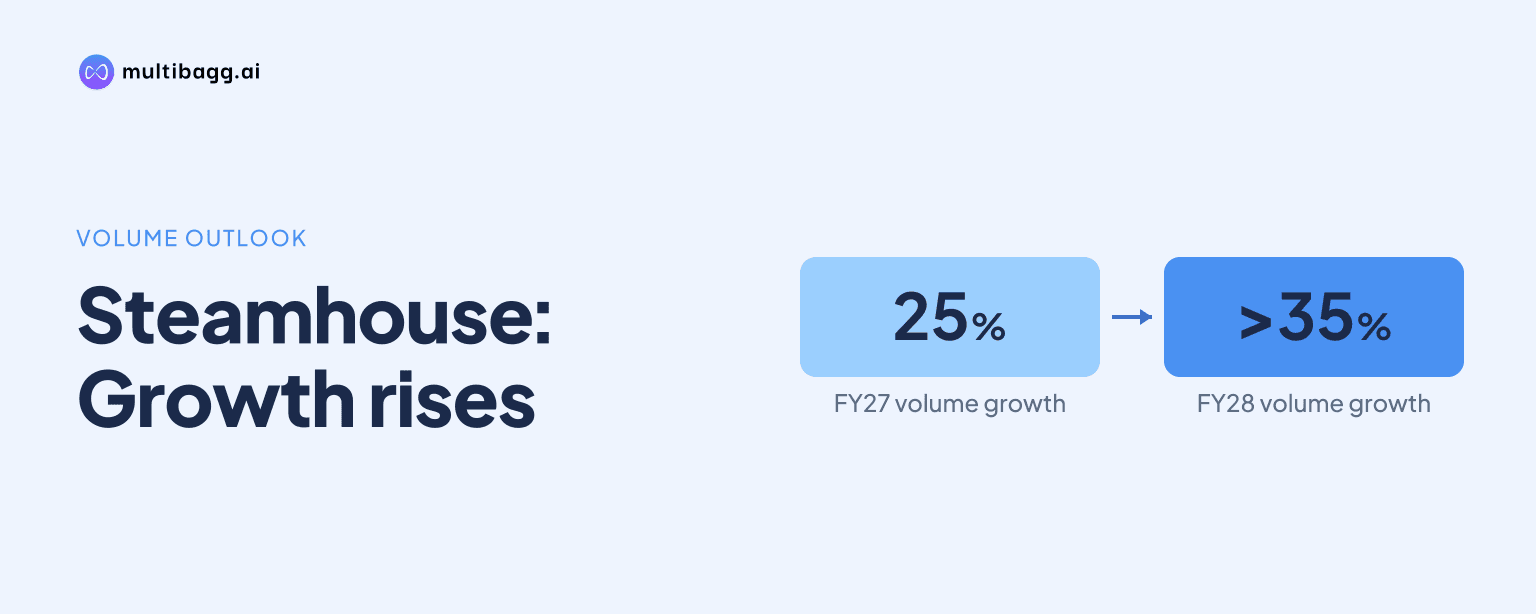
Steamhouse India Limited is targeting 25% steam-volume growth in FY27 from FY26 sales of 10.66 lakh tons, or about 13.25 lakh tons, while management said FY28 growth should exceed 35%. The FY27 target requires roughly 35% year-on-year growth in H2, supported by facility commissioning, customer additions and higher utilisation.
Know Steamhouse India inside out
Results, valuation, peers and who's buying, in one view.
What is Steamhouse’s FY27 and FY28 steam-volume target?
Steamhouse is targeting 25% or more steam-volume growth in FY27 against FY26 sales of 10.66 lakh tons. Management described the FY27 objective as about 13.25 lakh tons and said investors should assess progress through volumes and EBITDA per ton rather than revenue, because coal-price movements are generally passed through under customer agreements.
For FY28, Steamhouse said volume growth should be upwards of 35%. Management linked that outlook to facilities that are due to begin operating in FY27 contributing for a full year, as well as customers added during FY27 taking steam in the following year. This is management’s outlook, contingent on project execution, customer ramp-up and demand.
H1 FY27 steam sales rose 14.35% year on year to 6.07 lakh tons from 5.31 lakh tons in H1 FY26. Q2 FY27 sales were 3.02 lakh tons, up 12.06% from a year earlier but down about 1.36% sequentially, as monsoon conditions and scheduled maintenance at a steam-procurement facility affected supply and distribution volumes.
Why does Steamhouse need faster H2 FY27 growth?
Steamhouse needs about 35% year-on-year volume growth in H2 FY27 to achieve its full-year 25% target, according to management’s internal monthly planning. An analyst derived that implied second-half rate from H1 FY27 growth of 14.35%, and management confirmed the calculation. The required H2 increase is therefore higher than the rate reported in the first half.
Management expects the acceleration to come from new facilities, rising utilisation at existing locations and customer additions. Capacity utilisation was 41.91% in H1 FY27, compared with 37.03% in H1 FY26. Q2 FY27 utilisation reached 42.41%, versus 35.28% a year earlier and 41.40% in Q1 FY27.
Seasonality is also part of the H2 plan. Management said wet coal and higher transmission losses during the monsoon reduce steam-to-fuel conversion efficiency, while dry conditions in Q3 and Q4 should reduce those effects. Q2 FY27 EBITDA was Rs 24.68 crore, down sequentially from Rs 30.93 crore in Q1 FY27, despite Q2 steam volumes increasing 12.06% year on year.
Which facilities and customers could support Steamhouse’s target?
Steamhouse expected Jhagadia to begin selling steam in November, while other projects under commissioning were expected to add volumes during the financial year and calendar year. Management said three waste-to-steam facilities were under construction, including two expected in H2 FY27 and a third expected in the next calendar year. It said the three projects had contracts signed with end consumers.
The expansion pipeline also includes Nandesari, Vapi and Pirana, along with steam-trading opportunities at Dahej Special Economic Zone and Haldia, where pipelines were under construction. At Vapi, management said the new facility is 7 to 8 kilometres from its existing plant and lies across a highway, where obtaining pipeline permissions can take 1.5 to 2 years.
Existing sites are another stated growth source. Management said plants remain in ramp-up as customers expand or shift operations, highlighting Panoli, commissioned in the prior year, as a location with further potential. It also said agreements had been signed with customers at existing sites, supporting higher utilisation alongside new-facility volumes.
Got a follow-up? Ask IRIS
How could waste-to-steam affect Steamhouse’s operating results?
Steamhouse said waste-to-steam projects require capital expenditure of about 1.5 to 1.75 times that of comparable coal-fired projects, while operating expenditure is about 50% to 55% lower. Management attributed the operating-cost difference to waste replacing much of the coal cost and said stabilised projects could have payback periods of 2.5 to 3.5 years.
Management did not disclose a waste-to-steam EBITDA per ton figure, but said it was significantly above coal-fired operations. Coal-fired projects generate about Rs 800 to Rs 1,000 per ton, according to management, which expects the new waste-to-steam facilities to lift EBITDA per ton in the next full financial year after they are commissioned and ramped up.
Reported H1 FY27 EBITDA per ton was Rs 916, compared with Rs 632 in H1 FY26, an increase of 44.93%. Management attributed the year-on-year improvement partly to cash coal purchases replacing credit purchases and to utilisation at waste-to-steam facilities. It said coal costs are generally passed through, with a lag of about 15 days.
What could prevent Steamhouse from meeting its volume plan?
Steamhouse’s volume plan depends principally on commissioning, utilisation and customer offtake rather than coal-price-led revenue. Management said 4,200 gross calorific value coal cost about Rs 9,000 to Rs 10,000 per ton for most of the prior quarter, increased to about Rs 10,500 to Rs 11,000 per ton by end-September, and stood at about Rs 10,000 to Rs 10,500 per ton during the call.
The Himachal Pradesh project has unresolved commercial terms. Management said the exact pricing mechanism and markup remained under negotiation and that there was no government commitment on offtake volumes. Because the government would invest in the asset, Steamhouse said it does not expect the project to have the same EBITDA profile as its current operations, though profit before tax could be closer because depreciation would not be on its books.
Working-capital actions could also affect reported cash flow. Net debt to equity stood at 0.16 times at the end of H1 FY27, against 1.57 times in FY26, after the IPO. Management said it used IPO proceeds to repay creditors early, bringing trade payables close to zero and securing cash discounts, while noting that this could keep FY27 operating cash flow negative because of the working-capital movement.
Conclusion
Steamhouse’s FY27 objective of about 13.25 lakh tons requires a substantial H2 increase after H1 FY27 sales grew 14.35% to 6.07 lakh tons. Its stated drivers combine rising use of existing facilities, signed customer arrangements and new project additions, while waste-to-steam facilities could alter operating costs once stabilised.
The next milestones are the planned H2 FY27 commissioning of two waste-to-steam facilities, Jhagadia’s expected November steam sales and the third facility planned for the next calendar year. Investors will also need to monitor whether H2 FY27 achieves the management-indicated roughly 35% volume growth and whether Himachal Pradesh pricing and offtake terms are finalised.