










SKF India (Industrial) Q2 FY27 Revenue Rises 28.3% to ₹1,043 Crore
Key highlights
- SKF India (Industrial) reported Q2 FY27 revenue of ₹1,042.86 crore, up 28.3% year-on-year.
- Q2 FY27 profit after tax rose 34.5% year-on-year to ₹103.48 crore.
- PBT margin improved to 12.9% in Q2 FY27 from 9.0% in Q1 FY27.
- H1 FY27 revenue reached ₹2,013.63 crore, compared with ₹1,633.69 crore a year earlier.
powered by IRIS
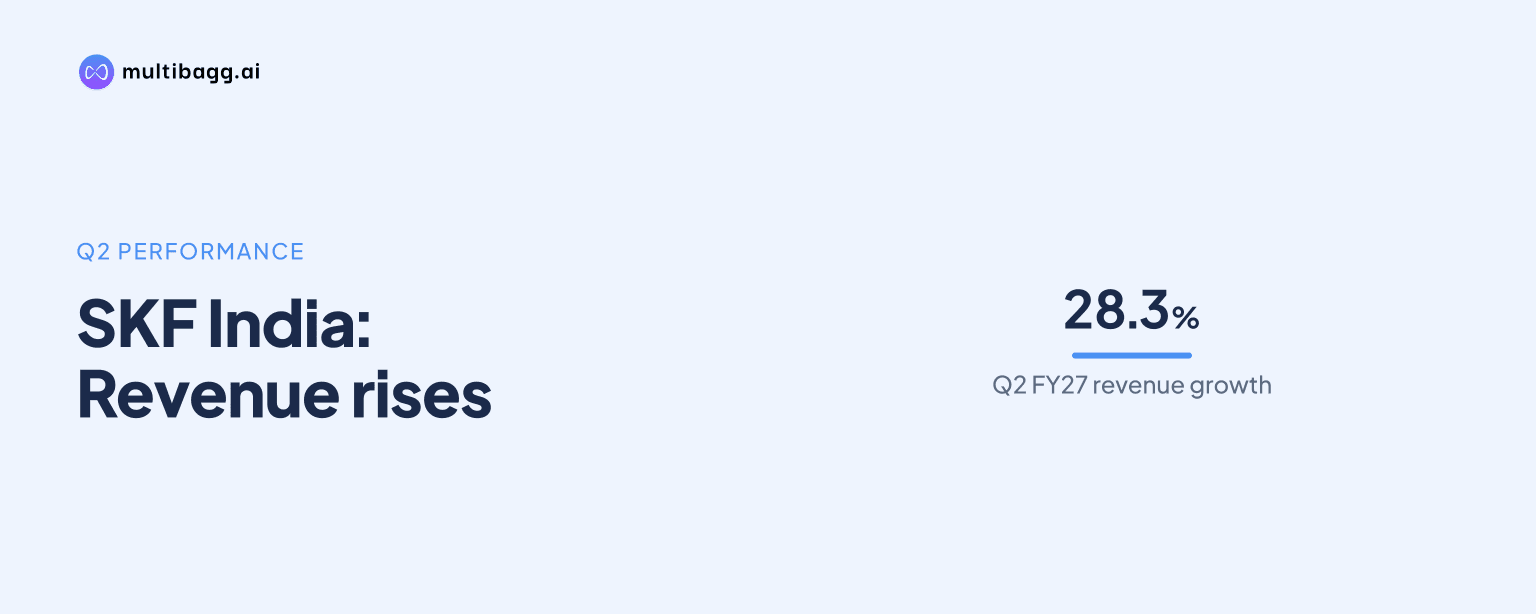
SKF India (Industrial) Limited reported revenue from operations of ₹1,042.86 crore in Q2 FY27, up 28.3% year-on-year, while profit after tax rose 34.5% to ₹103.48 crore for the quarter ended September 30, 2026. The results point to demand traction in heavy industries, wind, aftermarket and exports.
Know SKF India (Industrial) inside out
Results, valuation, peers and who's buying, in one view.
What did SKF India (Industrial) report for Q2 FY27?
SKF India (Industrial) reported higher revenue and profitability in the September quarter, with revenue from operations rising to ₹1,042.86 crore from ₹813.06 crore a year earlier. Profit before tax increased 32.6% year-on-year to ₹134.37 crore, while profit after tax rose from ₹76.93 crore to ₹103.48 crore.
The company also posted a sequential improvement from Q1 FY27. Revenue was 7.4% above the preceding quarter's ₹970.77 crore, and profit before tax was 54.6% higher than ₹86.92 crore in Q1. Profit after tax increased 67.1% quarter-on-quarter from ₹61.92 crore.
PBT margin improved to 12.9% from 12.5% in Q2 FY26 and 9.0% in Q1 FY27. PAT margin stood at 9.9%, compared with 9.5% a year ago and 6.4% in the preceding quarter. The company said the quarterly performance reflected industrial demand and operational efficiency.
Which businesses supported SKF India (Industrial)'s quarter?
SKF India (Industrial) identified continued demand traction across heavy industries, wind, aftermarket and exports as the main operating supports during Q2 FY27. These segments were specifically cited in the company's November 4 results release for the quarter ended September 30.
In an earnings discussion reported alongside the results, Chief Financial Officer Ashish Sarawad referred to contributions from wind, heavy industries, distribution, exports and sales to the company's sister business. He said growth excluding that contribution was around 17%, according to the discussion.
The same discussion highlighted agriculture, general machinery, pumps and motors among the demand areas being monitored for the second half of FY27. No specific revenue guidance was provided. The company described its objective as outpacing GDP growth and inflation, without setting a quantified target.
How did the first half of FY27 compare with last year?
SKF India (Industrial)'s first-half revenue from operations rose to ₹2,013.63 crore in H1 FY27 from ₹1,633.69 crore in H1 FY26. Profit after tax for the half was ₹165.40 crore, broadly unchanged from ₹164.82 crore in the comparable previous-year period.
The difference between strong revenue growth and nearly flat first-half profit is relevant when reviewing the period. The company reported H1 profit before exceptional items and tax of ₹221.29 crore, versus ₹230.49 crore a year earlier. Exceptional items were nil in H1 FY27, while H1 FY26 included exceptional items of ₹16.02 crore.
The statutory auditors issued an unmodified limited-review conclusion on the Q2 and H1 financial results. The results were approved by the board on November 4, 2026, and the company released the related press statement under Regulation 30 of the SEBI Listing Obligations and Disclosure Requirements Regulations.
Got a follow-up? Ask IRIS
What are the market and cost factors investors should track?
SKF India (Industrial)'s Q2 figures show that margins improved both year-on-year and sequentially, despite the company operating in industrial markets where input and imported-product costs can affect profitability. The 393-basis-point sequential gain in PBT margin and 354-basis-point gain in PAT margin were material contributors to the quarter's profit growth.
Management also flagged rising oil and steel costs and rupee depreciation as risks in the earnings discussion. Higher prices for these inputs, as well as a weaker rupee that raises imported-product costs, can influence the cost base. The company did not quantify the potential financial effect of these factors.
For investors, the disclosed results provide evidence of stronger September-quarter execution, particularly in revenue, profit and margins. However, the company has not issued numerical guidance for the second half. Demand in wind, heavy industries, aftermarket and export channels, along with input-cost and currency movements, therefore remain the disclosed factors relevant to assessing subsequent performance.
When was the earnings call held and where is the material available?
SKF India (Industrial) held its Q2 FY27 earnings call on November 5, 2026, at 10:00 am IST, following the announcement of results on November 4. The company subsequently submitted the audio recording link of the investor call under Regulation 30.
The Q2 earnings-call presentation was also submitted in connection with the scheduled investor meeting. SKF India (Industrial) has stated that quarterly earnings results, presentations and related financial documents are available through the Resources and investor-relations sections of its website.
The company is listed as SKFINDUS on the National Stock Exchange and as 544572 on the BSE. The formal disclosures and the earnings-call material give investors access to the released financial data and management's discussion of operating conditions.
Conclusion
SKF India (Industrial)'s Q2 FY27 performance was led by 28.3% year-on-year revenue growth to ₹1,042.86 crore, accompanied by a 34.5% rise in profit after tax to ₹103.48 crore. Higher PBT and PAT margins, as well as sequential improvement over Q1, underscore the strength of the reported quarter.
The next areas to watch are demand across the industrial, wind, aftermarket and export businesses, along with oil and steel prices and rupee movement, which management identified as cost risks. The company has not provided specific second-half guidance, leaving future disclosures and earnings-call updates as the key reference points.