










SKF Q2 revenue rose 28.3% while operating cash flow turned negative
Key highlights
- SKF’s Q2 FY 26-27 revenue rose 28.3% year on year to Rs 1,042.9 crore.
- SKF’s Q2 operating cash flow moved to negative Rs 6.1 crore from positive Rs 217.5 crore a year earlier.
- SKF’s Q2 PBT margin increased 42 bps to 12.9%, while PBT rose 32.6% to Rs 134.4 crore.
- SKF commissioned an Ahmedabad bearing line with annual capacity of about 220,000 units.
powered by IRIS
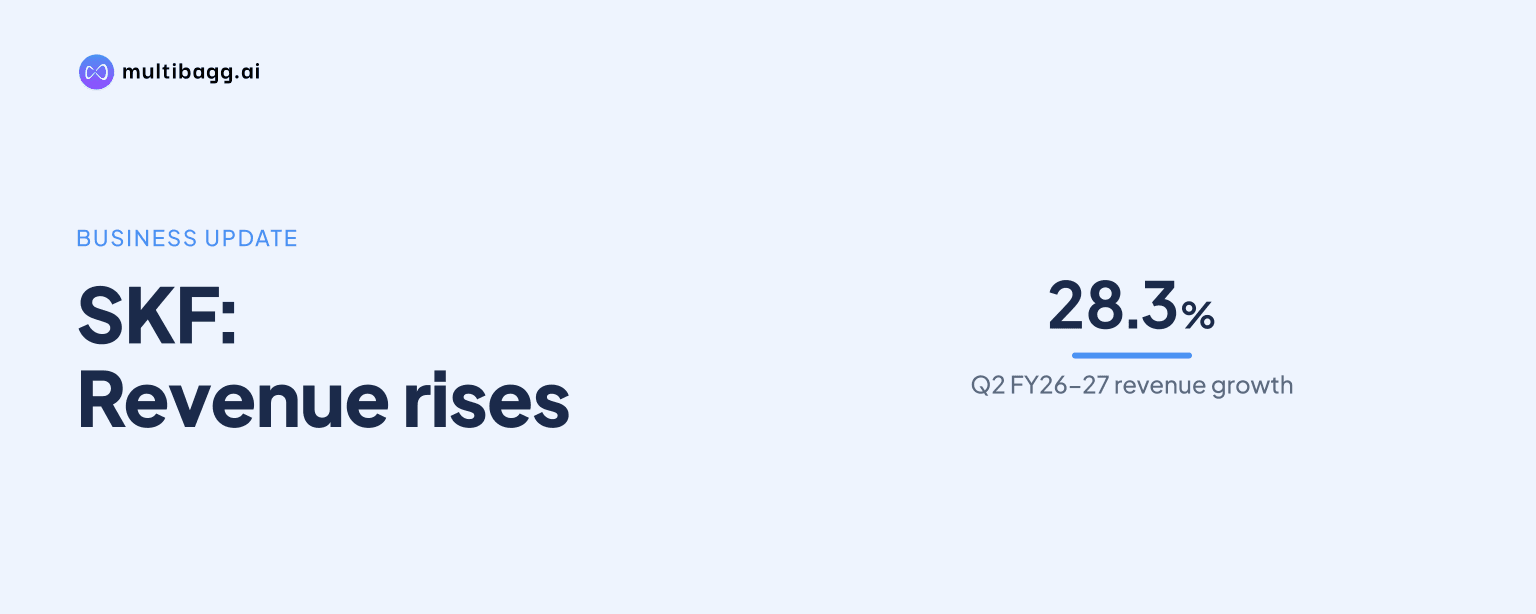
SKF India Industrial reported Q2 FY 26-27 revenue of Rs 1,042.9 crore, up 28.3% year on year, while operating cash flow turned to negative Rs 6.1 crore from positive Rs 217.5 crore after settlement of inter-company payables. Profit before tax rose 32.6% to Rs 134.4 crore and the margin reached 12.9%.
Know SKF India (Industrial) inside out
Results, valuation, peers and who's buying, in one view.
How fast did SKF’s Q2 revenue grow?
SKF’s Q2 FY 26-27 revenue grew 28.3% year on year to Rs 1,042.9 crore from Rs 813.1 crore in Q2 FY 25-26. Management attributed the top-line increase to wind, heavy industry, exports and distribution, identifying those areas as the contributors to quarterly growth.
Profit before tax, or PBT, rose 32.6% to Rs 134.4 crore from Rs 101.4 crore, exceeding the 28.3% revenue-growth rate. The presentation states that PBT is reported after exceptional items, meaning the comparison includes exceptional items in both Q2 FY 26-27 and Q2 FY 25-26.
Net working capital increased 25.8% to Rs 723.1 crore from Rs 574.7 crore, a slower rate than revenue growth. As a proportion of revenue, net working capital was 18.9%, compared with 18.8% a year earlier, an increase of 9 basis points, or bps.
Why did SKF’s PBT margin improve in Q2?
SKF’s PBT margin improved by 42 bps to 12.9% in Q2 FY 26-27 from 12.5% in Q2 FY 25-26. Management attributed the improvement to lower one-off demerger expenses and improved price realisation, partly offset by higher costs.
The 12.9% margin generated Rs 134.4 crore of PBT on Q2 revenue of Rs 1,042.9 crore. In the prior-year quarter, the 12.5% margin generated Rs 101.4 crore of PBT on revenue of Rs 813.1 crore, producing a Rs 33 crore increase in reported PBT.
The presentation separates lower demerger costs from improved price realisation, while also noting higher costs as an offset. It does not quantify how much each factor contributed to the 42-bps margin increase, nor does it provide a product-level or customer-level margin breakdown for Q2 FY 26-27.
Why was SKF’s operating cash flow negative?
SKF reported negative operating cash flow of Rs 6.1 crore in Q2 FY 26-27 because of settlement of inter-company payables. This was a reversal from positive operating cash flow of Rs 217.5 crore in Q2 FY 25-26, for which the presentation marks the percentage comparison as not meaningful.
Cash conversion was negative 4.5% in Q2 FY 26-27, compared with quarterly PBT of Rs 134.4 crore. The result shows that the 32.6% increase in PBT did not translate into positive operating cash generation during the quarter because of the payable settlement identified by management.
The working-capital figures give context but do not provide a full cash-flow reconciliation. Net working capital was Rs 723.1 crore, or 18.9% of revenue, against Rs 574.7 crore, or 18.8%, a year earlier; SKF separately identifies inter-company payable settlements as the reason for the negative cash-flow result.
Got a follow-up? Ask IRIS
How did SKF’s customer and segment mix change?
SKF’s original equipment manufacturer, or OEM, share declined to 51% in Q2 FY 26-27 from 54% in Q1 FY 26-27, while the category labelled Exports & SKF India (Auto) rose to 16% from 12%. Distribution declined by 1 percentage point to 33% from 34%, making exports and SKF India (Auto) the largest disclosed quarter-on-quarter movement.
GM was SKF’s largest Q2 FY 26-27 segment at 26% of the mix. Rail accounted for 17%, wind and heavy industries each accounted for 16%, agri and electrical represented 14%, and metals made up 11%; together, the six categories total 100%.
SKF disclosed a Rs 15 crore railways contract with a large private player for a complete drive system. In heavy industries, it secured the full bearing-supply scope for a steel project that management says enables more than Rs 5 crore in customer savings, although the presentation does not state the value of SKF’s supply contract.
What is SKF’s manufacturing and investment plan through 2030?
SKF disclosed an investment plan of Rs 800 crore to Rs 950 crore through 2030 for manufacturing expansion and capability building. Management said localisation is progressing and its Pune setup is underway, describing the plan within SKF’s first year as a focused industrial business after demerger.
At Ahmedabad, SKF commissioned a new medium cylindrical roller bearing, or mCRB, manufacturing line with annual capacity of about 220,000 units. The line is intended to support growth in gearboxes, motors, railways, agriculture and aftermarket, with automation and flexible manufacturing designed to improve productivity and responsiveness.
For H1 FY 2026-27, SKF reported Rs 2,014 crore of revenue from operations, an 11.0% PBT margin and 19.5% cash conversion. The H1 cash-conversion figure differs from the negative 4.5% recorded in Q2, but the presentation does not provide a quarterly reconciliation between the two measures.
Conclusion
SKF’s Q2 FY 26-27 results combined Rs 1,042.9 crore of revenue, 28.3% growth and a 42-bps PBT-margin increase with negative Rs 6.1 crore of operating cash flow. Management attributed the cash-flow reversal to inter-company payable settlements, while net working capital remained broadly stable relative to revenue at 18.9% versus 18.8% a year earlier.
The next disclosed execution points are SKF’s Rs 800 crore to Rs 950 crore investment programme through 2030, the Pune setup and continuing localisation work. The Ahmedabad mCRB line’s annual capacity of about 220,000 units, alongside the Rs 15 crore railways contract and the heavy-industry steel-project win, are the operating developments to watch under that plan.