










Exicom seeks Tritium sale while retaining manufacturing rights
Key highlights
- Tritium's order backlog reached US$23 million at September 2026, up from US$13 million in January.
- Tritium recorded US$14.7 million of bookings and US$10.1 million of revenue in Q2 FY27.
- Exicom targets a 100% Tritium sale by the end of 2026, about 60 days after countersignature.
- Exicom says Tritium needs about 12 more months of capital before its Q1 FY28 EBITDA-positive target.
powered by IRIS
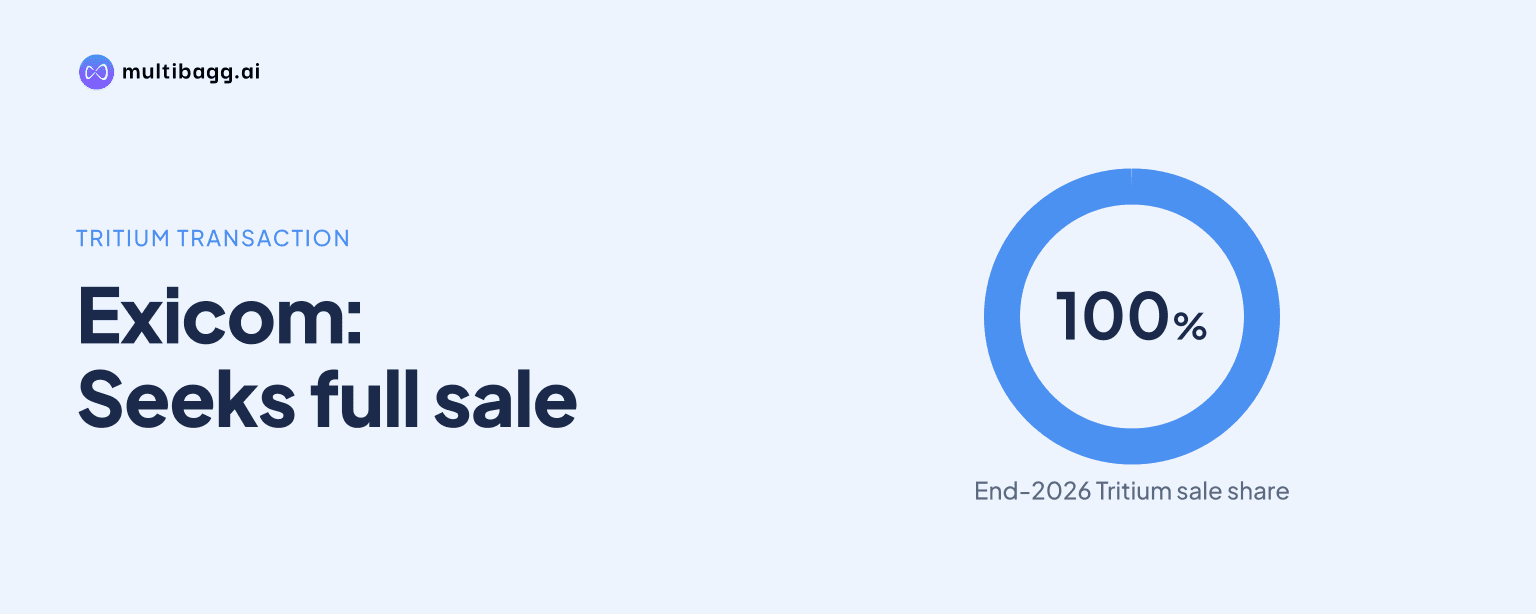
Exicom proposes selling 100% of Tritium despite its US$23 million order backlog at September 2026 because management says the business needs about 12 more months of capital before its targeted EBITDA-positive quarter of Q1 FY28. Exicom would retain Gen 2 module manufacturing work and a regional TRI-FLEX licence under the proposed transaction.
Know Exicom Tele-Systems inside out
Results, valuation, peers and who's buying, in one view.
Why is Exicom selling Tritium despite higher bookings?
Exicom is pursuing a full sale because Tritium requires further working-capital and engineering investment before management's Q1 FY28 EBITDA-positive target. The presentation says that funding the business alone would leave 100% of the risk with Exicom, while ramp-up losses would continue to consolidate into Exicom's profit and loss account.
Demand indicators improved during the last two reported quarters, but the presentation says working capital, rather than demand, constrained revenue. Bookings rose from US$9.3 million in Q3 FY26 and US$10.1 million in Q4 FY26 to US$17.0 million in Q1 FY27, before easing to US$14.7 million in Q2 FY27 as the largest customer accelerated purchasing and deployment timelines.
Exicom considered funding Tritium independently, raising minority capital or securing co-investment, and selling the company to a well-capitalised sponsor. The proposed full sale is therefore a strategic choice to transfer the capital requirement and execution risk, rather than an indication that the reported US$23 million September 2026 backlog lacks commercial relevance.
How did Tritium bookings and revenue change through Q2 FY27?
Tritium's Q2 FY27 bookings were US$14.7 million, down from US$17.0 million in Q1 FY27 but above the US$9.3 million recorded in Q3 FY26. Revenue was US$10.1 million in Q2 FY27, compared with US$10.4 million in Q1 FY27 and US$10.3 million in Q4 FY26.
The main change was the step-up in bookings in Q1 FY27 and Q2 FY27 relative to the preceding two quarters, while revenue remained near US$10 million for three consecutive quarters after Q3 FY26. Exicom also reports that Tritium's Q2 FY27 revenue grew 133% year on year and that Tritium accounted for 27% of consolidated revenue in H1 FY27.
The order backlog increased to US$23 million at September 2026 from US$13 million in January. The presentation separately lists US$31 million of revenue in nine months under its H1 FY27 commercial-traction summary, without reconciling that nine-month measure to the H1 FY27 label.
What will Exicom retain after the proposed Tritium sale?
Exicom says it will retain a manufacturing services agreement for Gen 2 power modules and a regional licence to sell TRI-FLEX electric-vehicle charging systems. These retained arrangements accompany the proposed 100% sale of the Tritium group rather than a complete separation from Tritium-related production and products.
Gen 2 alternating-current and direct-current modules are manufactured at Exicom's Hyderabad facility, according to the presentation. Exicom also says legacy-product production will continue, providing a stated manufacturing link after the proposed transfer of Tritium ownership.
The retained licence concerns TRI-FLEX systems in regions of interest to Exicom, although the presentation does not identify those regions or state the duration of the licence. The presentation similarly does not disclose the economics, volume commitments or term of the manufacturing services agreement.
Got a follow-up? Ask IRIS
Which product milestones underpin Tritium's planned ramp-up?
Tritium expects DC-FLEX, its fleet-focused charging platform, to enter mass production in April 2027, while GRID-FLEX is scheduled for mass production in July 2027. Procurement for DC-FLEX has begun, according to the presentation, before the April 2027 production target.
Exicom says Tritium is at advanced stages of receiving an approximately US$20 million GRID-FLEX order, with deliveries expected to begin in July 2027. The order is not described as awarded, and its timing remains linked to the planned GRID-FLEX production schedule and key-customer volumes.
The business has shifted from an electric-vehicle-charging focus to power infrastructure as well as charging. Tritium identifies Grid Edge as an addressable market of about 1.7 gigawatts by 2030, or about US$1 billion annually, and large-scale artificial intelligence as about 6.4 gigawatts, or about US$1.9 billion annually.
How is the proposed Tritium sale structured and timed?
Exicom proposes a 100% sale of the Tritium group on a cash-free, debt-free basis to an all-equity buyer with no financing condition. The target closing is the end of 2026, which the presentation describes as about 60 days after countersignature.
Management says the transaction would help Exicom become a net-cash company from its current net-debt position. The presentation does not disclose a purchase price, expected sale proceeds, the amount of net debt, or whether any closing conditions other than the stated buyer financing position remain outstanding.
The divestment is presented alongside an improving consolidated earnings comparison: consolidated EBITDA, or earnings before interest, tax, depreciation and amortisation, was Rs 1.8 crore in Q2 FY27 versus a loss of Rs 32.7 crore in Q2 FY26. Standalone EBITDA was Rs 25.6 crore in Q2 FY27, up from Rs 15.2 crore a year earlier, while Tritium's funding needs remained a disclosed risk.
Conclusion
Exicom's proposed sale separates ownership of Tritium from selected manufacturing and regional product rights. Tritium reported higher bookings, a US$23 million backlog and planned DC-FLEX and GRID-FLEX launches, but Exicom says further capital, continuing engineering investment and key-customer execution are needed before the Q1 FY28 EBITDA-positive target.
The next disclosed milestones are the targeted end-of-2026 closing, DC-FLEX mass production in April 2027, and GRID-FLEX mass production and proposed order deliveries from July 2027. Progress of the approximately US$20 million GRID-FLEX order, the buyer transaction and the retained manufacturing services agreement will determine whether the plan proceeds on the stated timeline.