










Exicom seeks vote on US$85 million Tritium business divestment
Key highlights
- Exicom signed a non-binding term sheet for an indicative US$85 million Tritium enterprise valuation.
- Exicom B.V. contributed Rs 204.3471 crore of revenue and a Rs 291.6284 crore net loss in the latest available consolidated figures.
- Tritium USA recorded FY 2025-26 standalone revenue of Rs 113.0812 crore and a net loss of Rs 252.5017 crore.
- The Board approved the proposed divestment and term sheet on November 4, 2026.
powered by IRIS
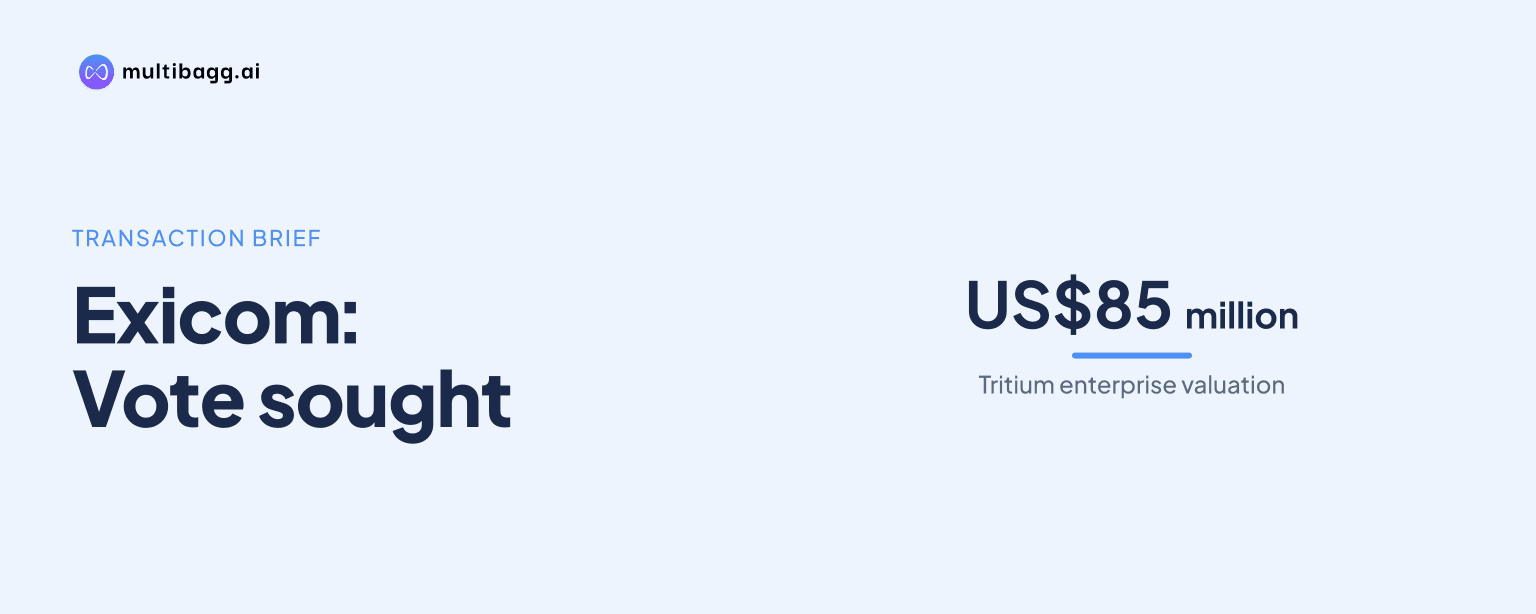
Exicom Tele-Systems Limited is seeking shareholder approval to divest its Tritium EV-charging business through two possible sale structures at an indicative enterprise value of US$85 million, after the business contributed Rs 291.6284 crore of the group’s Rs 274.1267 crore consolidated net loss in the latest available audited figures.
Know Exicom Tele-Systems inside out
Results, valuation, peers and who's buying, in one view.
What is Exicom proposing to sell?
Exicom is proposing to sell the Tritium electric-vehicle charging business either by transferring its entire holding in Exicom Power Solutions B.V. or by having that Dutch subsidiary sell all four operating subsidiaries. Exicom held 56,609,299 ordinary shares of EUR 1 each in Exicom B.V., equal to 90.29% of its issued and paid-up share capital, on the notice date.
The four entities covered are Tritium Power Solutions Inc. in the USA, Tritium NexGen Solutions B.V. in the Netherlands, Tritium Power Solutions Pty Ltd in Australia and Tritium Power Solutions Limited in the UK. The proposed perimeter includes Tritium-branded charging products, technology, intellectual property, software, assets, liabilities, contracts, customer relationships and goodwill used in the business.
Under the first alternative, Exicom would sell its Exicom B.V. stake and cease to control Exicom B.V. and the four Target Entities. Under the second, Exicom B.V. would sell its 100% stakes in the Target Entities, while Exicom would retain its 90.29% holding in Exicom B.V., subject to any conversion of optionally convertible debentures, or OCDs, and debt into equity.
FY 2025-26 standalone figures show Tritium USA generated the largest revenue among the four entities, at Rs 113.0812 crore, followed by Tritium NexGen at Rs 82.9966 crore. Tritium USA also recorded a Rs 252.5017 crore net loss, compared with Rs 21.0752 crore at Tritium UK, Rs 10.2487 crore at Tritium NexGen and Rs 1.2017 crore at Tritium Australia.
Why does Exicom need shareholder approval?
Exicom needs a special resolution because Exicom B.V. is a material subsidiary and either transaction structure would trigger shareholder-approval provisions under the Securities and Exchange Board of India, or SEBI, Listing Regulations and the Companies Act, 2013. The Board approved the proposed divestment and non-binding term sheet at its November 4, 2026 meeting.
If the first alternative is adopted, Exicom’s holding in Exicom B.V. would fall from 90.29% to nil and it would cease to control the material subsidiary. Regulation 24(5) requires prior shareholder approval where a listed company’s disposal of shares in a material subsidiary reduces its holding to 50% or below, or ends control.
The second structure also requires approval because investments in the Target Entities represent 94.3% of Exicom B.V.’s total standalone assets. Exicom B.V. reported total assets of Rs 854.7651 crore for FY 2025-26, while the carrying value of investments proposed for sale was Rs 805.8525 crore, above the 20% asset-disposal threshold under Regulation 24(6).
The vote must meet both the Companies Act special-resolution requirement and a separate public-shareholder test under Regulation 37A. The resolution can be acted on only when public shareholders voting in favour outnumber public shareholders voting against it; public shareholders that are parties to the disposal cannot vote.
What is the proposed price and who receives it?
The non-binding term sheet sets an indicative enterprise valuation of US$85 million for the Tritium Business on a cash-free and debt-free basis, but it does not set the final equity consideration payable to Exicom. The valuation remains subject to confirmatory due diligence, closing adjustments, transaction structure and definitive agreements.
Enterprise value is not equivalent to the amount Exicom would ultimately receive for its shares because external debt, inter-company loans including interest, escrow arrangements, indemnity claims and other adjustments may affect final consideration. Exicom says the final price will be determined at arm’s length and, where required, supported by an internationally accepted pricing methodology under the foreign-exchange framework.
In the first alternative, Exicom may receive consideration for its Exicom B.V. shares and settlement or repayment of inter-company loans. In the second alternative, consideration for the Target Entities would be received by Exicom B.V., rather than directly by Exicom, and any later amount to Exicom would depend on legally permitted repayment, settlement or other means.
Management says net proceeds actually received, after transaction costs, taxes and settlements, may be used to reduce external and inter-company debt raised for the Tritium investment, support existing businesses, fund working capital and pursue growth opportunities. Exicom has not disclosed a fixed allocation amount or transaction closing date.
Got a follow-up? Ask IRIS
How could the sale change Exicom’s reported financials?
On Exicom’s illustrative calculation, removing the Tritium contribution would change the latest available consolidated result from a Rs 274.1267 crore net loss to a Rs 17.5017 crore net profit under the first alternative. Under the second alternative, the illustrative result would be a Rs 50.07 lakh net profit because Exicom B.V. would remain a subsidiary after its operating units are sold.
Reported consolidated revenue before the transaction was Rs 1,151.7253 crore, of which Exicom B.V. contributed Rs 204.3471 crore. Both alternatives would therefore leave indicative consolidated revenue of Rs 947.3782 crore, while the business contribution to earnings before interest, tax, depreciation and amortisation, or EBITDA, was a Rs 169.6694 crore loss.
The first alternative would reduce illustrative consolidated net worth from Rs 651.2937 crore to Rs 482.4366 crore because Exicom B.V. would leave the group. Under the second alternative, the notice illustrates consolidated net worth of Rs 1,056.79 crore, reflecting Exicom B.V.’s continuing inclusion after the Target Entities cease to be step-down subsidiaries.
These are illustrative accounting positions rather than a forecast of final sale gains or losses. Exicom states that the actual effect, including any gain or loss on disposal, will be determined only when the transaction is completed and accounted for under applicable accounting standards and tax laws.
What conditions must Exicom satisfy before closing?
Exicom must complete due diligence, negotiate definitive transaction documents and obtain shareholder, corporate, regulatory and contractual approvals before either sale structure can close. As of the November 6, 2026 notice, a term sheet had been signed but no definitive transaction document had been executed.
The eventual documents are expected to cover shares transferred, payment mechanics, escrow, conditions precedent, warranties, indemnities, debt treatment, inter-company balances and transitional arrangements. The term sheet’s provisions on exclusivity, expense reimbursement, termination fees, confidentiality, announcements, governing law and disputes are binding to the extent specified, but the proposed divestment itself is not binding.
Approvals and compliance may be required under SEBI rules, the Companies Act, foreign-exchange rules, Overseas Investment Rules and Regulations, Dutch and other applicable foreign laws, and requirements of the designated authorised dealer bank. The prospective acquirer is not a related party of Exicom or its promoters, so the proposal is not described as a related-party transaction.
OCD or debt conversion at Exicom B.V. could occur separately and before closing, potentially diluting Exicom’s percentage holding. Nevertheless, under the first structure, Exicom would sell all equity shares it holds immediately before closing, whatever its percentage ownership at that point.
Conclusion
Exicom’s proposal seeks approval for an exit from the international Tritium operations through one of two structures built around an indicative US$85 million enterprise value. Its illustrative figures show the disposed business generated Rs 204.3471 crore of consolidated revenue but contributed a Rs 291.6284 crore net loss, exceeding the group’s reported Rs 274.1267 crore loss before the divestment.
The next items to watch are completion of confirmatory due diligence, the final choice between the two structures, treatment of debt and inter-company balances, and execution of definitive agreements. Exicom has said the final valuation, payment terms, transaction adjustments and accounting outcome remain unresolved and must return to the Board for further consideration and approval.