










Exicom Tele-Systems Revenue Rises 38%, Loss Narrows in Q2 FY27
Key highlights
- Exicom reported Q2 FY27 consolidated revenue of ₹388.35 crore, up 37.84% year on year.
- Consolidated EBITDA turned positive at about ₹1.8 crore, compared with a ₹32.7 crore loss in Q2 FY26.
- Exicom’s Q2 FY27 net loss narrowed to ₹56.78 crore from ₹68.81 crore a year earlier.
- The board approved a non-binding Tritium divestment term sheet at an indicative USD 85 million enterprise value.
powered by IRIS
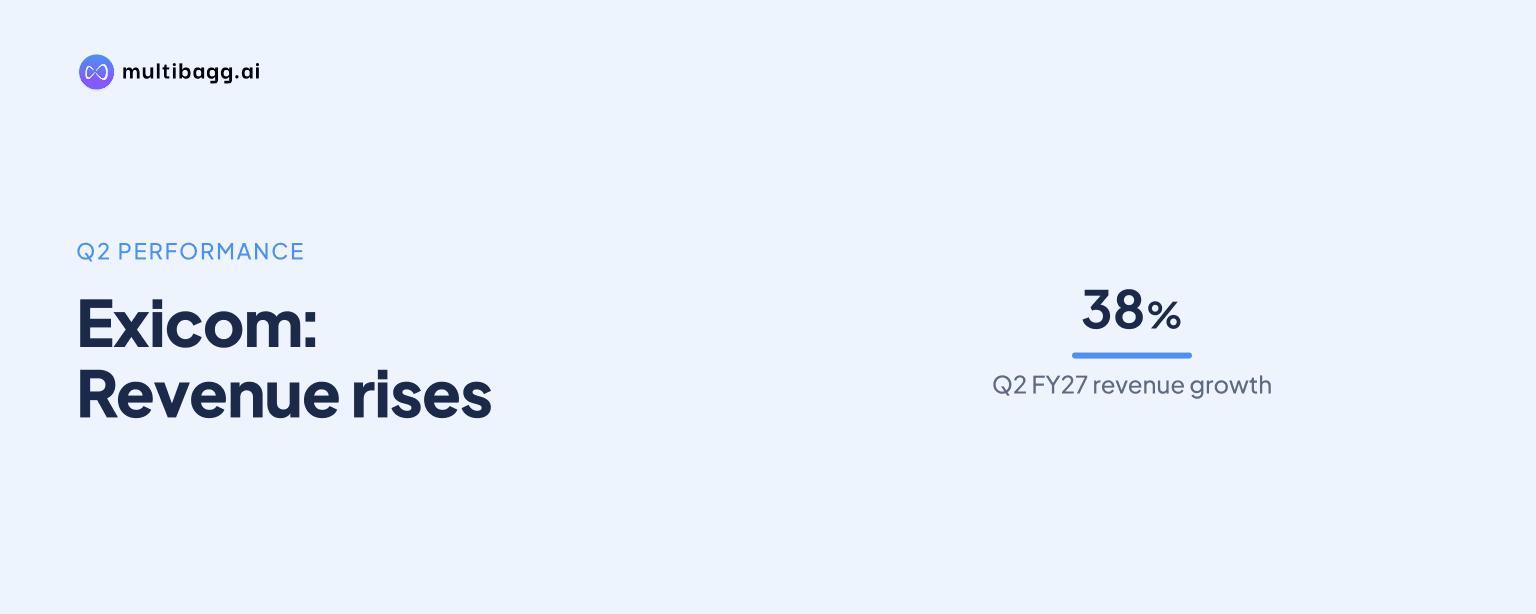
Exicom Tele-Systems Limited reported consolidated revenue of ₹388.35 crore for the quarter ended September 30, 2026, up 37.84% year on year, while its net loss narrowed to ₹56.78 crore from ₹68.81 crore. The results show stronger revenue and positive EBITDA, although the company remained loss-making at the net level.
Know Exicom Tele-Systems inside out
Results, valuation, peers and who's buying, in one view.
What did Exicom report for Q2 FY27?
Exicom reported Q2 FY27 consolidated revenue of ₹388.35 crore, compared with ₹331.07 crore in Q1 FY27 and ₹281.73 crore in Q2 FY26. This translates into quarter-on-quarter growth of 17.30% and year-on-year growth of 37.84%. The company announced the unaudited standalone and consolidated results on November 4, 2026, for the quarter and half year ended September 30, 2026.
Consolidated EBITDA turned positive at ₹1.8 crore, against an EBITDA loss of ₹21.9 crore in the preceding quarter and a loss of ₹32.7 crore a year earlier. Operating profit was reported at ₹1.18 crore in the quarterly-results summary, compared with an operating loss of ₹21.90 crore in Q1 FY27. The variation reflects differences in the presentation of reported operating-profit measures, while the company’s press release described consolidated EBITDA as approximately ₹1.8 crore.
The company still posted a consolidated net loss of ₹56.78 crore. However, this was narrower than the ₹73.58 crore loss in Q1 FY27 and the ₹68.81 crore loss reported for Q2 FY26. Profit before tax was a loss of ₹54.31 crore, compared with a ₹72.04 crore loss in the previous quarter.
Why did Exicom’s revenue grow while it remained loss-making?
Exicom’s revenue growth was supported by its India business, exports and the Tritium business, while net profitability remained negative despite the improvement in EBITDA. The company said its standalone India business generated revenue of about ₹277 crore, up 21.3% year on year from ₹228.4 crore and up from ₹236.8 crore in Q1 FY27.
Standalone EBITDA rose 69% year on year to ₹25.6 crore, from ₹15.2 crore in Q2 FY26. It was also higher than ₹20.9 crore in Q1 FY27. The company identified the standalone operation as its India engine and said it had benefited from portfolio expansion, access to new market segments, and operating and financial discipline.
Its electric-vehicle charging business crossed ₹100 crore of quarterly revenue for the first time, according to the company. Exicom said it produced 2.5 times more AC chargers and twice as many DC chargers during the quarter, alongside new customer wins across market segments. These operational details provide context for the growth in the domestic business, but they do not change the reported consolidated net loss.
The gap between positive EBITDA and a net loss is also visible in the reported financial line items. PBDT was a loss of ₹11.32 crore, while the company recorded a loss before tax of ₹54.31 crore. The results therefore indicate an improvement in operating performance, but continuing costs and charges below the EBITDA line kept the consolidated result in loss.
Got a follow-up? Ask IRIS
What is Exicom’s planned Tritium divestment?
Exicom’s board approved a strategic divestment process for the Tritium business, including a non-binding term sheet at an indicative enterprise value of USD 85 million. The company said the decision followed its capital-allocation assessment and its intention to pursue growth opportunities in its core Indian and export markets.
The divestment is not described as a completed transaction. The disclosed USD 85 million value is indicative, and the term sheet is non-binding. Investors will therefore need to distinguish between the board’s approval of the proposed process and the eventual completion terms, if any, of a sale.
Tritium was a material part of Exicom’s consolidated reporting and was cited alongside exports in explaining the consolidated revenue base. Exicom said Tritium’s revenue was expected to grow three times by FY27 to a triple-digit million-dollar level, with EBITDA breakeven targeted by Q4 FY27. This is a company target rather than a reported result for the September quarter.
The company also stated that consolidated EBITDA breakeven was expected within the next two quarters, while Tritium-level EBITDA breakeven was targeted by Q4 FY27. These targets frame the management outlook, but the reported Q2 figures show that Exicom’s consolidated EBITDA was only modestly positive and the net loss remained substantial.
How did the quarter affect Exicom’s operations and market context?
Exicom’s Q2 disclosure combined improving revenue and operating metrics with manufacturing consolidation and a proposed business divestment. The board approved the transition of manufacturing activities from the 75D facility in Sector 18, Gurugram, to existing facilities in Hyderabad and Solan. The announcement did not quantify the financial impact of this consolidation.
For shareholders, the quarter presented a mixed financial picture. Consolidated revenue increased by more than one-third year on year and EBITDA moved into positive territory, while the loss after tax declined by ₹12.03 crore from the prior-year quarter. At the same time, a ₹56.78 crore quarterly loss and the proposed exit from Tritium remain central considerations when assessing the consolidated business.
The available market snapshot dated November 8, 2026 showed Exicom shares at ₹138.82 on the NSE and ₹138.30 on the BSE. The supplied information does not provide a price movement for the result day or establish a direct link between the quarterly announcement and the share price. As a result, the market data should be read as a quoted reference rather than evidence of a results-driven reaction.
The broader industry relevance lies in Exicom’s domestic EV-charging scale-up. The company’s first ₹100 crore EV-revenue quarter signals higher activity in the segment, while its charger-production figures point to increased operating throughput. But the financial results also show that revenue expansion and positive EBITDA have not yet translated into consolidated profitability.
Conclusion
Exicom’s Q2 FY27 results showed a clear improvement in revenue and operating performance. Consolidated revenue rose to ₹388.35 crore, EBITDA turned positive at about ₹1.8 crore, and the net loss narrowed to ₹56.78 crore. The standalone India business contributed ₹277 crore of revenue and ₹25.6 crore of EBITDA, with EV revenue exceeding ₹100 crore for the first time.
The next developments to watch are progress on the non-binding Tritium divestment term sheet at an indicative USD 85 million enterprise value, the manufacturing transition to Hyderabad and Solan, and management’s stated EBITDA-breakeven targets. Exicom has targeted Tritium-level breakeven by Q4 FY27 and consolidated EBITDA breakeven within the next two quarters.