










Smartworks reaches 12% flex-stock share as GCCs expand
Key highlights
- Smartworks’ leased footprint grew 49% year on year to 15.3 Msf in Q2 FY27, versus 31% growth in India’s flex stock.
- Smartworks estimates its share of India’s flex-office stock increased from 10% to about 12% between Q2 FY26 and Q2 FY27.
- GCCs contributed about 22% of Smartworks’ rental revenue in Q2 FY27, up from about 15% in FY26.
- Bengaluru, Pune and Hyderabad account for 56% of Smartworks’ saleable business area, while 105 of 120 new GCC units in Q2 CY2026 were in Karnataka, Maharashtra and Telangana.
powered by IRIS
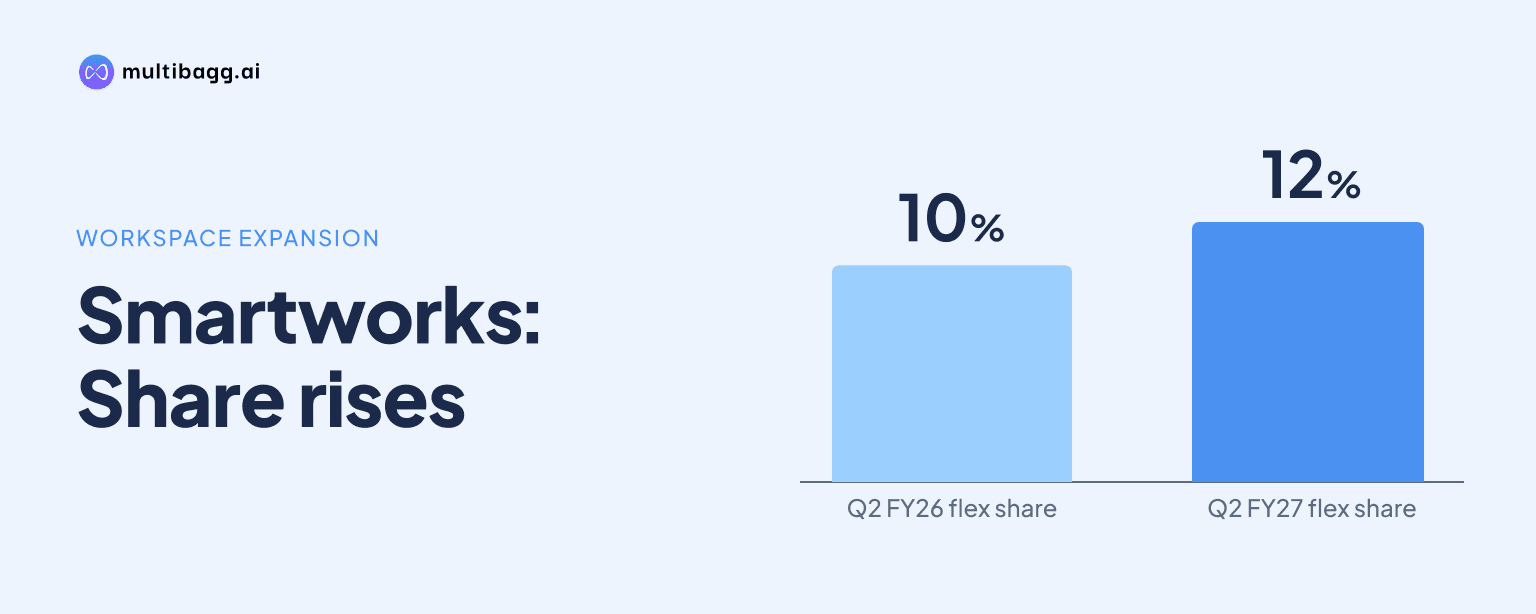
Smartworks says its leased footprint grew 49% year on year to 15.3 million square feet, or Msf, in Q2 FY27, compared with 31% growth in India’s flex stock. On that basis, Smartworks estimates its share of India’s flex-office stock rose from 10% to about 12%, with global capability centre, or GCC, demand concentrated in cities where it operates.
Know Smartworks Coworking Spaces inside out
Results, valuation, peers and who's buying, in one view.
How did Smartworks reach a 12% share of flex stock?
Smartworks reached an estimated 12% share because its leased stock expanded faster than both India’s flex stock and total office stock between Q2 FY26 and Q2 FY27. Its leased footprint increased from 10.3 Msf to 15.3 Msf, a 49% rise. Over the same period, India’s flex stock increased 31%, from 100 Msf to 131 Msf, while total office stock grew 9%.
Smartworks calculates that relative growth as an increase in its flex-stock share from 10% to 12%, or about one in every eight square feet of flex space in India. The company states that the industry stock figures used in this comparison are market estimates. Its leased-stock growth exceeded flex-stock growth by 18 percentage points in the period shown.
Why is India’s flex-office segment growing?
India’s flex-office segment is growing as occupiers allocate more leasing to flexible space while overall office absorption rises. Smartworks reports record absorption of 66.4 Msf in the first nine months of CY2026, up 8% year on year. Flex accounted for 24% of office leasing in Q3 CY2026, which the presentation identifies as the largest occupier segment.
The flex share of office leasing increased from 12% in 2021 to 24% in September 2026, after reaching 16% in 2023, 18% in 2024 and 21% in 2025. Smartworks also cites survey data showing that 67% of occupiers plan to use flex space within the next two years. This is the market backdrop for its larger-campus focus rather than a reported Smartworks demand forecast.
GCCs feature prominently in the large-deal data cited by Smartworks. GCCs accounted for about 59% of office transactions above 100,000 square feet in Q3 CY2026, while about 65% of GCCs expect flex to be part of their real-estate plan within two years. Nearly 50% of occupiers plan to operate in at least two cities, according to the presentation.
How are GCCs supporting Smartworks in its core cities?
GCC growth supports Smartworks because new units are concentrated in states containing its principal markets. India’s GCC count rose from 1,285 in FY19 to 1,700 in FY24 and 2,117 in FY26. The presentation projects 2,400 GCCs by 2030, while associated headcount is shown increasing from 1.0 million in FY19 to 2.36 million in FY26 and 2.8 million by 2030.
Of 120 new GCC units in Q2 CY2026, 105 were in Karnataka, Maharashtra and Telangana. Bengaluru, Pune and Hyderabad account for 56% of Smartworks’ saleable business area, or SBA, according to the presentation. That overlap is the basis for management’s view that GCC formation can support demand at its existing locations.
Smartworks also cites 183 new GCC units in H1 CY2026, equal to 83% of the CY2025 full-year total stated in the presentation. GCCs accounted for about 22% of Smartworks’ rental revenue in Q2 FY27, compared with about 15% in FY26. The company says GCC flex leasing is projected to grow about 1.7 times faster than other segments, which is a market projection rather than reported revenue.
Got a follow-up? Ask IRIS
What does Smartworks offer GCC clients?
Smartworks offers GCC clients SmartVantage, a service launched in September 2025 that it says can make a fitted, branded campus operational in about 60 days. The offering combines space with partner support for talent, legal, tax and compliance requirements. SmartVantage is designed around whole-building campuses tailored to a client’s identity and operating needs.
The presentation lists several large GCC client deployments. A global Swiss bank moved into a site with more than 3,400 seats in January 2026, while a Netherlands-based information-services company has 3,500 seats in Pune. A US healthcare analytics company has occupied 3,000 seats since 2021, and a German commercial-vehicle maker has more than 1,700 seats in Pune.
The listed clients show the seat scale Smartworks is seeking in the GCC segment. The increase in GCC rental-revenue share from about 15% in FY26 to about 22% in Q2 FY27 is the company’s reported measure of the segment’s contribution. SmartVantage’s approximately 60-day readiness target links that contribution to the company’s stated ability to support new GCC setups.
Will AI increase flex-office demand, according to Smartworks?
Smartworks argues that artificial intelligence, or AI, will redistribute office demand rather than reduce it. Its presentation estimates an additional 79 Msf of knowledge-economy office stock by CY2030 compared with a pre-AI path. It also shows the AI workforce in GCCs increasing from 181,000 to 730,000 by CY2030.
The company bases its view partly on survey findings about changing work patterns. About 60% of roles are being reshaped or augmented by AI, while about 93% of enterprises report increased collaboration. The presentation separately states that 93% use AI and that 57% expect no near-term reduction in office space.
Smartworks links these findings to a core-and-flex office model in which 70% to 80% of a portfolio remains core space and 20% to 30% is flex space. About 45% of enterprises report greater difficulty in workforce planning as hiring priorities shift quarter to quarter. The proposed allocation is a market model presented by Smartworks, not a reported client outcome.
Conclusion
Smartworks’ market-positioning argument combines leased-stock growth of 49% to 15.3 Msf with flex-stock growth of 31% nationally, supporting its estimate that its share rose from 10% to about 12%. GCC demand is a central component because 105 of 120 new units in Q2 CY2026 were in three states that include Bengaluru, Pune and Hyderabad, which account for 56% of Smartworks’ SBA.
The next measures to watch are whether GCC additions continue beyond the 183 units recorded in H1 CY2026, whether SmartVantage meets its stated approximately 60-day campus-readiness timeline, and whether Smartworks progresses toward the demand implied by its core-city footprint. The company’s 2,400-GCC projection for 2030 and its estimate of 79 Msf of AI-related incremental office stock remain forward-looking presentation assumptions.