










Smartworks expansion keeps ROCE at 21–22% for now
Key highlights
- Smartworks’ ROCE has stayed at about 21–22% for three quarters as roughly 20% of capital employed remains invested in unopened centres.
- Smartworks has 4.3 million square feet under fit-out or awaiting handover and targets 12.5–13.5 million square feet of operational space by March 2027.
- First-half FY27 revenue grew 41% year on year, while rental revenue increased about 31%.
- Smartworks’ contracted rental revenue rose to about Rs 580 crore from about Rs 540 crore in June, including roughly Rs 54 crore contracted during Q2 FY27.
powered by IRIS
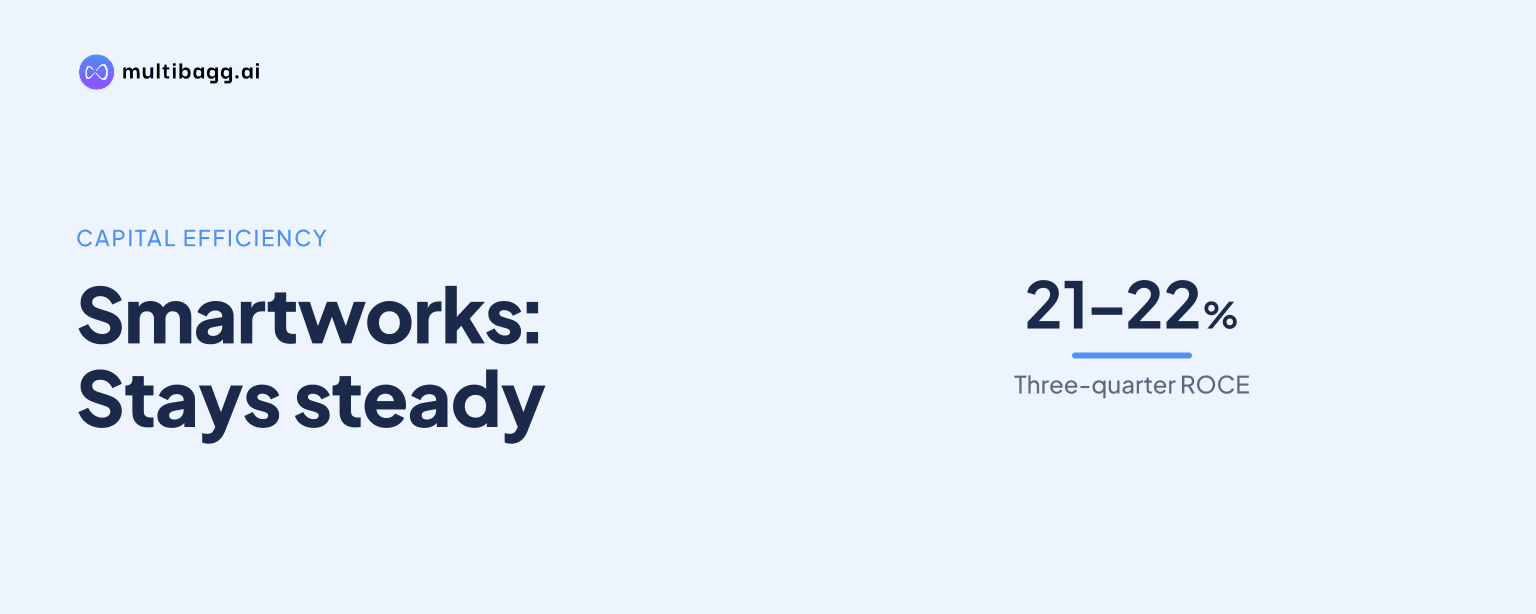
Smartworks Coworking Spaces Limited says roughly 20% of its capital employed is invested in centres that are not yet operational, keeping return on capital employed, or ROCE, at about 21–22% for three quarters. Smartworks reported cash conversion of 0.9x and expects free cash flow to improve after its mature operating base approaches 13 million square feet.
Know Smartworks Coworking Spaces inside out
Results, valuation, peers and who's buying, in one view.
Why is Smartworks ROCE flat at 21–22%?
Smartworks says ROCE has remained at about 21–22% for three quarters because it has made advance investments to secure capacity for FY28 and FY29. Those investments include security deposits on buildings, which are included in capital employed before the associated centres are operational and generating mature earnings.
About 20% of Smartworks capital employed is invested in centres that are not yet operational. This creates a timing difference between the deployment of deposits and fit-out spending and the later contribution of occupancy, rental revenue and earnings. Management says reported ROCE should improve as these centres become operational and mature, allowing earnings to catch up with capital already invested.
The gap between company-wide and operational-centre cash conversion is part of Smartworks’ explanation. Reported cash conversion was 0.9x, while cash conversion from centres already operating was above 1x. Management attributes the difference to capital deployed for future capacity rather than to the cash performance of mature centres.
How is Smartworks funding its expansion cycle?
Smartworks says it is adding 2.5 to 3.0 million square feet annually while taking over new buildings, a process expected to keep cash conversion softer for the next few quarters. It had 4.3 million square feet under fit-out or awaiting handover, against the 1.6 to 2.1 million square feet it says is required to go live in the second half of FY27.
Smartworks phases capital expenditure, or capex, with occupancy rather than fitting out all vacant space at opening. Management says it builds common areas and space for committed clients on day one, then develops the remaining area after a client signs. It also says clients pay deposits before construction and pay the company quickly, which management identifies as features of its expansion model.
The supply pipeline extends beyond immediate FY27 needs. Smartworks reported a total secured footprint of 17.5 million square feet and reaffirmed a March 2027 operational-space target of about 12.5 to 13.5 million square feet. The advance pipeline is intended to support FY28 and FY29 capacity, but it also means deposits and capex precede the cash generation of new centres.
When does Smartworks expect free cash flow to turn positive?
Smartworks expects free cash flow to turn positive a few quarters after cash conversion improves, when its mature operating base approaches 13 million square feet. Management says free cash flow remains negative during the build phase because capex and deposits run ahead of cash generated by new centres during their occupancy ramp-up.
The company’s stated sequence is that cash conversion improves as newly acquired buildings go live, followed a few quarters later by free-cash-flow improvement. Smartworks says cash from the mature operating base should then cover capex for the next expansion cycle. The presentation does not provide a specific quarter or fiscal-year target for positive free cash flow.
New-centre economics underpin this expectation. Smartworks says a new centre breaks even at about 60% occupancy, usually within its first year, and that each additional occupied seat after that point adds directly to profit. A new campus can weigh on profitability for six to nine months, while mature centres covering more than 9.7 million square feet were at about 91% committed occupancy.
Got a follow-up? Ask IRIS
What evidence supports Smartworks’ capacity plan?
Smartworks says its mature-centre base should limit the effect of Eastside and Eastbridge, its two largest campuses, which are due to open in the second half of FY27 with healthy committed occupancy. The company says its buildings have increased from 3–4 lakh square feet to 6–7 lakh square feet, while it has consistently reached 80–85% occupancy in under 18 months.
First-half FY27 revenue grew 41% year on year, while rental revenue grew about 31%. Following that performance, Smartworks raised FY27 revenue-growth guidance to 33–35% from 28–30% and reaffirmed normalised earnings before interest, tax, depreciation and amortisation, or EBITDA, margin guidance of 19–20%.
Demand visibility also increased during the build-out. Contracts entered into during Q2 FY27 included about Rs 54 crore of contracted rental revenue, comprising about Rs 23.5 crore from existing-client expansion and about Rs 30.5 crore from new clients. Contracted rental revenue rose to about Rs 580 crore from about Rs 540 crore in June, according to the presentation.
What should readers track as Smartworks centres mature?
Readers should track reported cash conversion, ROCE and the progress of new centres toward break-even, because Smartworks identifies these measures as the link between advance investment and later cash generation. The current comparison is 0.9x reported cash conversion against more than 1x from operational centres, alongside about 20% of capital employed in centres that have yet to open.
Occupancy at Eastside and Eastbridge is another relevant measure. Smartworks says 20–25% of a new building is typically spoken for before signing, new centres reach break-even at about 60% occupancy, and its larger buildings have historically reached 80–85% occupancy within 18 months. These indicators will show whether earnings are catching up with deposits and phased capex on the timetable management describes.
Margin performance provides a separate comparison. Smartworks reaffirmed normalised EBITDA margin guidance of 19–20%, although management says a new campus weighs on profitability for its first six to nine months. It attributes the contained effect to mature centres covering more than 9.7 million square feet at about 91% committed occupancy and to its practice of fitting out uncommitted space only after clients sign.
Conclusion
Smartworks is describing flat ROCE and softer cash conversion as outcomes of a front-loaded capacity programme rather than changes in its operating-centre economics. About one-fifth of capital employed is allocated to unopened locations, while reported cash conversion of 0.9x trails the more-than-1x conversion management reports from centres already operating.
The next developments to watch are the second-half FY27 openings of Eastside and Eastbridge, occupancy progress at those campuses and the conversion of 4.3 million square feet under fit-out or awaiting handover. Management expects cash conversion to recover as centres open and mature, with free cash flow improving a few quarters later as the mature base approaches 13 million square feet.