










Solarium Ahmedabad plant gains 1.23 GW ALMM List-I status
Key highlights
- Solarium commissioned its ₹90+ crore Ahmedabad module facility in March 2026.
- Solarium’s Ahmedabad factory gained ALMM List-I enlistment in July 2026 with 1.23 GW of annual capacity.
- Solarium’s fully automated line produces modules up to 725 Wp and is designed for one module every 16 seconds.
- Solarium reported ₹259.81 crore of module supply within its ₹720.87 crore order book.
powered by IRIS
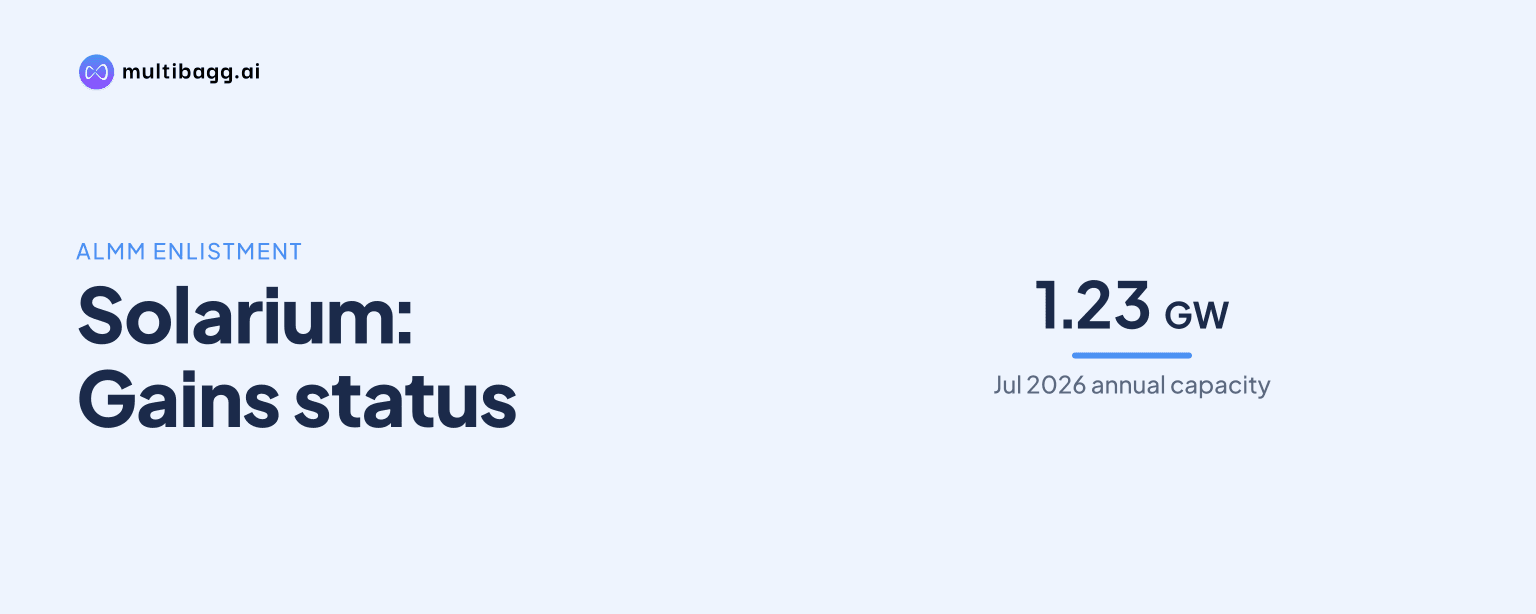
Solarium Green Energy Limited commissioned a ₹90+ crore Ahmedabad module plant in March 2026 and gained ALMM List-I enlistment in July 2026, establishing 1.23 gigawatts of annual enlisted capacity. The factory produces P-type mono c-Si PERC and N-type TOPCon modules up to 725 Wp, and management says a panel accounts for roughly 60% of rooftop-system value.
Know Solarium Green Energy inside out
Results, valuation, peers and who's buying, in one view.
What did Solarium commission at its Ahmedabad facility?
Solarium commissioned a fully automated module facility at Village Miroli, Daskroi, Ahmedabad, Gujarat, in March 2026, with capital investment of more than ₹90 crore. Its 1.23-gigawatt annual capacity is listed as enlisted capacity under ALMM List-I, the designation used in the presentation.
The line produces one module every 16 seconds, according to Solarium, and makes bifacial P-type mono c-Si PERC and N-type TOPCon products. Maximum stated module output is 725 Wp in the G12 format, while the plant uses artificial-intelligence-assisted inspection and radio-frequency identification, or RFID, traceability for every module.
The factory adds manufacturing to Solarium’s installation-led rooftop model. Management says the panel is the component a household sees and remembers and represents roughly 60% of a rooftop system’s value, whereas other components can be supplied under Solarium’s label by contract manufacturers.
When did Solarium obtain ALMM List-I enlistment?
Solarium obtained ALMM List-I enlistment for the Ahmedabad facility in July 2026, four months after its March 2026 commissioning. The presentation identifies bifacial P-type mono c-Si PERC and N-type TOPCon modules as the enlisted products.
Solarium says a brand owner putting its name on a module made by another manufacturer must use a brand-owner arrangement under the ALMM framework. That arrangement requires joint labelling and shared warranty liability, and Solarium says it is available only to a brand owner that does not operate a manufacturing facility.
Where only a manufacturer is enlisted, Solarium says a brand owner is restricted to distributed projects below 1 megawatt. Its own factory enlistment therefore links the Solarium name on the module with the manufacturing operation described in the presentation, rather than only with a third-party supply arrangement.
How has the plant affected Solarium’s revenue and margins?
Solarium reported revenue from operations of ₹310.47 crore in the first half of financial year, or FY, 2027, exceeding ₹116.93 crore in the corresponding half and ₹230.08 crore in all of FY2025. Management attributed the increase to large engineering, procurement and construction, or EPC, work and module sales, while stating that manufacturing generated revenue for only about two months of the half.
Blended gross margin was 21.6% in the first half of FY2027, down from 44.4% a year earlier. Management said the change reflected a greater mix of large EPC work and module sales relative to residential business, which it identifies as Solarium’s highest-margin business, rather than a change in pricing discipline in an individual operation.
Management also said the facility carried six months of fixed costs against roughly two months of manufacturing revenue because ALMM List-I enlistment came in July 2026. It expects fixed costs to be absorbed over more volume as utilisation rises, and said employee cost remained broadly flat on a net basis despite commissioning, with savings across other verticals.
Got a follow-up? Ask IRIS
Why does Solarium manufacture its own panels?
Solarium manufactures panels because management says the panel is both the visible household brand and roughly 60% of a rooftop system’s value. Making the module allows Solarium to connect the name printed on the panel with its own installation, supply and warranty proposition.
The approach also underpins Solarium’s kit channel, which was launched to serve unorganised installers beyond its own installation crews. Each kit includes 25 items, including Solarium-brand panels, an inverter, mounting hardware, electrical equipment and safety materials, and it includes five years of insurance cover at no cost to the installer or household.
Solarium says it is registered as a brand on the national portal, allowing an EPC installer using its kits to record the brand against an installation. The residential process covers site survey, design, financing support, supply, installation, net-metering applications and subsidy claims, with subsidy paid directly to the household after Solarium approves the file.
What demand pipeline accompanies Solarium’s module expansion?
Solarium reported an order book of ₹720.87 crore, comprising ₹461.06 crore of EPC work and ₹259.81 crore of module supply. It also said it had won two single-site EPC contracts of 50 megawatts alternating current each, reflecting the shift from distributed rooftop tenders to larger, technically demanding projects.
The order book contains more EPC value than module-supply value, with EPC representing ₹461.06 crore against ₹259.81 crore for modules. The presentation does not state how much of the module-supply order book will be manufactured at the Ahmedabad facility or when those orders will convert into revenue.
For FY2027, Solarium says it is bidding for a smaller number of high-value, single-site projects and using specialist contractors on fixed terms. Under that model, it says it retains a fixed margin and panel supply while seeking faster recovery than the working-capital cycle associated with hundreds of distributed rooftop sites.
Residential demand also has disclosed policy support, with state additions to the central subsidy ranging from about ₹17,000 to ₹78,000. Solarium says it files the subsidy claim on the national portal, but the payment is credited directly to the household and cannot be released until Solarium approves the file.
Conclusion
The March 2026 commissioning and July 2026 ALMM List-I enlistment give Solarium a 1.23-gigawatt annual manufacturing base for its branded module strategy. The ₹90+ crore plant makes modules up to 725 Wp, while management ties internal panel production to the panel’s roughly 60% share of rooftop-system value and to its installation and kit channels.
The next disclosed issue is utilisation: management said the first half of FY2027 contained roughly two months of manufacturing revenue but six months of fixed plant costs. Progress in converting the ₹259.81 crore module-supply order book, alongside the two 50-megawatt alternating-current single-site EPC wins, will be relevant, although Solarium has not specified which orders the Ahmedabad plant will fulfil.