










Solarium shifts EPC to outsourced high-value single-site projects
Key highlights
- Solarium won two single-site EPC contracts of 50 MWac each in H1 FY27.
- Solarium’s H1 FY27 order book was Rs 720.87 crore, including Rs 461.06 crore of EPC work.
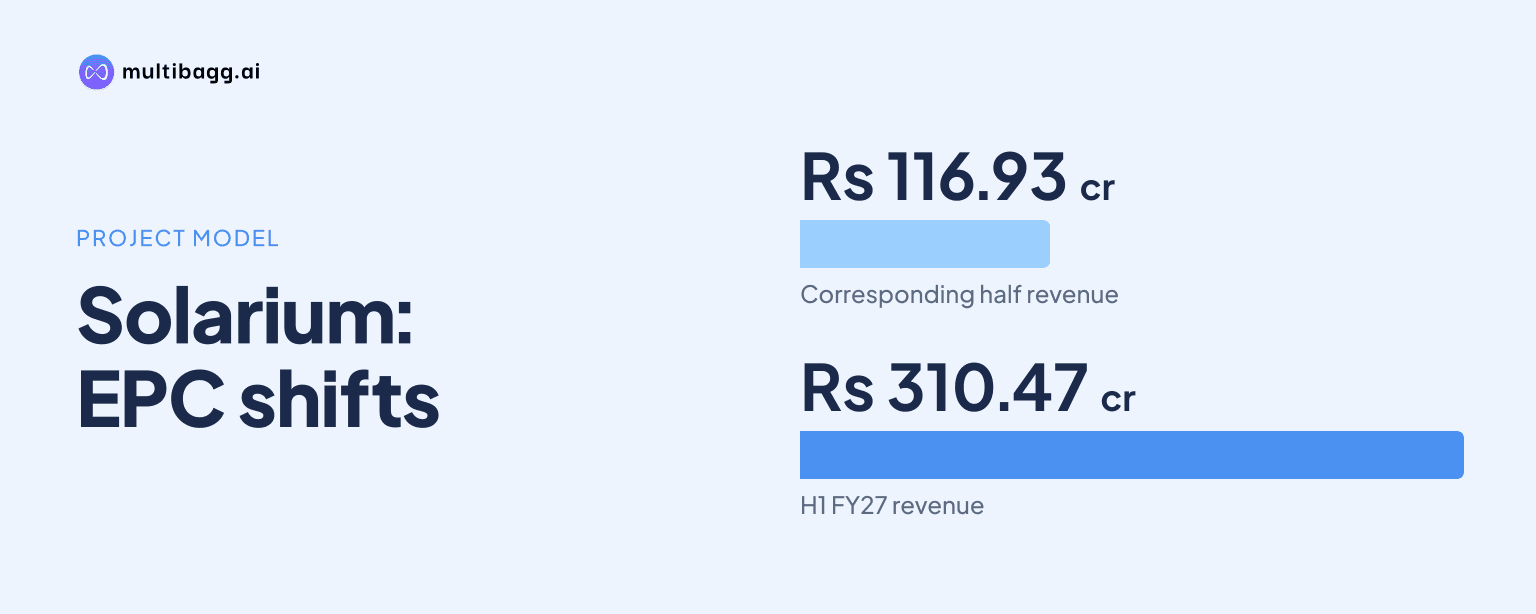
- Solarium reported H1 FY27 revenue of Rs 310.47 crore, versus Rs 116.93 crore in the corresponding half.
- Solarium’s trade receivables were Rs 281.85 crore at 30 September 2026, versus Rs 152.61 crore at 31 March 2026.
powered by IRIS
In H1 FY27, Solarium shifted its engineering, procurement and construction, or EPC, model to fixed-term specialist contractors for complex single-site work after winning two 50 MWac single-site contracts, replacing its prior approach of using its own teams across hundreds of distributed rooftop tender sites to pursue faster recovery of capital.
Know Solarium Green Energy inside out
Results, valuation, peers and who's buying, in one view.
Why did Solarium change its EPC strategy?
Solarium says its former model, used until FY2026, spread government rooftop tender work across hundreds of small sites and committed working capital at every site until certification. Its own teams carried out that site-by-site execution, with the company retaining an execution margin after what the presentation describes as a long receivable cycle. The earlier approach was designed to build execution capability across many locations at once.
From FY2027, Solarium says it will bid for a smaller number of technically demanding, high-value projects located at a single site. Management’s stated reason is that value lies in work that relatively few contractors can undertake, rather than in carrying the greatest volume of work. The new model prioritises avoiding blocked capital and faster recovery, rather than distributed project delivery.
The comparison is a change in both execution and the intended economics of EPC work. Under the old approach, Solarium was directly responsible for activity across many small locations. Under the FY2027 approach, it retains panel supply and a fixed margin while a specialist contractor performs project execution on agreed fixed terms.
How does Solarium’s new EPC model work?
Solarium’s stated FY2027 model is to select single-site work that is technically complex and engage a specialist contractor to execute it on fixed terms. The presentation does not identify those contractors or disclose the fixed contract amounts. It does specify that Solarium expects to retain a fixed margin and the supply of panels, rather than only an execution margin after a distributed-site receivable cycle.
Panel supply is central to the structure because Solarium says a panel represents roughly 60% of a rooftop system’s value. Its Ahmedabad facility was commissioned in March 2026 and was enlisted in ALMM List-I in July 2026, with 1.23 gigawatts of annual enlisted capacity. ALMM List-I is the facility enlistment category cited by Solarium in the presentation.
The financial statements provide context for management’s emphasis on recovery of capital, although they do not break out cash conversion by EPC project. Consolidated trade receivables increased from Rs 152.61 crore at 31 March 2026 to Rs 281.85 crore at 30 September 2026. Cash and bank balances fell from Rs 90.41 crore to Rs 35.55 crore over the same period, while H1 FY27 cash flow from operating activities was negative Rs 77.51 crore.
Got a follow-up? Ask IRIS
What experience supports Solarium’s single-site bids?
Solarium says its record in difficult locations qualifies it for the single-site tenders it now targets, which it says are awarded on technical criteria that most contractors cannot meet. The presentation cites installations in Leh and Ladakh, including locations near the Hanle observatory above 4,000 metres, as well as work in the Andaman and Nicobar Islands, Manipur, Silchar and Kutch.
Each cited geography involves a particular execution condition. In the islands, Solarium says every component must be shipped because there is no local supply chain. In the North East, the cited sites have short working seasons, while Kutch projects face salt flats, extreme heat and high wind loading. These examples explain why the company places technical complexity, rather than the number of individual sites, at the centre of its revised bidding approach.
Solarium also lists work delivered for the Bhabha Atomic Research Centre under the Department of Atomic Energy, the Indian Air Force at Bhuj, Gorakhpur and Port Blair, and the Border Security Force across border states. Other named customers include Military Engineering Services, NTPC and Gujarat Urban Development Company, for which it cites 7.73 MW across Gujarat. The presentation says this record supports qualification for current single-site tender bids.
What does H1 FY27 show about Solarium’s new mix?
Solarium reported revenue from operations of Rs 310.47 crore in H1 FY27, exceeding both Rs 116.93 crore in the corresponding half and Rs 230.08 crore for all of FY2025. The company won two single-site EPC contracts of 50 MWac each during the half. Its disclosed order book was Rs 720.87 crore, comprising Rs 461.06 crore of EPC work and Rs 259.81 crore of module supply.
The higher share of large EPC and module sales changed the reported gross-margin mix. Solarium said blended gross margin fell to 21.6% in H1 FY27 from 44.4% a year earlier, which management attributed to mix rather than pricing discipline within an individual business. Management also described residential work as the company’s highest-margin business, distinguishing it from the larger EPC and module-sales activity.
Manufacturing was only contributing for roughly two months of the six-month period because the module facility received its List-I enlistment in July 2026, according to management. The facility can produce bifacial P-type mono c-Si PERC and N-type TOPCon modules, with a maximum stated output of 725 Wp, or watts peak, in G12 format. Management said fixed manufacturing costs were carried through the half while utilisation was still building.
Conclusion
Solarium’s H1 FY27 results show a business mix increasingly shaped by larger EPC contracts and module supply: revenue reached Rs 310.47 crore, the order book included Rs 461.06 crore of EPC work, and blended gross margin declined to 21.6% from 44.4% a year earlier. Management attributes the margin change to mix, while its revised project structure is intended to retain panel supply and a fixed margin.
The next issue to watch is whether the stated faster-recovery model is reflected in subsequent working-capital and cash-flow figures, given H1 FY27 operating cash outflow of Rs 77.51 crore and receivables of Rs 281.85 crore at 30 September 2026. Management also says module-facility utilisation should absorb fixed costs over a larger volume after its July 2026 List-I enlistment, which is its disclosed basis for expecting margin recovery.