










Solarium faces Indian-cell rule for projects from January 2027
Key highlights
- Solarium was added to ALMM List-I at 1,230 MW in the July 2026 revision.
- Net-metering and open-access projects commissioned from 1 January 2027 must meet both List-I and List-II requirements.
- The temporary List-II exemption ends for eligible projects commissioned after 31 December 2026.
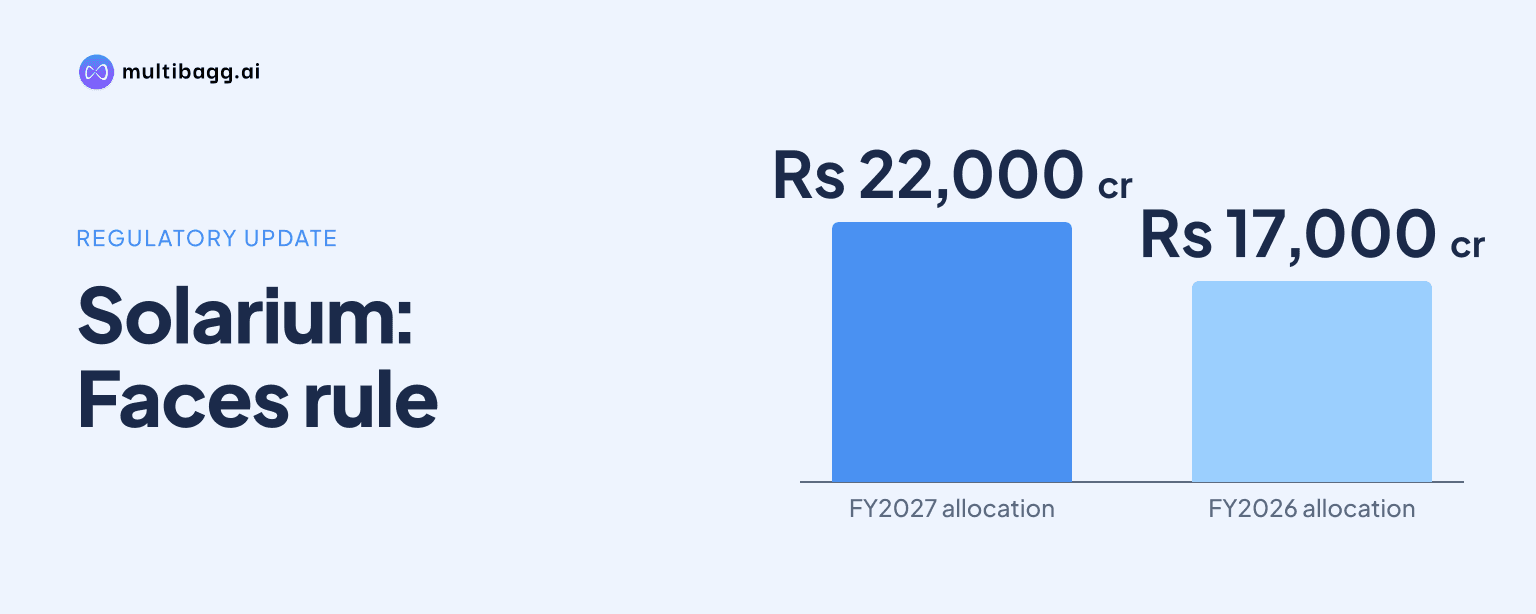
- PM Surya Ghar received a Rs 22,000 crore allocation for FY2027, versus a revised Rs 17,000 crore in FY2026.
powered by IRIS
Solarium Green Energy Limited will need approved domestic cells, as well as listed modules, for net-metering and open-access projects commissioned from 1 January 2027, because the Ministry of New and Renewable Energy exemption for those categories ends on 31 December 2026. Solarium was added to ALMM List-I with 1,230 megawatts of module capacity in July 2026.
Know Solarium Green Energy inside out
Results, valuation, peers and who's buying, in one view.
What changes for Solarium from January 2027?
From 1 January 2027, Solarium must meet both the Approved List of Models and Manufacturers, or ALMM, List-I module requirement and List-II cell requirement for net-metering and open-access projects. The policy framework says List-II applies to cells and came into force on 1 June 2026, but MNRE exempted the two project categories where commissioning occurs on or before 31 December 2026.
The change matters because the July 2026 relief is time-limited rather than a removal of the cell-list regime. For projects commissioned through the cutoff date, the source says the List-II requirement does not apply to net-metering and open-access installations. For projects commissioned from the following day, both lists apply, bringing cell sourcing alongside module eligibility into the compliance process.
How does ALMM List-I status differ from the cell rule?
Solarium's List-I enlistment establishes module eligibility for government-supported projects, while List-II introduces a separate condition for cells. The company was added to List-I in the July 2026 revision at 1,230 MW, when total enlisted capacity reached 204.4 gigawatts, or GW. The presentation says overall enlisted capacity was 217 GW by August 2026.
The distinction is material because module listing alone does not settle the post-2026 cell requirement for the exempted project categories. Solarium describes List-I enlistment as a precondition to supply government-supported demand. Its policy page separately states that domestic cells will be required across net metering and open access from 1 January 2027, indicating an additional sourcing and documentation consideration beyond listed module capacity.
List-II is therefore not presented as a replacement for List-I. The framework is described as a localisation ladder: modules under List-I, cells under List-II and wafers under List-III. The source says India has very limited wafer capacity today and expects the wafer requirement in June 2028, putting the 2027 cell step between current module rules and the proposed next stage.
Which solar programmes already require Indian modules and cells?
PM Surya Ghar and PM-KUSUM already require Indian-made modules built with Indian-made cells under the Domestic Content Requirement, or DCR. The presentation explicitly says DCR was not relaxed by the July 2026 List-II exemption. That means the temporary relief for net-metering and open-access categories did not alter the separate domestic-content rules applying to those two programmes.
This creates a difference between the policy pathways described in the source. Net-metering and open-access projects had an exemption tied to commissioning by 31 December 2026, whereas DCR-linked PM Surya Ghar and PM-KUSUM demand retained Indian-module and Indian-cell conditions. Readers should therefore distinguish the ALMM exemption from DCR compliance rather than treating the July 2026 memorandum as a broad relaxation of localisation rules.
PM Surya Ghar remains a large policy-supported rooftop market in the presentation. MNRE reported 50.06 lakh households benefiting from rooftop solar and 14.8 GW of rooftop capacity commissioned under the scheme as of its 4 August 2026 release. The Union Budget 2026-27 allocation for PM Surya Ghar was Rs 22,000 crore, compared with a revised Rs 17,000 crore in FY2026.
Got a follow-up? Ask IRIS
What other policy measures affect Solarium's solar systems?
The Goods and Services Tax, or GST, rate on solar cells, modules, inverters and balance-of-system equipment fell to 5% from 12% on 22 September 2025. Solarium says this reduction lowers the installed cost of a household system. The source identifies the change as following the 56th GST Council meeting of 3 September 2025.
Imported equipment remains subject to the duties set out in the presentation. Basic customs duty is 20% on imported cells and modules, while the Agriculture Infrastructure and Development Cess is 20% on modules and 7.5% on cells. The stated effective duty is consequently 40% for modules and 27.5% for cells, creating different policy treatment for the two components.
The policy backdrop also links to Solarium's residential channel. Its PM Surya Ghar national-portal brand registration page records 11,471 installations and a 4.8 out of 5 rating from 8,232 ratings. The company says any engineering, procurement and construction, or EPC, player fitting Solarium kits can show the Solarium brand against installations on the portal, although the presentation does not quantify how many of those installations will fall under the January 2027 rule.
How should the January 2027 deadline be read?
The 1 January 2027 date is a commissioning deadline, not merely an order-date marker, according to the wording in Solarium's policy summary. The exemption covers net-metering and open-access projects commissioned on or before 31 December 2026. A project slipping beyond that date moves into the framework where both List-I modules and List-II cells apply.
For Solarium, the disclosed evidence shows a module-side regulatory position through its 1,230 MW List-I addition, but it does not state a named cell supplier, cell-manufacturing capacity or List-II cell sourcing arrangement. The presentation instead states the policy outcome: domestic cells will be required across net metering and open access from the 2027 date. That leaves the company's implementation arrangements unresolved in the supplied material.
Conclusion
The central finding is that Solarium's ALMM List-I status is one part of a widening localisation framework, not the final compliance step. Listed modules are already required for government-supported projects, while approved domestic cells become relevant to net-metering and open-access projects commissioned from 1 January 2027. DCR programmes, including PM Surya Ghar and PM-KUSUM, already retain Indian module-and-cell requirements.
The next date to watch is 31 December 2026, the last commissioning date for the stated List-II exemption in net-metering and open access. After that cutoff, the policy requires both lists. The following disclosed milestone is the expected June 2028 introduction of List-III for domestic wafers, while the source says wafer capacity in India is currently very limited.