










Somany raises South JV capacity to 11-12 million sq m
Key highlights
- Somany raised the Siravit South JV expansion from 9 million to about 11-12 million square metres.
- All capacity added under Somany’s current expansion plan will be GVT, while GVT was 45% of Q2 FY27 mix.
- Siravit expansion capex is estimated at about Rs 250 crore and is planned with 50% debt and 50% equity.
- Somany targets firing in production around September next year and expects about 4 million square metres of annualised debottlenecking capacity in FY27.
powered by IRIS
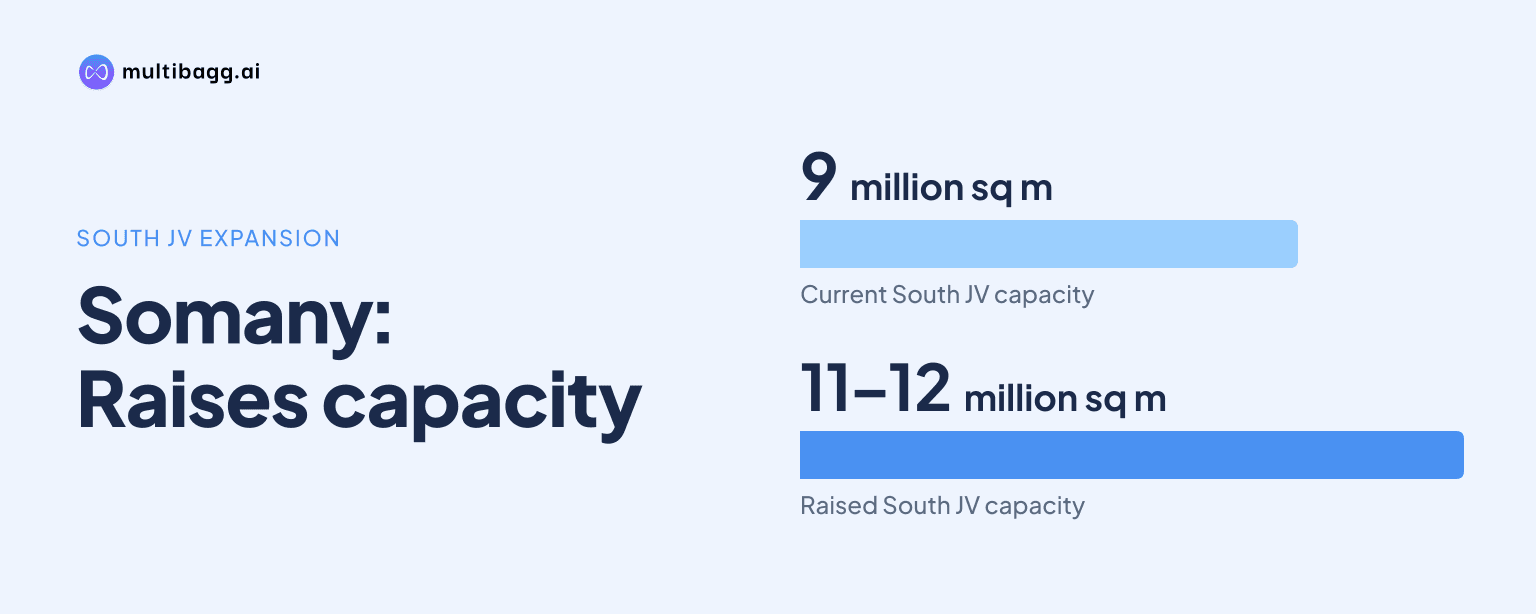
Somany Ceramics Limited has raised the Siravit South joint-venture expansion to about 11-12 million square metres from 9 million square metres, with the entire addition in glazed vitrified tiles, or GVT. Management targets firing in production around September next year and estimates total Siravit project expenditure at about Rs 250 crore.
Know Somany Ceramics inside out
Results, valuation, peers and who's buying, in one view.
How much is Somany expanding the Siravit South JV?
Somany is expanding the Siravit plant by approximately 11-12 million square metres, above its previously announced 9 million-square-metre plan. Management described the project as doubling its South joint-venture plant during the Q2 FY27 earnings call and said the construction and spending would take place over the next 12 months rather than wholly within FY27.
The revised Siravit programme forms part of a wider GVT expansion pipeline. Management said about 16 million square metres being put into production over the next 12 months would be GVT, while another response referred to 15-17 million square metres of GVT additions over 12-18 months. The differing ranges show that Siravit is a major part of the planned addition, alongside other capacity work.
The expansion follows a quarter in which operating plants were at 100% capacity, excluding equipment taken down for upgrades. Management said a Vintage plant and another facility were unavailable for about 20 days in July and partly in August, while a Northern line underwent a major upgrade in October. It expects fewer disruptions in H2 FY27 after those projects are completed.
How will Somany fund the Siravit expansion?
Somany estimates total Siravit capital expenditure at about Rs 250 crore and plans to fund it with 50% debt and 50% equity. Somany’s own contribution is expected to be about Rs 60 crore, which management presented as its share of the equity funding rather than the full cost of the South joint-venture project.
Management also disclosed Rs 15 crore of modernisation expenditure at Sudha and Rs 8 crore at Vintage. Somany normally incurs Rs 70-80 crore a year of routine standalone equipment-modernisation spending. It said routine expenditure, the Sudha and Vintage programmes, and the planned increase in sanitaryware joint-venture ownership would be funded through internal accruals.
Somany also plans to increase its holding in its sanitaryware joint venture to 76% from 51%, although the call did not disclose the cost of that transaction. Separately, management said debottlenecking and upgrades would raise annualised capacity by about 4 million square metres during FY27, with the additional output coming from existing plants.
Got a follow-up? Ask IRIS
Why is Somany adding only GVT capacity?
Somany is directing the expansion to GVT as its tile mix shifts toward that category. GVT represented 45% of mix in Q2 FY27, compared with about 40% a year earlier. In another answer, management cited a 41% prior-year level, indicating an increase of roughly 4-5 percentage points from the comparable period.
Management expects GVT to reach close to 65-70% of the mix over the next two to three years as the new GVT-only capacity enters production. It said GVT can have a slightly better margin, but it does not automatically create margin expansion because some GVT business is not margin-creating. The project is therefore a disclosed product-mix and capacity strategy, not a stated fixed-margin outcome.
Somany linked the mix change to its aim of selling more value-added formats, including big slabs. In Q2 FY27, tile revenue rose 27% year on year to Rs 723 crore, while overall volume growth was 5.5%. The difference between revenue and volume growth occurred as management said it was seeking to preserve realisations and avoid selling cheaper products.
The company said all of the capacity now being added from the current base is GVT. Its 45% GVT mix in Q2 FY27 was also above the 41% level management cited for the earlier year, while the planned 65-70% mix would represent a further shift of 20-25 percentage points from the current level over two to three years.
When will Somany commission the expanded South capacity?
Somany expects the Siravit expansion to be firing in production around September next year, rather than November. Management gave the September timing in response to an analyst question and said the deadline was “exactly same time next year,” without specifying a calendar year during the Q2 FY27 call.
Before Siravit starts, management expects operating conditions to improve after the Q2 FY27 maintenance interruptions. It said October had gone well and was hopeful of a better Q3 than Q2. The upgraded Northern line is intended to reduce costs and increase capacity, and management said most non-routine maintenance was behind it.
For FY27, Somany retained guidance for high-single-digit growth and increased its expected earnings before interest, tax, depreciation and amortisation, or EBITDA, margin improvement to about 2-2.5 percentage points over FY26. Management attributed that outlook to capacity utilisation, product mix, price pass-through and improved joint-venture performance, rather than to GVT alone.
The joint ventures moved from a Rs 12 crore loss in Q2 of the prior year to a Rs 3 crore profit in Q2 FY27. Management also said the Q2 FY27 result benefited from better utilisation and a full pass-through of price increases, even as overall gas costs stood at about Rs 70 per standard cubic metre, compared with Rs 45 per standard cubic metre in FY26.
Conclusion
Somany has increased the scale of its Siravit South joint-venture plan from 9 million to 11-12 million square metres and will make the additional capacity entirely GVT. The Rs 250 crore project supports management’s stated objective of moving GVT from 45% of Q2 FY27 mix toward 65-70% over the next two to three years, while adding capacity in a product category it views as increasingly central to its portfolio.
The next disclosed milestone is the September production target for Siravit. Management’s FY27 targets also leave execution points to monitor: high-single-digit growth, a 2-2.5 percentage-point EBITDA-margin improvement over FY26, about 4 million square metres of annualised debottlenecking capacity, and the effect of gas prices that were about Rs 70 per standard cubic metre during the call.