










Sportking expects H2 margins near first-half FY27 levels
Key highlights
- Sportking reported a 19.8% Q2 FY27 EBITDA margin, compared with 10.4% in Q2 FY26.
- Sportking expects yarn spreads of Rs 130 to Rs 145 per kg for the next three to four months.
- Exports accounted for about 52% of Sportking’s total revenue in the latest quarter.
- Sportking expects Rs 150 crore to Rs 200 crore of FY27 revenue from Odisha capacity.
powered by IRIS
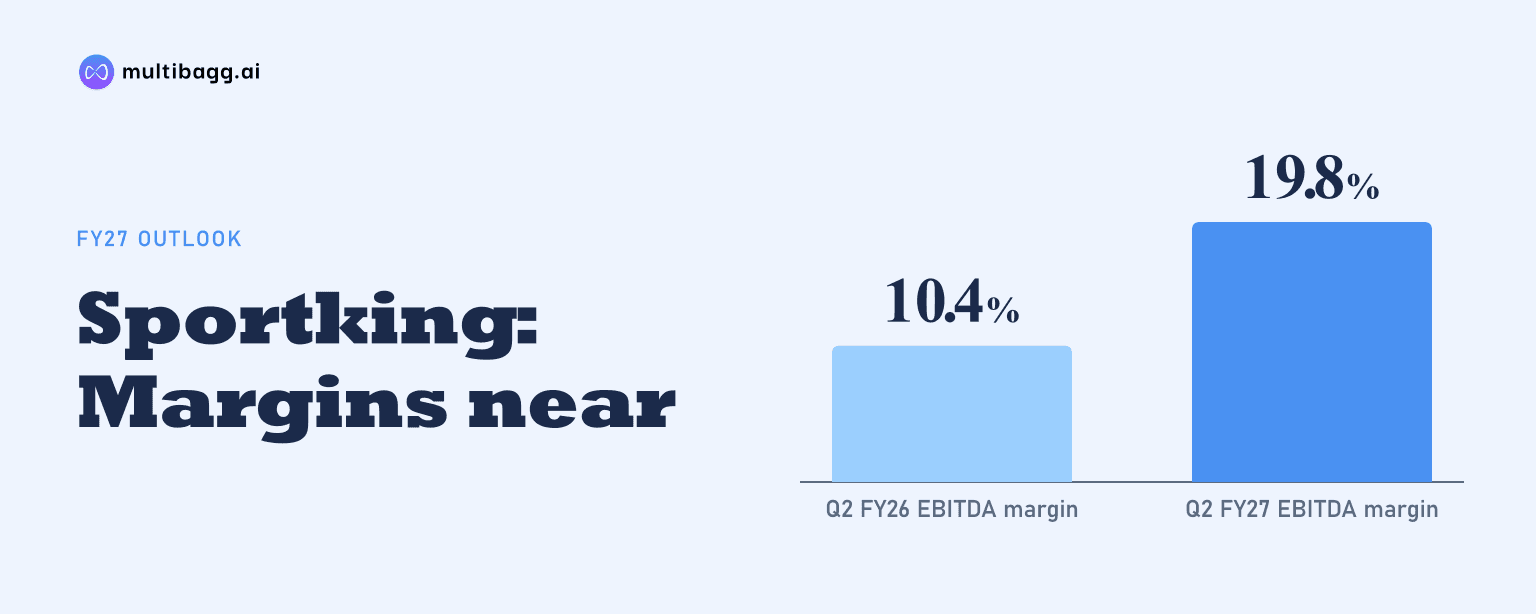
Sportking India Limited expects margins from its existing capacity to remain close to first-half FY27 levels in H2, after its Q2 FY27 earnings before interest, tax, depreciation and amortisation (EBITDA) margin rose to 19.8% from 10.4% a year earlier. Management cited export demand, Rs 130 to Rs 145 per kg yarn spreads and mixed cotton sourcing.
Know Sportking India inside out
Results, valuation, peers and who's buying, in one view.
Why does Sportking expect H2 FY27 margins to hold?
Sportking expects second-half FY27 margins from its existing capacity to remain broadly in line with the first half. Chairman and Director Munish Avasthi said management could not specify whether the result would be 18%, 19% or 21%, but expected margins to be close to the first six months. The statement does not include the incremental contribution expected from the Odisha plant.
The outlook follows a marked year-on-year improvement in Q2 FY27, when EBITDA margin reached 19.8%, compared with 10.4% in Q2 FY26. Management attributed the change to improving cotton and blended-yarn demand over the prior two to three quarters, cost-efficiency work undertaken over the previous two to three years, and cotton prices that it described as stable for about one year.
Management said the current operating environment remained similar to that of the first half. Its view depends on yarn demand, the ability to retain price-cost spreads and cotton procurement conditions, rather than a formal quarterly margin target. Sportking also said its existing facilities operated at 99% capacity in the quarter, limiting further volume growth from those plants.
What yarn spreads does Sportking expect in H2 FY27?
Sportking expects yarn spreads of Rs 130 to Rs 145 per kg for the next three to four months. Management said the Q1 FY27 spread was about Rs 133 per kg and the Q2 FY27 spread was about Rs 141 per kg, showing an Rs 8 per kg sequential increase rather than a reversal after the first quarter.
Management said prevailing spreads at the time of the October 30, 2026 call were similar to those achieved during the first six months. It allowed for a possible movement of plus or minus 2%, but said it did not expect spreads to decline materially from first-half levels. This assessment is the central basis for the H2 profitability expectation.
Sportking said firm yarn demand should help pass through any increase in cotton costs into yarn prices. Management also expects Indian cotton prices to decline after Diwali as crop arrivals increase, although it described cotton buying as a daily and dynamic decision. A fall in domestic cotton prices, if matched by yarn realizations, would affect the spread differently from a rise in raw-material costs.
How are exports supporting Sportking’s demand visibility?
Sportking said exports contributed about 52% of total revenue in the latest quarter, and management described demand from China and Bangladesh as robust. The company said it had sales visibility until March 10 and typically operates with an 80-to-90-day selling window, providing a disclosed basis for aligning yarn orders and raw-material procurement.
Management said Bangladesh demand had remained about 45,000 to 50,000 tonnes despite that market’s energy challenges. It said China had purchased about 60,000 tonnes over the preceding 12 months, citing higher local cotton prices and a 3% duty on imported cotton yarn compared with a 40% duty on imported cotton.
Domestic demand was slower in the preceding two to three months, while export demand was stronger, according to management. Sportking expects domestic demand to improve after Diwali during the period it called the rabi season, from Diwali to Holi. Management said it had already seen some initial domestic demand, which it expects to add to export demand in the coming months.
Got a follow-up? Ask IRIS
How will cotton sourcing affect Sportking’s H2 profitability?
Sportking said it buys cotton daily, selecting domestic or imported material according to the best available deal. Management said it sources raw material from 10 countries and uses a blend of imported and local cotton. When the company holds cotton for five to six months, it seeks to maintain a yarn order book of about three months to manage raw-material exposure.
Management said Indian cotton had fallen to around Rs 65,500 per candy in October from a peak of Rs 70,000 per candy. In a later response, it put domestic cotton at about Rs 65,000 per candy and imported cotton at about Rs 67,000 per candy, a difference of roughly 2% to 3%, rather than the 10% gap suggested by an analyst.
Sportking expects domestic arrivals to rise after Diwali and Indian cotton prices to move lower, but management did not commit to a fixed procurement mix. It also said it expected an extension of the cotton import-duty waiver beyond October 31. That was management’s expectation based on discussions with the government, not a disclosed government decision.
How could the Odisha expansion change Sportking’s earnings mix?
Sportking expects commercial production from its 150,000-spindle Odisha greenfield project within 30 to 40 days of the October 30 call. Management said first-phase construction was complete and machinery erection was under way, and it expects the whole project to start by the end of FY27.
Management expects the new capacity to contribute Rs 150 crore to Rs 200 crore of revenue in the remaining part of FY27. For the following financial year, it expects Rs 1,200 crore to Rs 1,300 crore of revenue from Odisha. These are management forecasts and depend on commissioning, ramp-up and the market conditions discussed on the call.
Management said the Odisha unit’s margin should be at least 4% to 6% above whatever margin Sportking achieves after the plant becomes operational. It cited power at Rs 4 for 10 years in Odisha, compared with a blended Punjab power cost of around Rs 6, as one cost advantage. The company also cited a 30% capital subsidy payable in five equal instalments.
Conclusion
Sportking’s H2 FY27 margin outlook rests on management’s expectation that first-half demand and yarn spreads will persist. The 19.8% Q2 EBITDA margin was 9.4 percentage points above Q2 FY26, while the Rs 130 to Rs 145 per kg spread outlook, 52% export revenue share and blended cotton procurement approach support management’s view that existing-capacity profitability can remain near first-half levels.
The next developments to watch are commercial production at Odisha within 30 to 40 days of October 30, 2026, and completion of the full project by March 2027. Domestic demand after Diwali, the difference between imported and domestic cotton prices, and any government decision on extending the cotton import-duty waiver will test the assumptions behind Sportking’s margin expectation.