










Srinibas Pradhan Constructions Reports Higher H1 FY27 Margins
Key highlights
- H1 FY27 total income fell 13.88% year on year to ₹39.30 crore.
- EBITDA rose 17.18% to ₹8.95 crore and EBITDA margin reached 22.81%.
- PAT increased 33.87% to ₹5.50 crore, with PAT margin at 14.02%.
- SPCON reported a ₹161 crore order book and 58 ongoing projects as of 30 September 2026.
powered by IRIS
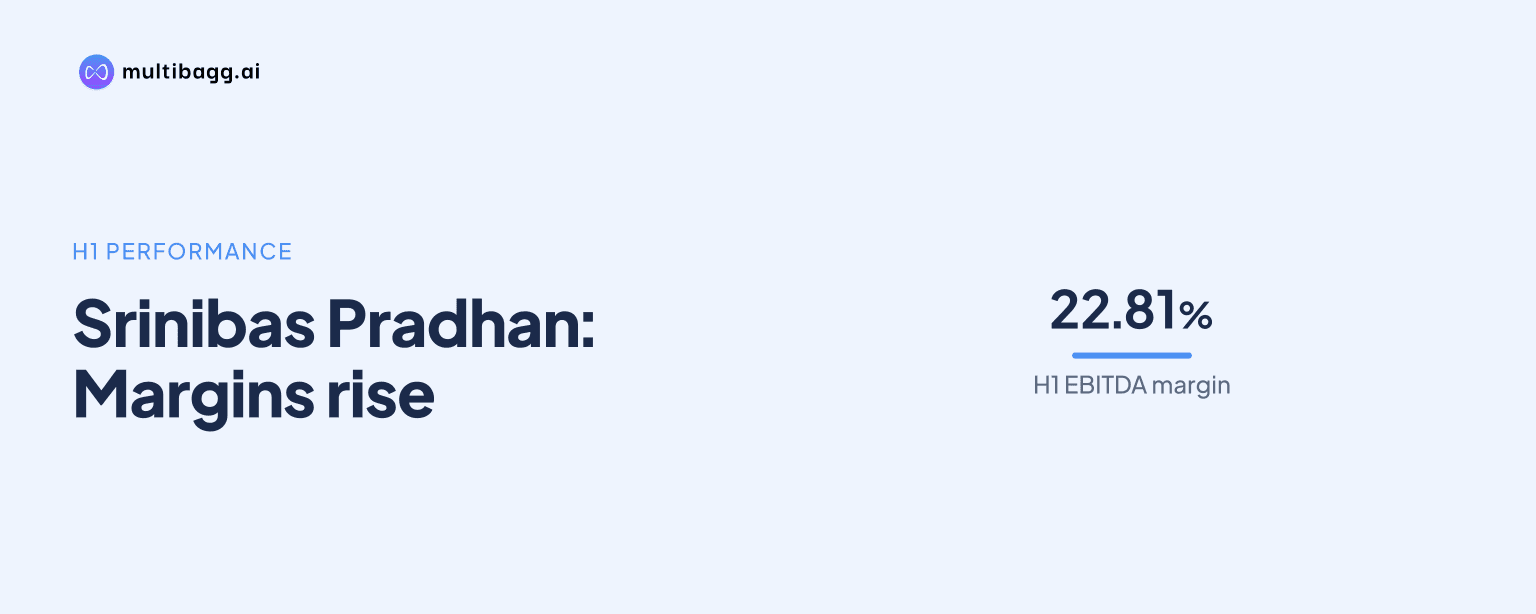
Srinibas Pradhan Constructions Limited reported a 13.88% year-on-year decline in H1 FY27 total income to ₹39.30 crore, while EBITDA margin increased to 22.81% and net profit rose 33.87% to ₹5.50 crore. The performance reflects stronger profitability despite disruption to bitumen supplies linked to the West Asia conflict.
Know Srinibas Pradhan Constructions inside out
Results, valuation, peers and who's buying, in one view.
Why did H1 FY27 total income decline?
SPCON said H1 FY27 total income fell because costly and inconsistent bitumen supplies slowed road-project execution. Total income was ₹39.30 crore for the half year, compared with ₹45.63 crore in H1 FY26. The company identified the West Asia conflict as the factor behind the disruption in bitumen availability and pricing.
Bitumen is a key input for road construction, making supply consistency important for the timing and cost of project execution. The presentation indicated that the disruption affected the pace of work rather than pointing to a reduction in the company’s stated project pipeline. SPCON did not provide quantified financial guidance for the remainder of FY27.
The company operates in roads and highways, bridges, industrial projects and civil construction. Its work includes rural, district and urban roads, bridges and steel structures, foundations, superstructures, factories and industrial facilities. It also bids for projects in Odisha across roads, bridges, irrigation, canals, civil works and industrial construction.
How did SPCON improve profitability despite lower income?
SPCON improved profitability through a substantial expansion in reported margins despite the fall in total income. EBITDA increased 17.18% year on year to ₹8.95 crore, and the EBITDA margin rose to 22.81% from 16.76%. The company reported margin expansion of 605.81 basis points.
Profit after tax increased 33.87% to ₹5.50 crore. The PAT margin reached 14.02%, compared with 9.01% in the corresponding prior-year period. These figures show that earnings grew even as total income contracted during the period.
Management’s outlook on margins remains conditional. It expects margins to hold if crude prices normalise, linking the sustainability of the improvement to the cost environment for bitumen and other petroleum-linked inputs. The presentation does not set out a specific revenue, margin or profit target.
Got a follow-up? Ask IRIS
What order book supports SPCON’s execution plans?
SPCON reported a consolidated order book of ₹161 crore as of 30 September 2026, with 58 ongoing projects. The company also stated that ongoing projects accounted for ₹152 crore, providing a stated base for future project execution.
An order book indicates contracted or awarded work that remains to be executed, but its conversion into reported income depends on project schedules, materials availability and site conditions. In SPCON’s case, the bitumen disruption illustrates how execution of road projects can be affected even when a company has work in hand.
The company has roots tracing back to 2001 and was incorporated as a public limited listed company on 25 September 2020. It is based in Jharsuguda, Odisha, and operates in the infrastructure, engineering and construction segment. Its service portfolio also includes turnkey delivery, supervision and consultancy, water-conservation work, equipment leasing and manpower sourcing.
What are the main customer and supply-chain risks for SPCON?
SPCON’s principal risks are its exposure to bitumen supply conditions and customer concentration. Government and public-sector undertaking clients accounted for 81.5% of revenue, while the top five clients represented 56% of revenue, according to the investor presentation.
Government and PSU contracts can provide a large addressable project base for an infrastructure contractor, but they also make business activity dependent on public-sector project execution and client concentration. The presentation does not disclose changes in these concentration levels from previous periods, so the figures describe the current reported exposure rather than a trend.
The West Asia-linked bitumen disruption also highlights the sensitivity of road contractors to crude-related input costs. Management’s stated expectation that margins can hold as crude normalises is therefore an operating assumption, not quantified guidance. Investors will need to track whether supply conditions stabilise and whether project execution converts the reported order book into income.
Conclusion
SPCON’s H1 FY27 presentation showed a split performance: total income fell 13.88% to ₹39.30 crore as road execution faced bitumen supply disruption, but EBITDA and PAT increased, lifting margins to 22.81% and 14.02%, respectively. The result places cost control and project execution at the centre of the company’s near-term financial performance.
The next factors to watch are the normalisation of crude and bitumen conditions, progress across the 58 ongoing projects, and conversion of the ₹161 crore order book into reported income. Management has not issued quantified guidance, making subsequent disclosures on execution and margins particularly relevant.