










SRIT proposes Rs 140 crore Blossom stake, targets 20% Carnot
Key highlights
- SRIT proposes a 50% Blossom stake with an indicative value of Rs 140 crore.
- SRIT proposes to invest Rs 5 crore for an initial 10% Carnot stake at an indicative Rs 50 crore valuation.
- Carnot’s target holding is 20% within 12 to 18 months, with the increase priced by an independent valuer.
- H1FY27 e-governance revenue was Rs 116.10 crore, versus healthcare revenue of Rs 18.20 crore.
powered by IRIS
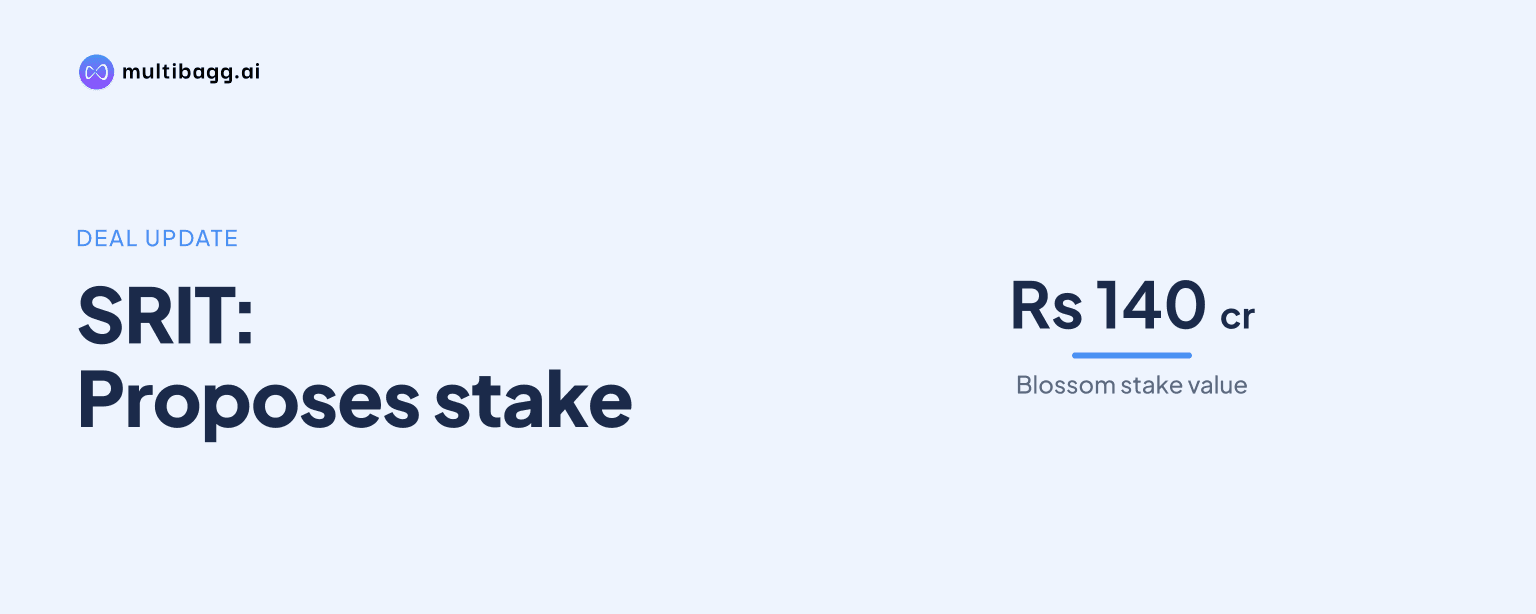
SRIT India Limited has signed term sheets for an indicative Rs 140 crore investment in a 50% stake in a new Blossom company and Rs 5 crore for 10% of Carnot Research, with a target to raise the Carnot holding to 20%. Both proposals remain subject to due diligence, valuation and approvals.
Know SRIT India inside out
Results, valuation, peers and who's buying, in one view.
What are SRIT’s proposed Blossom and Carnot investments?
SRIT proposes a 50% investment in a new Blossom company and an initial 10% investment in Carnot Research, linking healthcare delivery and sovereign artificial intelligence, or AI, to its existing technology capabilities. Blossom has historically screened more than 600,000 beneficiaries, while Carnot’s proposed holding could rise to 20% within 12 to 18 months.
Blossom is intended to provide clinical operations and field reach across six planned lines: mobile medical units, preventive care, diagnostics and laboratories, digital health, clinics, and hospitals. SRIT says it would add AI, analytics and digital infrastructure, with the stated objective of combining engineering capability and ground delivery into a HealthTech platform.
Carnot brings icarKno, an AI platform that the presentation says operates fully on premises and in an air-gapped environment, with 100% zero cloud dependency. It supports more than 22 Indian languages and provides answers citing their sources, which SRIT positions for defence, government technology and critical-infrastructure deployments where data cannot leave a customer’s site.
How are the proposed Blossom and Carnot stakes valued?
SRIT’s proposed 50% Blossom stake has an indicative value of Rs 140 crore, based on an indicated equity valuation of Rs 280 crore, while its initial 10% Carnot stake is priced at Rs 5 crore at an indicative Rs 50 crore valuation. The structures differ because Blossom is proposed as a 50% acquisition, whereas Carnot begins as a minority investment with a later step-up.
For Carnot, SRIT says the proposed increase from 10% to 20% will be priced by an independent valuer. The presentation does not disclose the consideration for the follow-on purchase or a final valuation for the 20% holding. For Blossom, the Rs 140 crore value is expressly indicative and remains conditional on due diligence, valuation and approvals.
Carnot has four deliverables already in the field, according to the presentation: NIDMS for the National Security Guard, SACHET with C-DOT, SAATHI for Delhi public transport, and BharGati for transport analytics. SRIT says it provides the government-client data layer while Carnot would contribute an AI layer, forming its proposed outcome-driven AI offering for government.
Got a follow-up? Ask IRIS
Why do the related-party disclosures matter for SRIT’s proposals?
The two proposals involve parties connected to SRIT’s board: Dr. Chandan Dash, identified as Blossom’s proprietor, and Dr. Amit Oberoi, identified as Carnot’s founder, are Non-Executive Directors of SRIT. The presentation identifies both transactions as signed term sheets, rather than completed acquisitions, making their due-diligence, valuation and approval conditions material.
SRIT targets Carnot definitive agreements around the end of November 2026 and Blossom completion within two to three months. These are disclosed target dates, not completion dates, and both transactions remain subject to due diligence, valuation and approvals. The presentation gives a specific independent-valuation mechanism only for Carnot’s proposed move from 10% to 20%.
The source does not disclose payment terms, a funding source, revenue forecasts, or final ownership terms beyond the proposed 50% Blossom stake and 10%-to-20% Carnot holding. It also does not disclose an expected consideration for Carnot’s second purchase. Those details will determine the final economics if the term sheets progress to definitive agreements.
How do the investments fit SRIT’s reported business mix?
The proposals align with SRIT’s three reported business exposures: e-governance, telecom and broadband, and healthcare. In H1 FY27, e-governance revenue was Rs 116.10 crore, telecom and broadband revenue was Rs 58.21 crore, and healthcare revenue was Rs 18.20 crore. Blossom is linked to healthcare delivery, while Carnot is positioned around government-client AI applications.
E-governance accounted for 60.3% of H1FY27 revenue, compared with 52.7% in Q2FY27, while telecom and broadband represented 30.2% against 35.3%, and healthcare accounted for 9.5% against 12.0%. Because H1FY27 covers six months and Q2FY27 covers one quarter, this is a comparison of revenue mix across periods of different duration rather than a quarter-on-quarter growth calculation.
In healthcare, SRIT already offers the Renaissance Health Enterprise Suite, a hospital enterprise-management product that it says is moving to software as a service with clinical decision-support modules. In e-governance, it cites citizen-service and supply-chain platforms, including SafeKerala. The presentation does not quantify revenue, profit or cash flow expected from either Blossom or Carnot.
Conclusion
SRIT’s two term sheets outline an expansion beyond technology implementation into healthcare delivery and sovereign AI. The Rs 140 crore indicative Blossom proposal is the larger disclosed commitment and would create a 50% holding, while the Rs 5 crore Carnot investment begins at 10% with a stated path to 20%. Their proposed roles correspond with SRIT’s healthcare and e-governance activities, but neither transaction had completed.
The next disclosed milestones are Carnot definitive agreements around the end of November 2026 and a Blossom completion target within two to three months. Investors will need to watch due diligence, valuation and approval outcomes, as well as the independent valuation of Carnot’s proposed increase to 20%, particularly given the disclosed Non-Executive Director links.