










SRIT India Limited relies on government tenders for 89% FY26 revenue
Key highlights
- SRIT India derived 89% of Fiscal 2026 revenue from government tenders.
- SRIT India's September 2025 order book was ₹1,280.62 crore, equal to about 3.29 times FY2025 revenue.
- Electronic governance accounted for 72.12% of SRIT India's order book.
- SRIT India won 6 of 43 bids in Fiscal 2026, producing a 13.95% bid-to-win ratio.
powered by IRIS
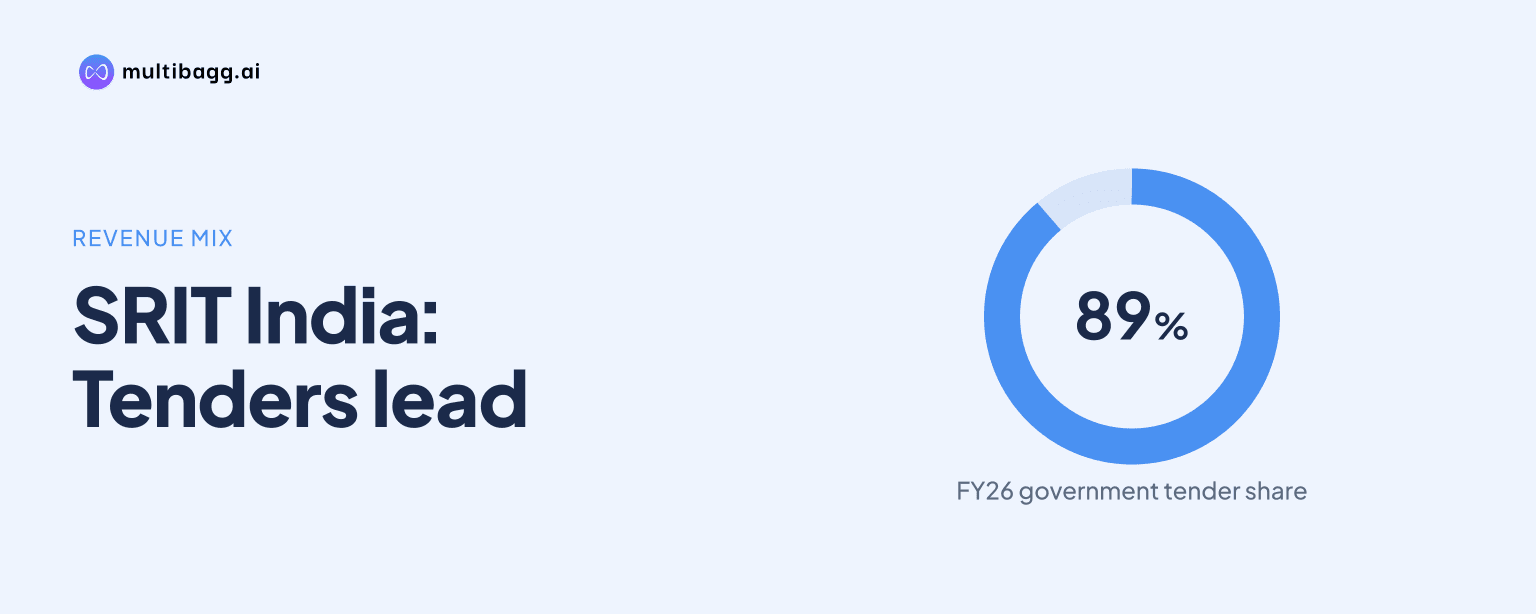
SRIT India Limited derived 89% of its Fiscal 2026 revenue from government tenders, underlining its dependence on public-sector technology spending despite an order book of ₹1,280.62 crore as of September 2025. The Bengaluru-based IT company has built its business around e-governance, healthcare, telecom and broadband projects.
Know SRIT India inside out
Results, valuation, peers and who's buying, in one view.
Why does SRIT India depend on government tenders?
SRIT India depends on government tenders because public-sector assignments accounted for 89% of its Fiscal 2026 revenue. The company provides technology-enabled solutions, system integration, operations and maintenance services to government clients and enterprises. Its work covers custom software, platform automation and turnkey system-integration projects.
The revenue concentration makes the company's performance closely linked to its ability to qualify for, win and execute government contracts. Tender-based work can offer sizeable project opportunities, but it also exposes revenue to procurement cycles, bid outcomes, project approvals and the pace of government spending.
SRIT India won six of the 43 bids in which it participated during Fiscal 2026. This resulted in a bid-to-win ratio of 13.95%, calculated as bids awarded divided by bids participated. The data shows that contract wins were selective rather than broad-based across all bidding opportunities.
What is SRIT India's order book position?
SRIT India's outstanding project orders were valued at ₹1,280.62 crore in September 2025, equivalent to about 3.29 times its FY2025 annual revenue. This order book represents work already secured but not fully executed, providing visibility into the company's pending delivery commitments.
The order book was concentrated in electronic governance, which accounted for 72.12% of the total. Healthcare represented 13.33%, while telecom and broadband accounted for 14.55%. The mix reinforces the central role of e-governance projects in SRIT India's operations.
Over the last decade, SRIT India executed more than 103 projects with an aggregate order value of about ₹1,234.72 crore. Its stated project record spans public governance, telecommunications and healthcare, sectors where system integration and ongoing maintenance can form part of the delivery requirement.
How has SRIT India's financial and client base changed?
SRIT India reported revenue growth at a 36.87% compound annual growth rate between FY2023 and FY2025, while profit after tax grew at a 30.73% compound annual growth rate over the same period. The figures point to growth during the period alongside an expanding project order base.
The company served an average of 65 clients in Fiscal 2026, compared with 61 in Fiscal 2025 and 75 in Fiscal 2024. The Fiscal 2026 client count was higher than the preceding year but below the Fiscal 2024 level.
For investors, these operating measures need to be read alongside the government concentration. A sizeable order book and historical growth provide context on execution activity, while the client count and tender conversion record indicate that business development and project delivery remain important operational variables.
Got a follow-up? Ask IRIS
What does the IPO schedule and valuation indicate?
SRIT India's IPO was scheduled to open on September 28, 2026, after anchor bidding on September 25, and close on September 30, 2026. The basis of allotment was indicated as being on or about October 1, 2026.
At the floor price of ₹123 per share, the total offer value was ₹206.64 crore. At the cap price of ₹130 per share, it was ₹218.40 crore. These figures describe the proposed offer size at the two ends of the stated price band.
The IPO information should be assessed with the company's disclosed business risks. The order book was significant, but its eventual conversion into revenue depends on continued execution of projects, customer acceptance and the timing of contractual milestones.
How does government exposure affect SRIT India investors?
Government exposure affects SRIT India investors because public tenders supplied nearly nine-tenths of Fiscal 2026 revenue and e-governance comprised more than 72% of the September 2025 order book. This creates concentration around government procurement and project-execution conditions.
A listed tender for the installation of CCTV surveillance systems at the Shiv Chhatrapati Sports Complex in Mahalunge Balewadi, Pune, carried a value of ₹5.7 crore and was marked awarded in an update dated October 27, 2026. The available information identifies the tender and its status, but does not establish SRIT India as the award recipient.
The relevant indicators for the company are order-book movement, fresh contract wins, bid conversion, client additions and delivery progress. These measures will show whether SRIT India can translate its project pipeline into reported revenue while managing its reliance on public-sector demand.
Conclusion
SRIT India's reported figures show a company with a substantial ₹1,280.62 crore order book, historical revenue and profit growth, and a business anchored in government technology projects. At the same time, 89% dependence on government tenders and a 13.95% Fiscal 2026 bid-to-win ratio highlight the importance of tender outcomes and disciplined project execution.
Investors can watch for developments following the September 28-30, 2026 IPO subscription period, the indicated October 1 allotment timeline, and updates on outstanding order execution. Changes in the e-governance-led order mix, contract awards and government-client concentration will remain central to evaluating the business.