










V-Marc India Limited Q2 Revenue Rises 72.6%, Cash Flow Turns Negative
Key highlights
- V-Marc India reported Q2 FY27 revenue of ₹719.8 crore, up 72.6% year on year.
- Q2 FY27 EBITDA was ₹87.9 crore and EBITDA margin was 12.21%.
- H1 FY27 operating cash flow was negative ₹45.7 crore as inventory days rose from 54 to 70.
- V-Marc India outlined ₹400 crore of FY27 capex and capacity of 3.8 lakh km.
powered by IRIS
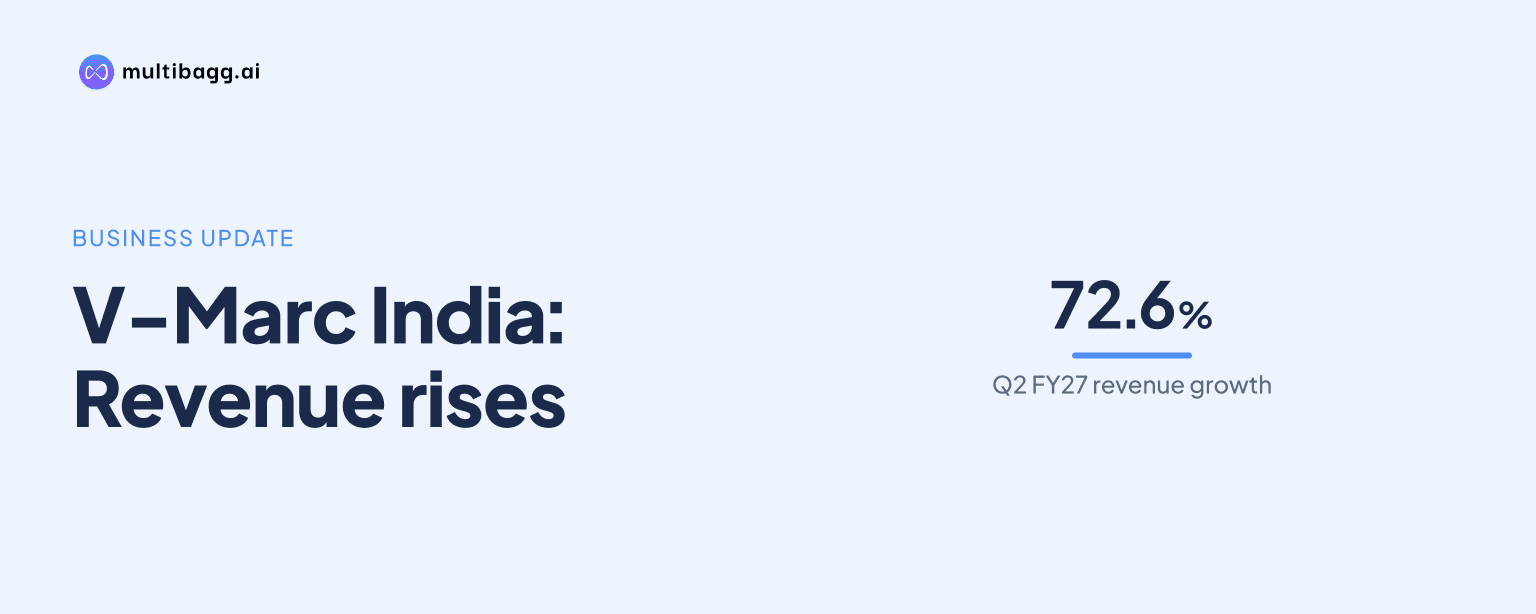
V-Marc India Limited reported Q2 FY27 revenue of ₹719.8 crore, up 72.6% year on year, but its H1 operating cash flow was negative ₹45.7 crore as inventory days increased from 54 to 70. The results show strong reported growth alongside a higher working-capital requirement and rising debt.
Know V-Marc India inside out
Results, valuation, peers and who's buying, in one view.
What did V-Marc India report for Q2 FY27?
V-Marc India reported revenue from operations of ₹719.8 crore in Q2 FY27, compared with ₹417.1 crore in Q2 FY26. Revenue was also 29.6% higher than ₹555.5 crore in Q1 FY27. The company’s earnings-call summary stated that H1 revenue grew 84.4% year on year.
Quarterly EBITDA rose 77% year on year to ₹87.9 crore from ₹49.5 crore. EBITDA margin was 12.21%, up 34 basis points from 11.87% a year earlier and 151 basis points above the 10.70% reported in Q1 FY27. Net profit for the quarter was ₹47.9 crore, up about 79.4% year on year.
For the first half, profit after tax was ₹76.4 crore, a rise of 103.8% year on year, according to the call summary. The combination of revenue and profit growth indicates that V-Marc India expanded output and sales while retaining an EBITDA margin within its stated full-year range.
Why did operating cash flow turn negative despite profit growth?
Operating cash flow turned negative ₹45.7 crore in H1 FY27 because the company built inventory, according to the earnings-call summary. Inventory days rose to 70 from 54, tying up more cash in working capital even as accounting profit increased.
This distinction matters because revenue, EBITDA and net profit are recorded under accrual accounting, while operating cash flow reflects the cash generated after movements in working capital. A rise in inventories can reduce operating cash flow when a company is preparing for higher production or sales, but it also increases the capital committed to day-to-day operations.
The summary also cited debt of ₹359 crore. Higher inventory and debt levels place greater importance on the pace at which inventory is converted into sales and receivables are collected. The call material did not provide a separate debt-reduction timetable.
What were the margin and channel trends in the quarter?
V-Marc India reported a Q2 gross margin of 22.5%, 30 basis points higher year on year. However, H1 gross margin was 21.2%, down 132 basis points from the comparable period, showing that the first-half margin trend was weaker than the quarterly result.
Management guided for a FY27 gross margin of 21% to 22% and an EBITDA margin of 11% to 12%. The Q2 EBITDA margin of 12.21% was slightly above that range, while the gross-margin outlook suggests the company expects input costs, product mix and pricing conditions to remain relevant through the year.
The chief financial officer said dealer, or B2C, sales declined 19% year on year in Q2. The source does not specify the absolute value of dealer sales or provide a detailed explanation for the decline. It does, however, identify a channel-level weakness within a quarter of overall revenue expansion.
Got a follow-up? Ask IRIS
What is V-Marc India planning for FY27?
V-Marc India outlined FY27 capacity of 3.8 lakh km and capex of ₹400 crore. The planned expenditure is linked to its expansion programme and comes while the company is managing a larger inventory base and negative first-half operating cash flow.
The company also raised its FY27 revenue-growth guidance to more than 60% from more than 40%, according to its investor-presentation summary. Separately, management referred to a longer-term objective of reaching more than ₹3,000 crore in sales and targeting 60% compound annual growth in overall business.
These targets indicate that capacity creation is central to the company’s strategy. But capex and inventory additions require funding, making the reported debt position and cash conversion important factors for investors assessing the quality of growth.
What risks did management identify for investors?
V-Marc India’s call summary identified inventory expansion, negative operating cash flow, debt and price pressure from UltraVolt as key risks. These factors can affect margins, cash requirements and the pace at which the company converts reported revenue into cash generation.
Competitive price pressure is particularly relevant in wires and cables, where pricing, raw-material movements and distribution reach can influence gross margins. The company’s FY27 gross-margin guidance of 21% to 22% provides the stated benchmark for assessing that operating environment.
The decline in dealer sales is another item to monitor because B2C distribution is an important route to market. The source does not provide a forecast for dealer-channel recovery, so the available information supports monitoring rather than drawing a conclusion about future channel demand.
Conclusion
V-Marc India delivered strong Q2 FY27 revenue, EBITDA and net-profit growth, with revenue reaching ₹719.8 crore and net profit reaching ₹47.9 crore. Yet the H1 operating cash outflow of ₹45.7 crore, inventory days rising to 70 and reported debt of ₹359 crore show that cash conversion has not matched the pace of reported earnings growth.
Investors will watch whether inventory normalises, dealer sales stabilise and operating cash flow improves during the remainder of FY27. They will also track progress on the ₹400 crore capex plan, the 3.8 lakh km capacity target, and management’s ability to maintain its 11% to 12% EBITDA-margin guidance amid competitive pricing pressure.