










V-MARC plans lower B2G mix as OEM sales reach H2 record
Key highlights
- V-MARC reported Rs 453 crore of B2G revenue in H1, up 86.9% year on year.
- V-MARC reported Rs 432 crore of B2B revenue in H1, up 75% year on year.
- Management said V-MARC’s H2 OEM sales will reach the highest level in its history.
- V-MARC’s working-capital cycle rose to 58 days in H1 from 51 days at FY26 end.
powered by IRIS
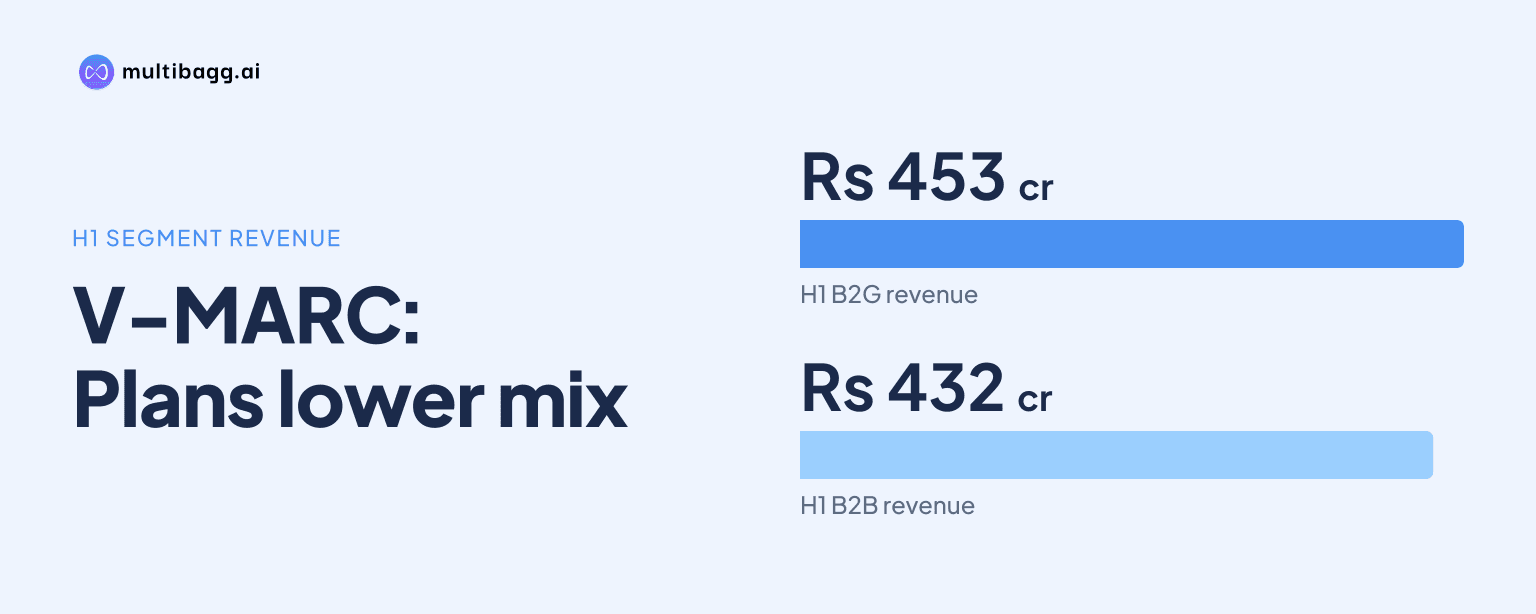
V-MARC India Limited plans to make B2G a smaller part of its revenue mix next year by expanding B2B and original equipment manufacturer, or OEM, sales, after B2G revenue rose 86.9% year on year to Rs 453 crore in H1. Management said OEM sales in H2 will reach the highest level in V-MARC’s history.
Know V-Marc India inside out
Results, valuation, peers and who's buying, in one view.
Why is V-MARC reducing its B2G revenue mix?
V-MARC is planning a gradual reduction in B2G’s share of revenue as it shifts future growth toward B2B and OEM customers. An analyst said receivables were highest in B2G, and Chairman and Managing Director Vikas Garg responded that V-MARC had already begun changing its mix and that B2G would gradually come down next year. The company did not disclose B2G-specific receivable days or an individual collection balance.
The B2G business remains a large part of the current sales base. Government sales increased 86.9% year on year to Rs 453 crore in H1, compared with B2B revenue of Rs 432 crore, up 75%. Together, the two channels represented about 70% of H1 revenue, meaning the stated plan is to alter the contribution of new growth rather than stop pursuing government business.
V-MARC also continues to pursue B2G opportunities while planning the mix change. Management said it had submitted bids of substantial value across B2G segments, with outcomes expected within about one month, and held three to four months of orders. This order pipeline indicates that government sales will remain part of operations while B2B and OEM activity is expanded.
How will B2B and OEM sales change V-MARC’s mix?
V-MARC expects OEM sales to be the most immediate additional channel in the planned mix shift. Garg said the company began supplying OEM customers in H1 and that automotive business, which also existed in the previous year, had performed well in the current year. He said H2 OEM sales would be at their highest level in V-MARC’s history, without providing either an OEM revenue figure or a target share of sales.
B2B is the other channel identified for expansion, with Rs 432 crore of H1 revenue and 75% year-on-year growth. Management linked its customer-diversification strategy to adding product categories across wires and cables. V-MARC also expects to become eligible for a 66 kilovolt rating within the current financial year after entering high-tension, or HT, cables.
The company’s product strategy is intended to support both customer channels. Management said it is introducing innovations in low-tension, or LT, cables and e-beam wire products, while expanding categories to address more applications. However, V-MARC did not disclose whether OEM customers will buy particular cable segments or whether B2B and OEM sales will carry different receivable terms than B2G.
What does V-MARC’s H1 customer mix show?
V-MARC’s H1 figures show B2G narrowly ahead of B2B, while exports emerged as another fast-growing channel. Exports reached Rs 181 crore, or 14.2% of H1 revenue, which was 2.9 times the Rs 62 crore exported in full-year FY26, V-MARC’s first year of exports. Q2 exports alone were Rs 118 crore, up 89% from Q1.
Dealer sales, also called business-to-consumer, or B2C, revenue, rose 3% year on year to Rs 207 crore in H1. That growth was lower than the 86.9% increase in B2G and the 75% rise in B2B. Management specifically identified B2B and OEM, rather than dealer sales, as the channels intended to reduce B2G’s relative contribution.
Product revenue also reflects a diversified operating base. HT cables were the largest H1 segment at Rs 585 crore, or 46% of revenue, after growing 62% year on year. Building wires and industrial cables generated Rs 485 crore, or 38%, with 181% growth, while LT cables contributed Rs 204 crore, or 16%, after 29% growth.
Got a follow-up? Ask IRIS
What working-capital pressures does V-MARC face?
V-MARC’s working-capital needs increased in H1 even though overall receivable days improved. Receivable days declined to 78 days in H1 from 85 days at the end of FY26, while inventory days increased to 70 days from 54 days. The working-capital cycle consequently rose by seven days to 58 days, and net working capital increased to Rs 406 crore on September 30 from Rs 251 crore on March 31.
Inventory rose by Rs 222 crore during H1 to Rs 488 crore, contributing to an operating cash outflow of Rs 45.7 crore. This contrasts with operating cash inflow of Rs 114 crore in full-year FY26, including Rs 108 crore on a standalone basis. Chief Financial Officer D.K. Bansal said V-MARC’s H2 priority is to bring inventory to the required level and turn revenue growth into cash.
Management also cited goods and services tax input tax credit, or GST ITC, linked to capital expenditure as a factor in the working-capital movement. Bansal said this credit is expected to flow in during H2 and improve working capital alongside revenue and other factors. V-MARC spent Rs 106 crore on capital expenditure in H1, and capital work-in-progress stood at Rs 57 crore.
How does V-MARC’s capacity plan support the sales shift?
V-MARC is expanding capacity while pursuing the B2G, B2B and OEM mix change. Capacity increased to 2,60,000 kilometres in H1 from 2,12,000 kilometres in FY26, and management expects it to reach 3,80,000 kilometres by FY27. Current utilisation was 60% to 65%, compared with the 70% to 75% industry range cited by management.
Management had provided 60% growth guidance for the current year. When asked about the following year, Garg said 40% would be conservative and said V-MARC would continue its product and geographic expansion policy. He also said the company would enter products where it is not currently present during the current year, but deferred naming them until after Q3, in Q4.
Expansion has required additional borrowing. Borrowings excluding lease liabilities increased to Rs 359 crore at September-end from Rs 213 crore in March. V-MARC reported debt-to-equity of 0.99 times and debt equal to 1.33 times earnings before interest, tax, depreciation and amortisation, or EBITDA, earned over the preceding 12 months.
Conclusion
V-MARC’s plan is to reduce B2G’s relative share by building B2B and OEM sales, while continuing to execute its existing government orders and pursue bids. The current mix shows why the change is consequential: B2G and B2B together accounted for about 70% of H1 revenue, while inventory growth lifted the working-capital cycle to 58 days and produced an operating cash outflow of Rs 45.7 crore.
The next measures to watch are management’s H2 OEM sales outcome, the planned inventory reduction and the expected GST ITC inflow. Investors can also track B2G bid outcomes expected within about one month, the product announcements management said would follow Q3 in Q4, and progress toward planned FY27 capacity of 3,80,000 kilometres.