










V-MARC raises FY27 growth guidance above 60% after H1 results
Key highlights
- V-MARC raised FY27 revenue-growth guidance to more than 60% from more than 40%.
- H1 FY27 revenue rose 84.4% year on year to Rs 1,275.36 crore.
- Installed capacity increased to 260,000 km at September 30, 2026, from 212,600 km at March 31, 2026.
- V-MARC plans approximately Rs 400 crore of further capital expenditure through FY30 for capacity above one million km.
powered by IRIS
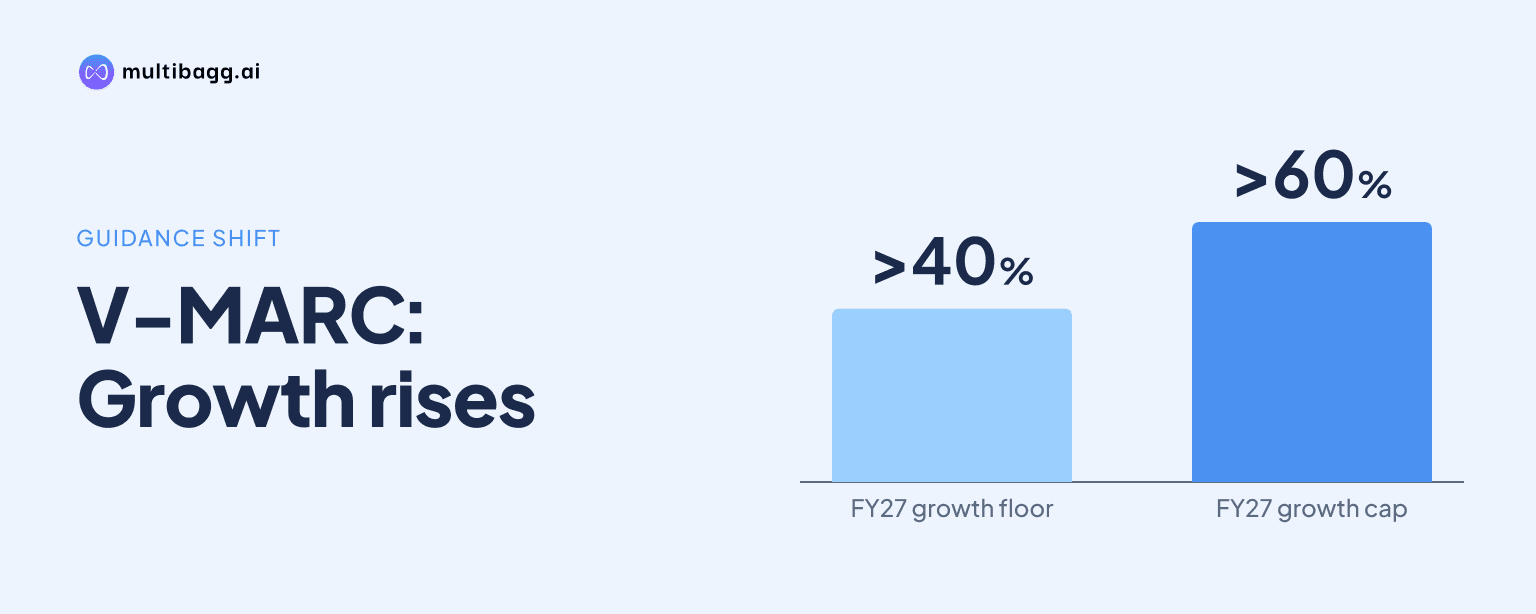
V-MARC India Limited raised FY27 revenue-growth guidance to more than 60% on November 6, 2026, after H1 FY27 revenue increased 84.4% year on year to Rs 1,275.36 crore. V-MARC also plans approximately Rs 400 crore of further capital expenditure through FY30 to take installed wire and cable capacity above one million km.
Know V-Marc India inside out
Results, valuation, peers and who's buying, in one view.
Why did V-MARC raise FY27 revenue-growth guidance?
V-MARC raised its FY27 revenue-growth guidance because its first-half performance was ahead of the pace implied by its earlier outlook. Management increased the target to more than 60% from more than 40% and retained its earnings before interest, tax, depreciation and amortisation (EBITDA) margin target of 11% to 12%. H1 FY27 EBITDA rose 84.3% year on year to Rs 147.33 crore, while the 11.6% margin was within the stated range.
The company attributed growth to demand for building wires and industrial cables, government and engineering, procurement and construction (EPC) channels, and exports. Building wires and industrial cables were the fastest-growing disclosed product category, with H1 FY27 revenue up 181% to Rs 485.38 crore. This compared with a 62% increase in high-tension cables to Rs 585.33 crore and 29.3% growth in low-tension cables to Rs 204.63 crore.
What revenue does V-MARC need in H2 FY27?
V-MARC needs about Rs 1,600.34 crore of revenue in H2 FY27 to reach the revenue level implied by more than 60% growth, according to its management presentation. This would be 44.8% above H2 FY26 revenue. H1 FY27 represented 44.3% of the Rs 2,875.70 crore revenue level implied by the revised guidance.
V-MARC reported Rs 719.85 crore of revenue in Q2 FY27, 29.6% above the Rs 555.51 crore recorded in Q1 FY27. Q2 profit after tax increased 79.7% year on year to Rs 47.91 crore, while H1 profit after tax rose 103.8% to Rs 76.43 crore. Profit after tax therefore grew faster than revenue in both the second quarter and first half.
How will V-MARC reach more than one million km capacity?
V-MARC plans approximately Rs 400 crore of further capital expenditure through FY30 to lift installed capacity above one million km. Installed wire and cable capacity was 260,000 km at September 30, 2026, after the addition of 47,400 km in H1 FY27. The FY30 target is more than 740,000 km above the installed level reported at the half-year date.
Capital expenditure in H1 FY27 was Rs 106.40 crore, adding 35,000 square metres of owned land and taking total land area to 92,600 square metres. Capacity rose 22.3% from 212,600 km at March 31, 2026, to 260,000 km at September 30, 2026. V-MARC also cited backward integration into compounds and conductors, operating efficiencies, and higher retail and export contribution as support for its FY27 outlook.
The specialised-product plan includes commissioning a second E-beam line and launching what management describes as India’s first E-beam submersible cable for agricultural applications. These actions sit alongside a distribution network of more than 1,200 dealers and more than 150 turnkey EPC contractors across 25 states and union territories. The source does not provide a separate revenue contribution from the E-beam products.
Got a follow-up? Ask IRIS
What balance-sheet changes accompany V-MARC's expansion?
V-MARC's net working capital rose to Rs 406.43 crore at September 30, 2026, from Rs 251.33 crore at March 31, 2026. The working-capital cycle lengthened by seven days to 58 days of revenue from 51 days. Management said inventories increased to support a higher scale of execution, while receivable days improved.
Borrowings excluding lease liabilities increased to Rs 359.82 crore at September 30, 2026, from Rs 213.66 crore at March 31, 2026, to fund capital expenditure and working capital. Debt to equity was 0.99 times, compared with 0.74 times at the March year-end. Debt to trailing 12-month EBITDA was 1.33 times, versus 1.06 times based on FY26 EBITDA.
How did V-MARC's margins and exports change?
V-MARC's Q2 FY27 EBITDA margin improved to 12.2%, from 11.9% in Q2 FY26 and 10.7% in Q1 FY27. Gross margin reached 22.5% in Q2, compared with 22.2% a year earlier and 19.6% in the preceding quarter. For H1 FY27, EBITDA margin was unchanged year on year at 11.6%, while gross margin declined to 21.2% from 22.6% because of the lower Q1 margin.
Profit after tax margin increased to 6.7% in Q2 FY27 from 6.4% in Q2 FY26, despite the effective tax rate rising to 27.5% from 23.4%. H1 profit after tax margin rose 57 basis points to 6.0% from 5.4%, while the effective tax rate was 25.5% against 24.6%. The retained EBITDA-margin guidance of 11% to 12% places the H1 result of 11.6% within management's range.
Exports were Rs 181.36 crore in H1 FY27, equivalent to 14.2% of revenue and 2.9 times the Rs 62.60 crore reported for all of FY26. Management identified Europe, the US and the Middle East and North Africa as target markets. Its plan includes attending six to 10 international cable and wire exhibitions during FY27 with a dedicated export team based in Mumbai.
Conclusion
V-MARC's more-than-60% FY27 revenue-growth guidance follows H1 revenue growth of 84.4% to Rs 1,275.36 crore and profit after tax growth of 103.8% to Rs 76.43 crore. The expansion plan combines a Rs 400 crore further-capex programme through FY30 with a move from 260,000 km of capacity at September 2026 to more than one million km.
The next measures to watch are H2 FY27 revenue of about Rs 1,600.34 crore required for the revised growth outlook, progress on the FY30 capacity programme, and six to 10 planned international exhibitions during FY27. Management's disclosed balance-sheet markers were net working capital of Rs 406.43 crore, borrowings of Rs 359.82 crore and a 58-day working-capital cycle at September 30, 2026.