










VIESL targets over 30% FY27 growth, aims for margin recovery
Key highlights
- VIESL targets approximately 30% or more FY27 revenue growth, subject to market conditions.
- H1 FY27 total income rose 38.6% year on year to Rs 398.92 crore.
- H1 FY27 EBITDA increased 30.4% year on year to Rs 101.99 crore.
- VIESL had 571 equipment units and reported debtor days of 90 at 30 September 2026.
powered by IRIS
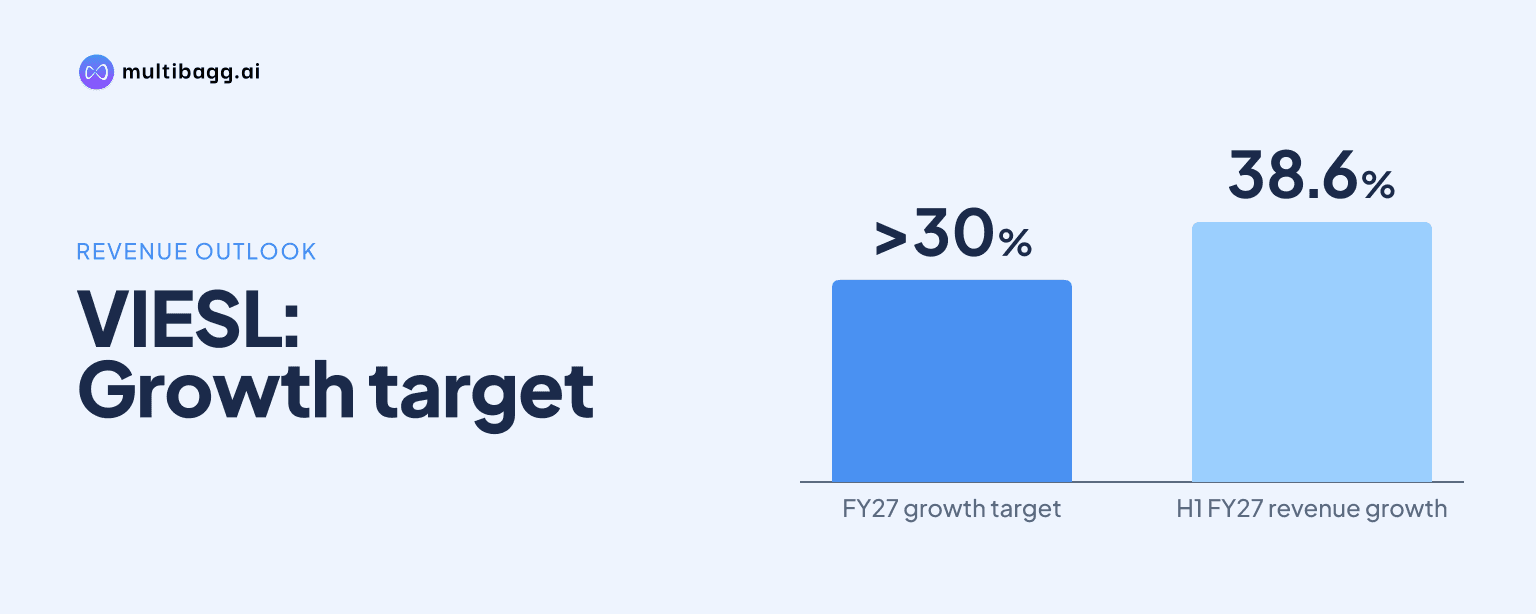
Vision Infra Equipment Solutions Limited is targeting more than 30% year-on-year revenue growth in FY27, subject to market conditions, while seeking EBITDA margin improvement through productivity, asset utilisation and cost optimisation. The objective follows H1 FY27 total income growth of 38.6% to Rs 398.92 crore and EBITDA growth of 30.4% to Rs 101.99 crore.
Know Vision Infra Equipment Solutions inside out
Results, valuation, peers and who's buying, in one view.
What is VIESL targeting for FY27?
VIESL is pursuing approximately 30% or more year-on-year revenue growth in FY27, subject to market conditions. Management also identifies strengthening Equipment-as-a-Service, or EaaS, broadening specialised solutions and selectively developing international opportunities as growth priorities. The release gives no rupee revenue target, quarterly outlook or numerical EBITDA margin target for FY27.
The objective follows results for H1 FY27, the half-year ended 30 September 2026, which the board approved on 5 November 2026. Total income, including other income, rose to Rs 398.92 crore from Rs 287.83 crore in H1 FY26, a 38.6% increase. That H1 growth rate exceeded the FY27 objective, although the company explicitly makes the full-year objective conditional on market conditions.
VIESL reported that EBITDA, defined as profit before tax plus finance costs and depreciation, grew more slowly than total income in H1 FY27. Profit before tax and profit after tax each more than doubled from H1 FY26. The company also disclosed a change in depreciation method from written-down value to straight-line method, effective 1 October 2025, which is relevant when reading profit comparisons across the two periods.
How does VIESL plan to improve EBITDA margins?
VIESL plans to improve EBITDA margins through productivity, better asset utilisation and cost optimisation. Management said external cost pressures had influenced operating margins, and said a better broader business environment combined with its productivity and cost work could provide opportunities for margin improvement over time.
The company has not quantified cost pressures, set a recovery timetable or disclosed a target EBITDA margin. Its stated actions are operational mechanisms rather than a specific profitability forecast: raising productivity, using assets more fully and controlling costs while pursuing the FY27 revenue objective.
Asset deployment is central to this approach because VIESL had 571 machines and equipment units as of 30 September 2026. Gross fixed assets increased to Rs 737 crore from Rs 602 crore, and net fixed assets rose to Rs 553 crore from Rs 471 crore. The release does not disclose fleet utilisation rates, revenue per unit or equipment-level returns.
VIESL also reported debtor days of 90 for H1 FY27, down from 104 in H1 FY26 under its reported calculation. Reported return on capital employed increased to 25.24% from 24.29%. Its strategic priorities include improving cash conversion and capital allocation, but no FY27 target was provided for either measure.
Got a follow-up? Ask IRIS
Which businesses support VIESL's growth plan?
VIESL’s growth plan centres on EaaS, specialised infrastructure solutions and technology-driven road rehabilitation and maintenance. EaaS covers specialised infrastructure equipment availability and, where contracted, equipment operations, technical support and output-linked solutions. VIESL says this commercial description does not change the statutory classification of rental, lease or service income.
The specialised portfolio includes crushing, soil stabilisation, recycling, milling, paving and piling, as well as integrated infrastructure solutions. VIESL has commenced technology-driven road rehabilitation and maintenance operations, adding to its service portfolio. It also said it held sizable order-book positions in integrated infrastructure solutions, without giving an order-book value, duration or project count.
VIESL intends to advance EaaS and broaden specialised solutions as part of the FY27 plan. However, the release does not split H1 FY27 income between rental, lease, service, output-linked, maintenance or other activities. The 38.6% increase in total income therefore cannot be attributed to a specific product or operating segment from this disclosure.
What is VIESL doing in Gulf markets?
VIESL is selectively pursuing Gulf-market opportunities through its wholly owned subsidiary, Vision Infra Equipment LLC, UAE. The subsidiary is intended to provide a platform for equipment deployment and allied infrastructure business opportunities across the Gulf region, alongside VIESL’s continued focus on India’s infrastructure sector.
The release does not disclose a Gulf contract, revenue contribution, capital commitment, equipment transfer or commercial operating start date. International activity is therefore presented as a selective strategic priority rather than a quantified FY27 revenue driver. VIESL’s strategic priorities identify the UAE subsidiary as the vehicle for developing selected Gulf-market opportunities.
Management says it will maintain disciplined growth and prudent capital allocation. While VIESL reported gross fixed assets of Rs 737 crore and 571 equipment units at 30 September 2026, it did not state how many units would be assigned to UAE or other Gulf work. Its forward-looking statement also says actual outcomes may differ materially because strategy and expected developments involve assumptions, risks and uncertainties.
Conclusion
VIESL has paired an approximately 30% or higher FY27 revenue-growth objective with measures intended to address management’s stated operating cost pressures. The disclosed strategy links EaaS, specialised services, road maintenance and selective Gulf opportunities to growth, while linking profitability improvement to productivity, asset utilisation and cost optimisation.
The next reported evidence to watch is progress against the FY27 objective, including changes in debtor days, asset utilisation and cash conversion, which are named strategic priorities. Management has not disclosed an EBITDA margin target, a timetable for margin recovery, or a revenue or investment target for the UAE subsidiary, leaving those outcomes unresolved.