










VIESL H1 FY27 profit rises 101% after depreciation change
Key highlights
- VIESL reported H1 FY27 profit after tax of Rs 43.45 crore, up 101.0% year on year.
- VIESL’s H1 FY27 total income rose 38.6% to Rs 398.92 crore and EBITDA rose 30.4% to Rs 101.99 crore.
- VIESL changed its depreciation method from written-down value to straight-line value effective 1 October 2025.
- VIESL reported 90 debtor days, 571 equipment units and gross fixed assets of Rs 737 crore at 30 September 2026.
powered by IRIS
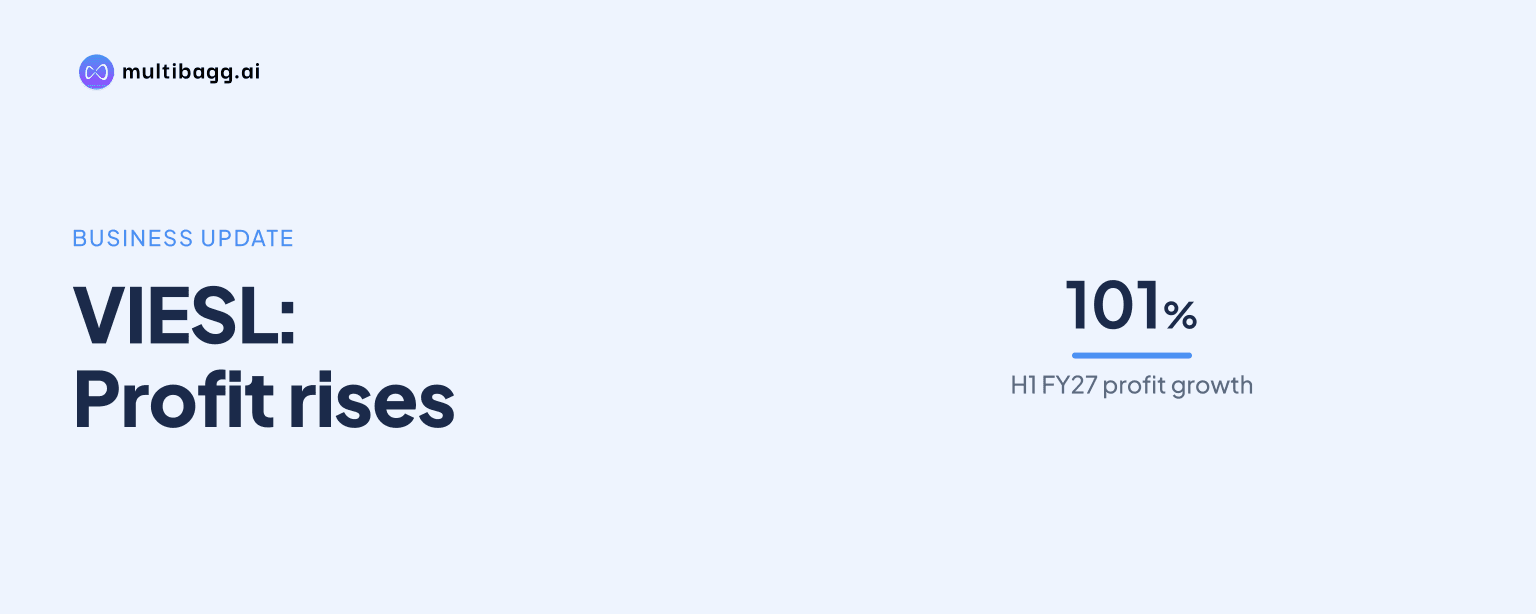
Vision Infra Equipment Solutions Limited reported H1 FY27 profit after tax of Rs 43.45 crore, up 101.0% year on year for the half-year ended 30 September 2026, while EBITDA rose 30.4% to Rs 101.99 crore. The comparison follows VIESL’s shift from written-down-value depreciation to the straight-line method effective 1 October 2025.
Know Vision Infra Equipment Solutions inside out
Results, valuation, peers and who's buying, in one view.
How did VIESL perform in H1 FY27?
VIESL increased total income by 38.6% year on year to Rs 398.92 crore in H1 FY27 from Rs 287.83 crore in H1 FY26. Total income includes other income, according to the release, making it broader than operating revenue alone. The Board approved the financial results on 5 November 2026, and VIESL issued its investor release on 6 November 2026.
EBITDA, defined by VIESL as profit before tax plus finance costs and depreciation, increased by Rs 23.76 crore to Rs 101.99 crore from Rs 78.23 crore. Its 30.4% growth rate was below the 38.6% increase in total income, while profit before tax rose 100.9% to Rs 58.04 crore. The reported figures therefore show profit before tax and profit after tax growing much faster than EBITDA during the comparison.
Profit after tax rose by Rs 21.84 crore from Rs 21.61 crore in H1 FY26. The difference between the 101.0% profit-after-tax increase and the 30.4% EBITDA increase is material because EBITDA excludes depreciation, whereas profit before tax and profit after tax include its effect. VIESL did not provide a line-by-line bridge for finance costs, depreciation and tax between the two half-years.
Why did VIESL’s profit rise faster than EBITDA?
VIESL disclosed a change in its depreciation method from written-down value to straight-line value effective 1 October 2025, but did not quantify the effect on H1 FY27 profit. H1 FY26 preceded the effective date, while H1 FY27 followed it. This means the reported comparison spans two depreciation-method regimes.
The company said the revised method aligns depreciation expense with the period in which assets earn revenue over their useful lives. Since depreciation is excluded from VIESL’s EBITDA calculation but included in profit before tax and profit after tax, the policy change is directly relevant to the gap between the 30.4% EBITDA increase and the 100.9% rise in profit before tax.
VIESL did not state the rupee impact of the revised method on H1 FY27 depreciation, profit before tax or profit after tax. It also did not restate the H1 FY26 profit after tax of Rs 21.61 crore on a straight-line basis. The release therefore permits identification of the accounting change, but not calculation of how much of the Rs 21.84 crore profit-after-tax increase came from operating activity rather than depreciation accounting.
Management said external cost pressures influenced operating margins in H1 FY27. It said an improved broader business environment, productivity measures and cost optimisation could create opportunities for margin improvement over time. This is management’s outlook and does not provide a quantified explanation for the reported EBITDA or profit growth rates.
Got a follow-up? Ask IRIS
What changed in VIESL’s assets and working capital?
VIESL reported gross fixed assets of Rs 737 crore, compared with Rs 602 crore in the reported prior comparison, an increase of Rs 135 crore. Net fixed assets increased by Rs 82 crore to Rs 553 crore from Rs 471 crore. The asset-base expansion sits alongside VIESL’s equipment deployment and infrastructure-solutions activities.
The company possessed 571 machines and equipment units as of 30 September 2026. Its Equipment-as-a-Service, or EaaS, framework covers specialised infrastructure equipment availability and, where contracted, equipment operations, technical support and output-linked solutions. VIESL said this commercial description does not alter the statutory classification of rental, lease or service income.
VIESL reported debtor days of 90, down from 104 under its own calculation, a reduction of 14 days. It also reported return on capital employed, or ROCE, of 25.24%, compared with 24.29%. The release does not disclose the receivables balance, capital-employed amount or calculation inputs behind those indicators.
The 571-unit fleet supports specialised services including crushing, soil stabilisation, recycling, milling, paving and piling. VIESL also said it commenced technology-driven road rehabilitation and maintenance operations. The release does not provide separate H1 FY27 revenue, utilisation or profitability figures for those activities.
What is VIESL planning for FY27?
VIESL’s stated FY27 revenue-growth objective is approximately 30% or more year on year, subject to market conditions. The objective follows H1 FY27 total-income growth of 38.6% to Rs 398.92 crore, but it is a management target rather than a reported full-year outcome. Management’s profitability priority is to improve EBITDA margins through productivity, better asset utilisation and cost optimisation.
The company plans to strengthen its EaaS proposition, broaden specialised solutions and selectively develop international opportunities. VIESL established wholly owned subsidiary Vision Infra Equipment LLC, UAE, as a platform to pursue equipment deployment and allied infrastructure opportunities across the Gulf region. The release does not disclose revenue, order intake or capital committed by the UAE subsidiary as of 30 September 2026.
VIESL said it continued to have sizable order-book positions in the integrated infrastructure-solutions segment, but did not provide an order-book value, customer concentration or execution schedule. Its strategic priorities also include improved cash conversion and capital allocation, alongside the reported 90 debtor days and Rs 737 crore of gross fixed assets. Actual outcomes may differ because the release says forward-looking statements involve assumptions, risks and uncertainties.
Conclusion
VIESL’s H1 FY27 results showed total income rising 38.6%, EBITDA increasing 30.4% and profit after tax increasing 101.0% to Rs 43.45 crore. The substantially faster increase in profit before tax and profit after tax than in EBITDA should be considered alongside the straight-line depreciation method adopted from 1 October 2025, whose financial effect was not quantified in the release.
The next disclosures to watch are progress toward management’s approximately 30% or more FY27 revenue-growth objective, efforts to improve EBITDA margins through utilisation and cost measures, and execution in the UAE and road-maintenance activities. Further detail on the stated sizable order book and the rupee effect of the depreciation-method change would clarify performance beyond the 30 September 2026 half-year.