










Shigan Quantum electronics revenue rose 224% in H1 FY27
Key highlights
- Shigan Quantum electronics revenue rose 224% to Rs 13.2 crore in H1 FY27 from Rs 4.1 crore in H1 FY26.
- Electronics increased to 10% of Shigan Quantum revenue in H1 FY27 from 4% a year earlier.
- Shigan Quantum consolidated revenue grew 17% to Rs 128.7 crore, while EBITDA rose 35% to Rs 12.2 crore in H1 FY27.
- Shigan Quantum commercialised BMS through Shigan Electronics Private Limited during H1 FY27 and secured new BMS customers.
powered by IRIS
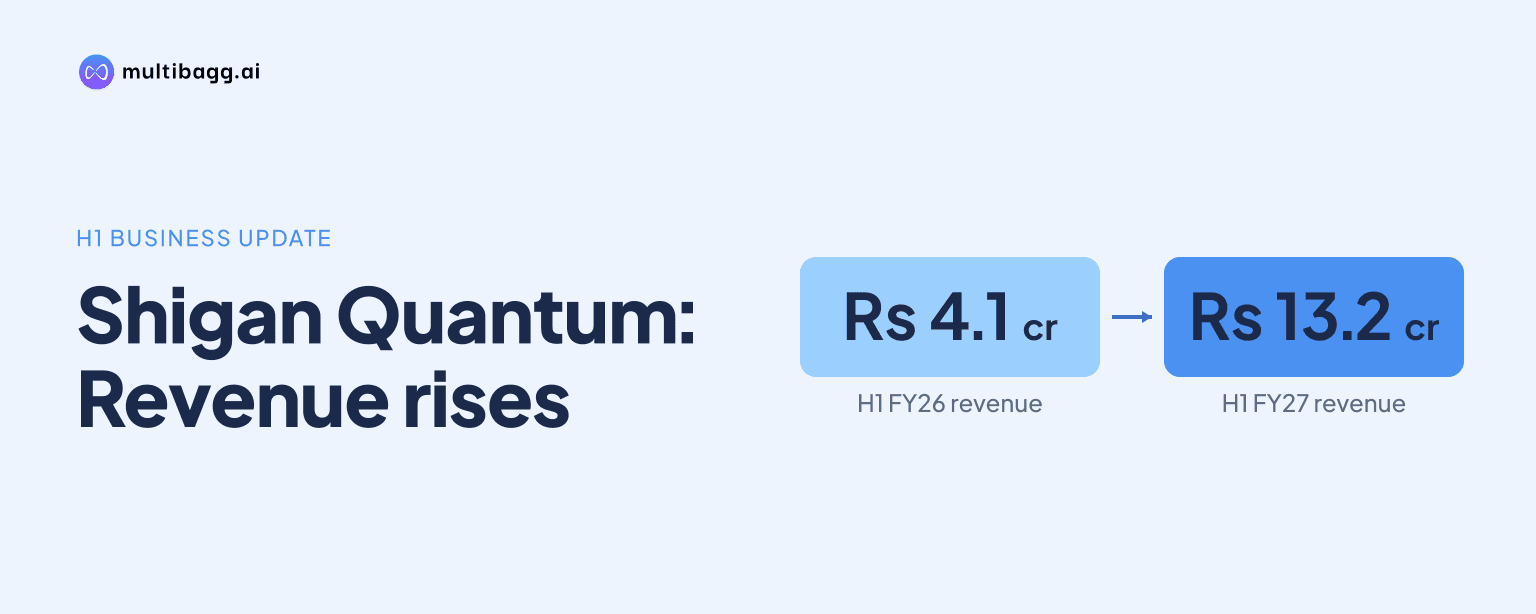
Shigan Quantum’s electronics business generated Rs 13.2 crore of revenue in H1 FY27, up 224% year on year from Rs 4.1 crore, and increased its contribution to group revenue to 10% from 4%. The rise followed commercialisation of battery management systems and work in converters and electronic manufacturing services.
Know Shigan Quantum Technologies inside out
Results, valuation, peers and who's buying, in one view.
What drove Shigan Quantum’s 224% electronics revenue increase?
Shigan Quantum’s electronics revenue rose by Rs 9.1 crore to Rs 13.2 crore in H1 FY27, with Battery Management Systems, DC-AC converters for 55T truck original equipment manufacturers, and electronic manufacturing services for L3 aftermarket BMS cited as the principal drivers. The 224% increase exceeded the growth rates reported for the company’s other two business lines during the half year.
Battery Management System, or BMS, commercialisation by wholly owned subsidiary Shigan Electronics Private Limited was a specific operational development in H1 FY27. The subsidiary also secured new BMS customers following commercialisation, according to the presentation. The disclosed DC-AC converter work relates to 55T truck OEMs, or original equipment manufacturers. The presentation does not disclose individual product revenue, customer names, order values or the number of BMS customers.
Electronic manufacturing services, or EMS, for L3 aftermarket BMS added another disclosed source of electronics activity. Management said the electric-vehicle and EMS businesses expanded with implementation of PM E-DRIVE and PM-eBus Sewa. This describes management’s view of the operating backdrop rather than a quantified forecast: the presentation does not give separate EV, EMS, BMS or converter sales for H2 FY27.
How did Shigan Quantum’s business mix change in H1 FY27?
Shigan Quantum’s electronics share of revenue rose to 10% in H1 FY27 from 4% in H1 FY26, while Alternative Fuel Systems fell to 65% from 71% and Fire Protection Systems remained at 25%. The business-line revenue figures show that electronics was the fastest-growing segment, whereas Alternative Fuel Systems remained the largest source of sales at Rs 84.2 crore.
Alternative Fuel Systems added Rs 6.3 crore year on year, compared with the Rs 9.1 crore increase in electronics. Shigan Quantum attributed the 8% Alternative Fuel Systems increase to new compressed natural gas passenger-vehicle launches by OEMs and higher passenger-vehicle volumes. Despite its absolute revenue increase, that segment’s mix share declined by six percentage points because electronics expanded faster.
Fire Protection Systems, or FPS, increased revenue by Rs 3.4 crore, or 12%, to Rs 31.3 crore in H1 FY27. Shigan Quantum linked this movement to demand for FPS solutions in electric buses and said it secured new customers for Fire Detection and Suppression Systems, or FDSS, in electric buses and sleeper coaches. Its reported 25% mix share was unchanged from H1 FY26, unlike the movement in electronics and Alternative Fuel Systems.
Got a follow-up? Ask IRIS
How did the business mix shift affect Shigan Quantum’s consolidated results?
Shigan Quantum reported consolidated revenue of Rs 128.7 crore in H1 FY27, up 17% from Rs 109.6 crore in H1 FY26, while EBITDA including other income rose 35% to Rs 12.2 crore. The faster increase in EBITDA than revenue coincided with a 119-basis-point improvement in EBITDA margin to 9.4% from 8.2%; one basis point equals one-hundredth of a percentage point.
Consolidated profit after tax was Rs 3.7 crore, up 52% from Rs 2.4 crore in H1 FY26, and earnings per share increased to Rs 1.82 from Rs 1.20. Total expenses rose 17% to Rs 117.6 crore, matching revenue growth, while cost of goods sold increased 18% to Rs 104.5 crore. Depreciation rose 68% to Rs 3.2 crore and interest increased 5% to Rs 3.97 crore.
The sequential comparison was different. Revenue of Rs 128.7 crore in H1 FY27 was 18% above Rs 108.8 crore in H2 FY26, but EBITDA of Rs 12.2 crore was 2% below Rs 12.4 crore and the EBITDA margin was 9.4%, compared with 11.2%. Profit after tax of Rs 3.7 crore was also below Rs 4.3 crore in H2 FY26. The presentation supplies these results but does not allocate margins or profitability by business line.
What capacity actions and policy factors could affect H2 FY27?
Shigan Quantum installed a helium testing machine, commissioned a clean room for assembly lines and upgraded existing product lines during H1 FY27 to raise productivity and capacity. The company said these actions are intended to support new business in compressed natural gas receptacle filling valves, increase its share of business and meet demand in the passenger-vehicle CNG segment.
For H2 FY27, Shigan Quantum identified PM E-DRIVE localisation and PM-eBus Sewa as factors expanding the EV and EMS businesses. It also cited upcoming Bharat Stage VII emission norms as expected to shape alternative-fuel demand. These are growth drivers presented by management, not revenue guidance, and the presentation does not provide a sales target, capital-expenditure amount or timing for the regulatory changes.
Shigan Quantum also said Automotive Industry Standard 135, or AIS-135, FPS requirements are extending to additional vehicle segments. Management linked FPS growth to AIS-135 implementation in electric buses and listed new FDSS customers for e-buses and sleeper coaches. The disclosed H1 FY27 evidence is the segment’s 12% revenue growth to Rs 31.3 crore; its eventual contribution in the second half is not quantified.
Conclusion
Shigan Quantum’s H1 FY27 business mix became less concentrated in Alternative Fuel Systems as electronics revenue increased from Rs 4.1 crore to Rs 13.2 crore. Electronics accounted for 10% of revenue after BMS commercialisation, new BMS customers, truck converter work and L3 aftermarket BMS EMS activity. At the group level, revenue grew 17%, EBITDA rose 35% and profit after tax increased 52% year on year.
The next reported evidence to watch is whether the new BMS customers, PM E-DRIVE and PM-eBus Sewa backdrop, and the expanded production setup translate into further electronics and EMS revenue in H2 FY27. Management has also identified Bharat Stage VII norms, broader AIS-135 application and new FDSS customers as potential demand influences, but it has disclosed no segment-level H2 target or order-value outlook.