










Shigan sees Rs 300+ crore fire-safety market in 3-4 years
Key highlights
- Shigan estimates a Rs 300+ crore fire-safety opportunity across EV, diesel and CNG fleets over the next three to four years.
- AIS-135 amendments are expected to move FDAS and FDSS coverage for EV buses towards mandatory compliance by 2026.
- PM e-Drive and PM e-Bus SEWA are described as targeting deployment of more than 50,000 buses by 2026.
- Shigan says AIS-135-compliant FDSS modules are already integrated by top OEMs.
powered by IRIS
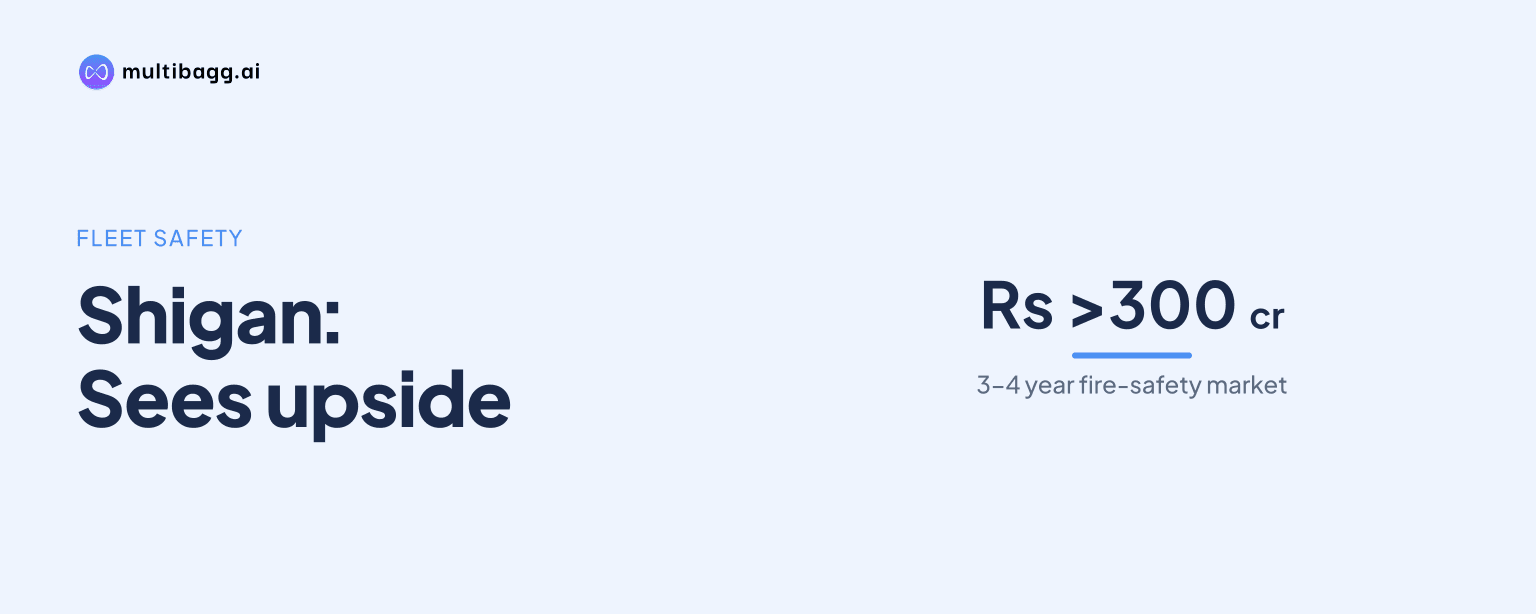
Shigan sees a Rs 300+ crore vehicle fire-safety opportunity over the next three to four years, as AIS-135 amendments are expected to move EV-bus fire detection and suppression towards mandatory coverage by 2026. The estimate spans EV, diesel and CNG fleets and includes detection, alarm, suppression and water-mist protection systems.
Know Shigan Quantum Technologies inside out
Results, valuation, peers and who's buying, in one view.
What is Shigan's fire-safety market opportunity?
Shigan estimates a Rs 300+ crore addressable market over the next three to four years for fire-protection systems used in EV, diesel and CNG fleets. The estimate is broader than electric buses alone, covering multiple commercial-vehicle fuel types and potential demand from original equipment manufacturers, or OEMs, fleet operators and retrofit customers.
Management presents fire safety as a prospective core revenue vertical and compares its potential role with the contribution CNG injectors made to Shigan's first growth cycle. That is management's strategic comparison rather than a financial forecast, because the presentation does not disclose current fire-safety revenue, order values, market share or installed-system volumes.
The opportunity includes four system categories. A Fire Detection and Alarm System, or FDAS, uses sensors and alarms in the engine, battery or saloon area to alert drivers and operators. A Fire Alarm System, or FAS, provides audio-visual warning in passenger areas, while a Fire Detection and Suppression System, or FDSS, adds automatic fire detection and suppression.
A Fire Alarm and Protection System, or FAPS, is Shigan's most integrated configuration, combining detection, suppression and water-mist sprinklers for vehicle and passenger protection. This product progression ranges from warning systems to automatic suppression covering battery packs, engines and saloon compartments.
Why could AIS-135 raise EV-bus fire-safety demand?
AIS-135 amendments are expected to soon mandate FDAS and FDSS coverage for EV buses, according to Shigan. Management expects a shift from voluntary compliance to regulatory compulsion by 2026, which could make compliance requirements a more direct demand driver for bus fire-safety equipment.
The presentation contrasts voluntary OEM adoption with the expected regulatory framework. Leading OEMs are already opting for integrated safety systems for asset protection and export readiness, while a mandatory requirement would broaden the need for compliant systems across EV buses. Shigan does not provide the final amendment text, technical thresholds or a confirmed implementation date.
Shigan links the expected rule change to PM e-Drive and PM e-Bus SEWA, which it says are intended to deploy more than 50,000 buses by 2026. The presentation states that these buses will require compliant fire-protection systems, but the 50,000-plus figure is a policy deployment tailwind rather than a disclosed Shigan order pipeline.
The EV-bus focus is tied to the battery-area coverage in FDAS and FDSS systems. However, the Rs 300+ crore estimate includes diesel and CNG fleets as well, meaning Shigan's market case also relies on engine and saloon protection requirements beyond battery-electric vehicles.
Which fire-protection products does Shigan offer?
Shigan's displayed fire-protection range includes a control panel, smoke detector, water-spray nozzle, nitrogen-pressure regulator, horns, strobe, nitrogen tank, water-tank assembly and solenoid. The component list indicates a system combining sensing, passenger warning, pressurised suppression media and controlled discharge.
The company describes a proprietary multi-zone Fire Controller architecture for EV and CNG buses. Its modular design supports battery, engine and saloon compartments, matching the FDSS application described in the presentation, where automatic detection and suppression can operate across these three vehicle zones.
Shigan's product range distinguishes an alert from a suppression response. FDAS alerts a driver or operator through sensors and alarms; FDSS combines detection with automatic suppression; and FAPS adds water-mist sprinkler protection. The presentation does not disclose unit prices, component sourcing, product-level capacity or separate economics for EV, CNG and diesel applications.
Although the market estimate includes diesel fleets, the Fire Controller description specifically refers to EV and CNG buses. Shigan does not provide separate diesel-system specifications or disclose how its component mix differs between battery-electric, CNG and diesel vehicles.
Got a follow-up? Ask IRIS
How is Shigan preparing to supply this market?
Shigan says its AIS-135-compliant FDSS modules have already been integrated by top OEMs. This is the presentation's clearest evidence of existing customer engagement, although it does not identify the OEMs, state the number of vehicle platforms involved, or disclose programme values, production volumes or revenue.
The company says it is working with the Defence Research and Development Organisation, or DRDO, the Centre for Fire, Explosive and Environment Safety, or CFEES, and certification bodies to align with upcoming EV safety mandates. Shigan also says its in-house design and validation are aligned with DRDO and Automotive Research Association of India, or ARAI, protocols.
Management describes its presence in EV-FDSS and FAPS as an early-mover advantage before the next regulation wave. That is a management assessment rather than a verified competitive ranking, as the presentation provides no rival comparison on certification, system cost, reliability, manufacturing capacity or market share.
The modular Fire Controller is central to Shigan's proposed supply model because it can support battery, engine and saloon configurations. The source does not state whether Shigan manufactures every listed part, including tanks, nozzles and sensors, or obtains any of them from external suppliers.
Where could Shigan generate fire-safety revenue beyond new buses?
Shigan plans to expand to state transport utilities, or STUs, and private fleet operators participating in PM schemes. This creates a route beyond direct OEM integration, but the presentation does not disclose STU tenders, fleet contracts, target vehicle counts or expected revenue from those channels.
The company also identifies aftermarket and retrofit potential across existing fleets seeking compliance upgrades. This differs from the OEM channel: factory-fit systems can be installed during vehicle production, whereas retrofits could address buses and other fleet vehicles already operating when compliance or fleet-safety requirements change.
Management says cost-engineered modules are intended to support mass scalability without margin erosion. No manufacturing capacity, bill of materials, module pricing, margin target or utilisation figure is provided, so this describes the intended operating model rather than a reported financial outcome.
Shigan's stated lifecycle approach therefore has three sales routes: OEM-installed modules, systems supplied to STUs and private fleet operators under public schemes, and retrofit upgrades for existing fleets. Conversion of the Rs 300+ crore estimate depends on the expected AIS-135 changes and on actual bus deployments and compliant-system purchasing.
Conclusion
Shigan's fire-safety strategy combines a Rs 300+ crore, three-to-four-year market estimate with an expected 2026 move towards mandatory EV-bus coverage under AIS-135. Its product range covers detection, alarms, automatic suppression and water-mist protection, while its target market includes EV, CNG and diesel fleets through OEM, fleet and retrofit channels.
The next factors to watch are the final timing and requirements of AIS-135 amendments, progress in PM e-Drive and PM e-Bus SEWA deployments towards more than 50,000 buses by 2026, and evidence of execution such as named OEM programmes, certifications, retrofit contracts or disclosed FDSS and FAPS revenue.