










V-Marc E-Beam Wires Carry Nearly 10% Premium Over PVC Wire
Key highlights
- V-Marc said e-beam wires are priced nearly 10% higher than normal PVC wire.
- V-Marc plans Rs 400 crore of capital expenditure to target 10 lakh kilometres of capacity by FY30.
- V-Marc said current exit capacity is 3.5 lakh kilometres.
- V-Marc operates through more than 1,200 dealers across more than 25 states and union territories.
powered by IRIS
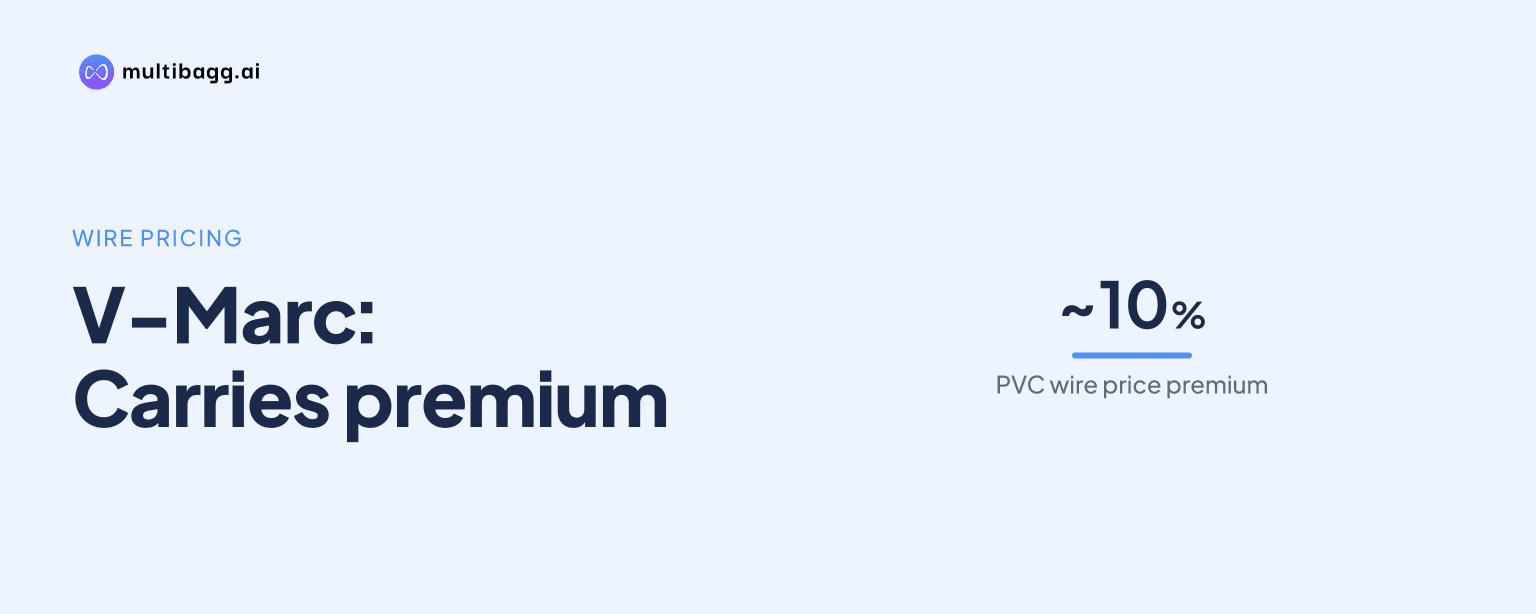
V-Marc said its e-beam wires carry a nearly 10% premium over normal PVC wire because they offer enhanced current-carrying capacity, fire resistance and heat resistance. V-Marc is seeking data-centre product approvals while planning Rs 400 crore of capacity and backward-integration capital expenditure through FY29.
Know V-Marc India inside out
Results, valuation, peers and who's buying, in one view.
Why do V-Marc e-beam wires carry a premium over PVC wire?
V-Marc said e-beam wire is priced nearly 10% higher than normal polyvinyl chloride, or PVC, wire. Chairman and Managing Director Vikas Garg linked the premium to enhanced current-carrying capacity, fire-resistance properties and heat resistance, describing the practical benefit to users as improved load-bearing capacity.
The comparison is technology-led rather than simply a difference between wire categories. Management said e-beam technology is the route through which the three cited performance improvements can be achieved, and it expects consultants and builders to adopt it because of fire-safety requirements. This is management’s expectation, not a disclosed sales forecast, and the call did not provide e-beam revenue, volumes, margins or its share of V-Marc’s wire portfolio.
The nearly 10% figure is a price premium versus PVC wire, not a disclosed gross-margin increase for V-Marc. Separately, the company said nearly 99% of its business-to-government, or B2G, sales are covered by price-variation clauses, while 10% to 12% of firm-price institutional orders are hedged on the Multi Commodity Exchange, or MCX. Management said these mechanisms result in minimal gross-margin impact from metal-price movements.
How is V-Marc pursuing data-centre demand?
V-Marc is pursuing data-centre supply opportunities by seeking approvals for its e-beam cable range. Management said it was already approved with some consultants serving data-centre contractors and was pushing to have its product range approved for data centres. Garg identified e-beam cables as the new technology referred to in that approval process.
Management said V-Marc expects to become part of the supply basket for data centres in coming months and quarters. That statement describes an intended commercial progression rather than confirmed orders: the call did not name a data-centre contractor, quantify approved products, disclose order value or give a date for first revenue. Consultant approvals are the disclosed mechanism for entering this end market.
The data-centre effort sits alongside a wider push towards retail and exports, which Chief Financial Officer D.K. Bansal called controllable segments compared with bid-specific government and institutional business. V-Marc said it operates across more than 25 states and union territories through a network of more than 1,200 dealers. Management also said roughly 75% of sales are concentrated in North and Central India, including Madhya Pradesh, Gujarat, Haryana and Uttar Pradesh.
Got a follow-up? Ask IRIS
What capacity investment is V-Marc planning through FY30?
V-Marc’s stated vision is to reach 10 lakh kilometres of capacity by FY30 through Rs 400 crore of capital expenditure. Management put current exit capacity at 3.5 lakh kilometres and said the gap of roughly 6 lakh kilometres would be addressed in FY27, FY28 and FY29. The Chief Financial Officer said the company expects additions of more than 2 lakh kilometres each year over those three years.
Management gave two descriptions of the annual build programme. Garg referred to capacity enhancement of about 1 lakh to 1.5 lakh kilometres annually over the next three to four years, while the Chief Financial Officer later described the FY27-to-FY29 gap as requiring additions of more than 2 lakh kilometres a year. The latter statement ties directly to the Rs 400 crore FY30 plan, but neither executive provided a year-by-year capacity schedule.
The new capital expenditure is focused on extra-high-voltage, or EHV, and high-tension/low-tension, or HT/LT, products rather than the earlier e-beam expansion aimed broadly at housing wires, according to management. The Rs 400 crore programme also includes backward-integration capital expenditure. Management said the investment could be met through a mix of internal accruals and debt, while any further equity issuance would be a Board decision.
How does e-beam fit V-Marc’s wider growth strategy?
V-Marc is using e-beam as part of a product-mix strategy while management expects all sales segments to grow. Bansal said retail and exports could grow faster because the company can push those channels directly, whereas B2G and business-to-business, or B2B, sales are influenced by order opportunities. V-Marc currently exports mainly copper wires and some LT cables to African countries and Nepal.
Management said certifications for Europe, the United States and Middle East and North Africa, or MENA, markets were under process. V-Marc is also trying for HT cable orders in these markets once certifications are secured. The call’s disclosed end-market initiative for e-beam was data centres; it did not provide a railway, electric-vehicle charging or automotive-cable plan, revenue target or order book for e-beam products.
Nearer-term retail conditions were mixed. Management said dealer sales rose 3% year on year in the first half, while second-quarter dealer sales declined 19% year on year, citing an extended rainy season and spikes in copper and aluminium prices. It said it expected to cover that gap in the second half, whereas e-beam adoption was presented as a longer-term product and safety proposition rather than a quantified remedy for the retail slowdown.
Conclusion
V-Marc’s disclosed e-beam proposition is a nearly 10% price premium over PVC wire in return for higher current-carrying capacity and improved fire and heat resistance. Its current commercial route centres on consultant approvals for data centres, while its broader plan combines retail, exports, EHV and HT/LT products with an expansion towards 10 lakh kilometres of capacity by FY30.
The next milestones to watch are management’s stated move into data-centre supply baskets in coming months and quarters, progress towards certifications in Europe, the United States and MENA, and execution of the Rs 400 crore FY27-to-FY29 capital programme. Management has not quantified prospective e-beam revenue, margins or capacity, leaving those measures unresolved.