










V-Marc targets 10 lakh km capacity by FY30 with Rs 400 crore
Key highlights
- V-Marc targets 10 lakh kilometres of capacity by FY30, versus 3.5 lakh kilometres of current exit capacity.
- V-Marc plans Rs 400 crore of capex across FY27 to FY29, including backward integration.
- Management indicated additions of more than 2 lakh kilometres a year in FY27, FY28 and FY29.
- V-Marc reported net working capital of 58 days in H1, compared with 51 days in FY26.
powered by IRIS
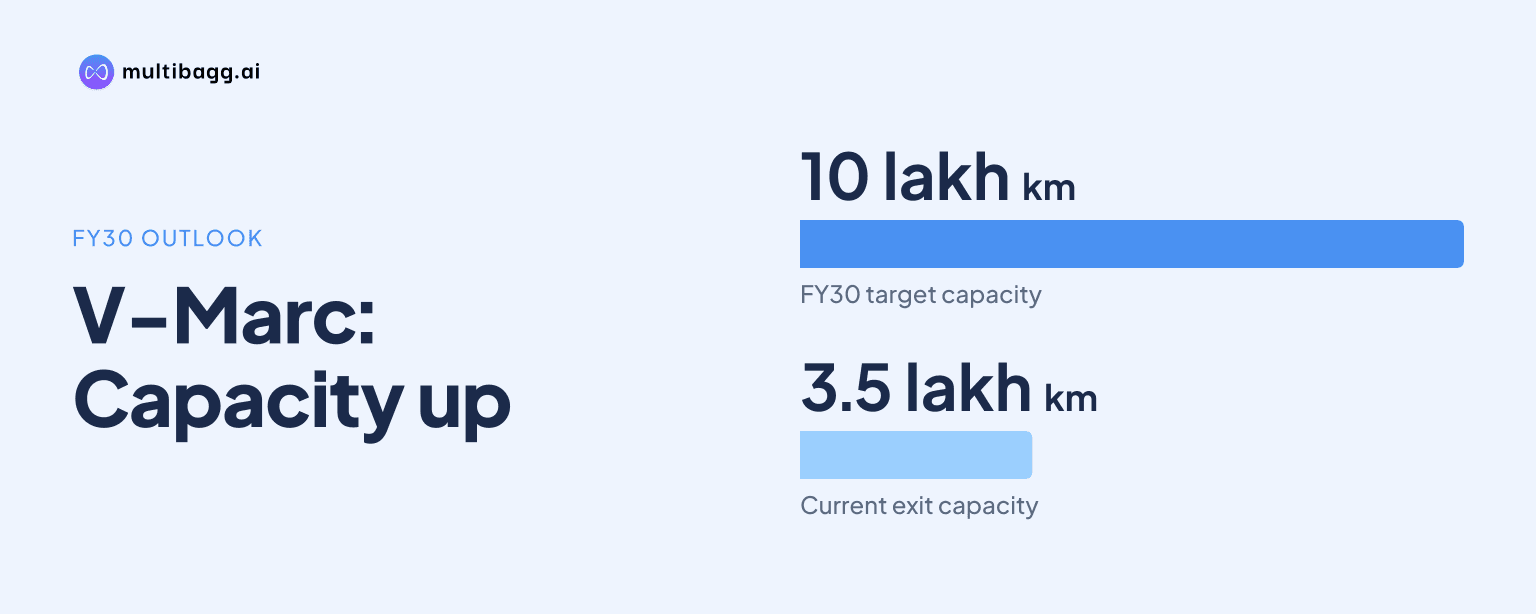
V-Marc plans to reach 10 lakh kilometres of capacity by FY30, from 3.5 lakh kilometres cited as current exit capacity, through Rs 400 crore of capital expenditure over FY27 to FY29. Management said the programme includes backward integration and can be financed with internal accruals and debt, subject to Board decisions on any equity.
Know V-Marc India inside out
Results, valuation, peers and who's buying, in one view.
What capacity is V-Marc targeting by FY30?
V-Marc is targeting 10 lakh kilometres of capacity by FY30, compared with 3.5 lakh kilometres of current exit capacity cited by Chairman Vikas Garg. The difference between those two stated levels is 6.5 lakh kilometres, while the Chief Financial Officer described the remaining gap as “roughly” 6 lakh kilometres over the next three financial years.
The Chief Financial Officer said V-Marc would add more than 2 lakh kilometres annually in FY27, FY28 and FY29, with the objective of reaching the 10 lakh-kilometre vision by 2030. That would put the expansion programme over a three-year period, rather than defer most capacity additions until FY30.
The call contained a second, less aggressive annual range from the Chairman, who said capacity was being enhanced by around 1 lakh to 1.5 lakh kilometres a year over the next three to four years. V-Marc did not reconcile that range with the Chief Financial Officer’s indication of additions of more than 2 lakh kilometres a year, so the precise annual commissioning schedule remains undisclosed.
How will V-Marc deploy Rs 400 crore of capex?
V-Marc plans to spend Rs 400 crore on the capacity programme over FY27 to FY29, with the Chief Financial Officer indicating annual expenditure of around Rs 125 crore. The Chairman separately referred to Rs 100 crore to Rs 125 crore a year over the next two years, indicating that the company has provided an approximate spending range rather than fixed annual allocations.
The new spending is aimed at extra-high-voltage, high-tension and low-tension cable products, rather than the housing-wire focus of the earlier investment cycle. Management said capex from FY23 to FY26 included expansion of its electron-beam, or e-beam, facility, which was broadly focused on housing wires. It attributed the differing capital required per kilometre of capacity to product mix, not lower equipment costs.
Backward integration is included in the Rs 400 crore programme. In response to an analyst who referred to an FY27 margin range of 11% to 12%, the Chief Financial Officer said the team was working on backward integration and was confident that margins would improve in coming years. Management did not disclose the processes involved, the capex allocation or a quantified margin benefit.
The company is also pursuing e-beam cable applications, including potential data-centre supply. Management said e-beam cables offer higher current-carrying capacity, fire resistance and heat resistance than polyvinyl chloride, or PVC, wire, while costing nearly 10% more. V-Marc said it had approvals from some consultants serving data-centre contractors and expected to join the supply basket in coming months and quarters.
Got a follow-up? Ask IRIS
How will V-Marc finance the FY30 expansion?
V-Marc expects internal accruals and debt to fund the Rs 400 crore plan. The Chief Financial Officer cited sufficient profit after tax in FY26 and good profit after tax in the first half, or H1, as support for internal funding, and said the three-year capex programme could be met through a mix of accruals and debt.
V-Marc has not said that further equity is permanently ruled out. Asked whether more equity dilution would be needed, the Chief Financial Officer said that decision rests with the Board, while maintaining that the Rs 400 crore programme was manageable through internal accruals and debt. The disclosed financing approach therefore does not set a requirement for a further equity raise.
Management also said it was confident of maintaining positive cash flow over the next couple of years despite the planned capital expenditure. In discussing higher debt, the Chief Financial Officer said internal accruals would fund the promoters’ portion and debt would be used on a case-by-case basis for the company’s vision through 2030.
Net working capital was 58 days in H1, compared with 51 days in FY26, according to management. The 7-day increase was attributed mainly to higher inventory and other current assets, while debtor days had reduced. Management said the other current assets would convert into cash in H2 and targeted a return to its range by Q3.
What operating factors could affect the capacity plan?
V-Marc is expanding against management’s view that the wires-and-cables market is growing 15% year on year and that the company held 1.8% market share based on FY26 results. Management identified grid upgradation, exports, transmission projects and the conversion of overhead power lines to underground lines as opportunity areas, but did not disclose an order book or project commitments supporting the FY30 target.
Management expects government, institutional, retail and export segments to grow, but identified business-to-consumer retail and exports as areas where it can exert more control. Government sales and institutional business-to-business sales depend more on bids and order opportunities. V-Marc said it has more than 1,200 dealers across more than 25 states and union territories.
Retail demand weakened during the reported first half. Management said dealer sales rose 3% year on year in H1 but fell 19% year on year in the second quarter. It attributed the quarterly decline to an extended rainy season, increases in copper and aluminium prices, and a broader sector demand slowdown, while expecting to cover the shortfall in H2.
Commodity-price clauses and hedging are part of V-Marc’s margin management. Management said about 99% of business-to-government, or B2G, sales include price-variation clauses, while 10% to 12% of institutional orders are fixed-price and hedged through the Multi Commodity Exchange. It said retail sales and exports are market-driven, resulting in minimal gross-margin impact from price movements, and expected gross margin to remain in the 21% to 22% range, all else equal.
Conclusion
V-Marc has set out a substantial manufacturing expansion from 3.5 lakh kilometres of current exit capacity to 10 lakh kilometres by FY30, using Rs 400 crore of planned capex. The programme shifts investment toward extra-high-voltage, high-tension and low-tension products, includes backward integration, and is intended to use internal accruals and debt rather than a defined additional equity raise.
The next disclosures to watch are capacity additions and capex deployment across FY27, FY28 and FY29, for which management indicated more than 2 lakh kilometres and around Rs 125 crore annually. Management’s stated Q3 working-capital target, recovery in dealer sales after the 19% second-quarter decline, and eventual disclosure of backward-integration economics will further clarify execution of the FY30 plan.