










Star Cement Limited Q2 FY27 Profit Falls 44% as Costs Rise
Key highlights
- Star Cement reported Q2 FY27 revenue of ₹831 crore, up 2.5% year-on-year from ₹811 crore.
- Q2 FY27 net profit fell 44.3% year-on-year to ₹39.58 crore.
- EBITDA declined to ₹164 crore from ₹194 crore, while per-tonne EBITDA was ₹1,372.
- Cement sales rose 4.8% year-on-year to 11.23 lakh tonnes, and management guided for 12% to 13% growth in Q3 and Q4.
powered by IRIS
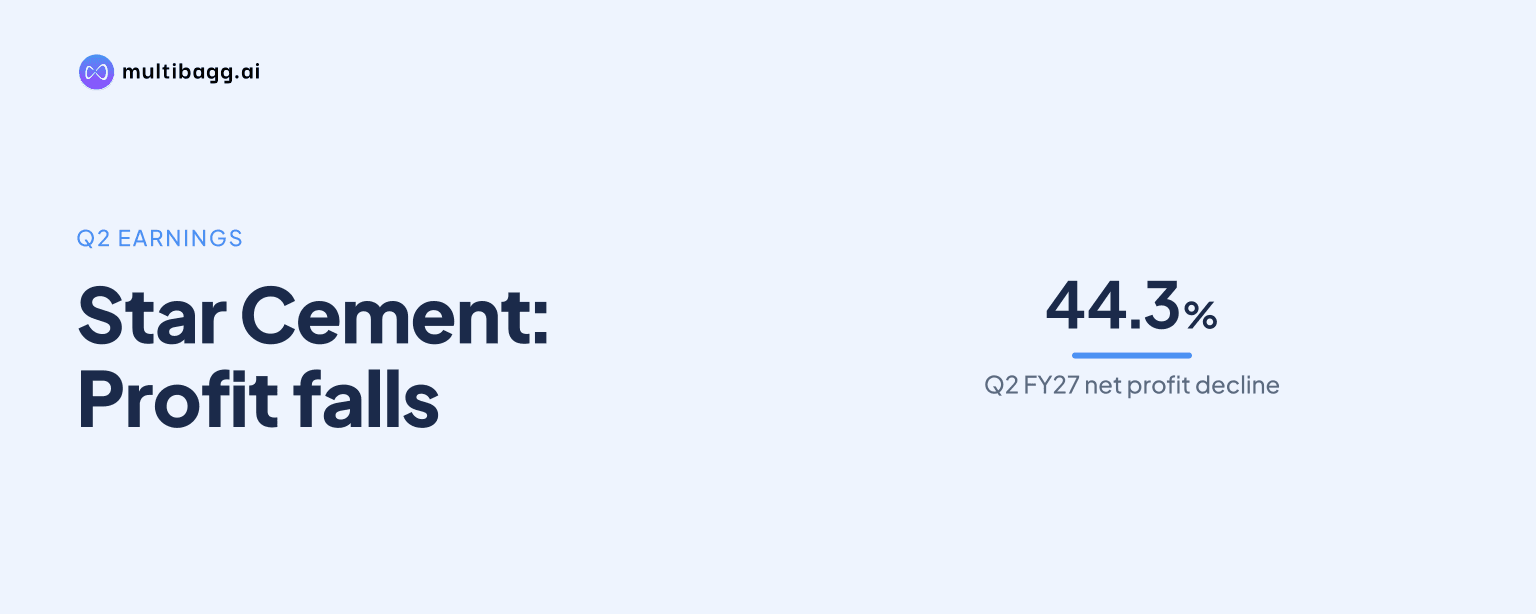
Star Cement Limited reported Q2 FY27 revenue of ₹831 crore, up 2.5% year-on-year, but net profit fell 44.3% to ₹39.58 crore as EBITDA declined to ₹164 crore from ₹194 crore in the comparable quarter.
Know Star Cement inside out
Results, valuation, peers and who's buying, in one view.
Why did Star Cement's Q2 FY27 profit decline?
Star Cement's Q2 FY27 profit declined because operating profitability fell despite an increase in cement sales volumes and revenue. Revenue for the quarter ended September 2026 rose to ₹831 crore from ₹811 crore a year earlier, while EBITDA fell by 15.5% to ₹164 crore from ₹194 crore.
The lower EBITDA translated into a sharper reduction in profit after tax. Net profit was ₹39.58 crore, down 44.3% year-on-year. The earnings-call summary attributed the weaker profitability to cost pressure and a decline in per-tonne EBITDA, which was reported at ₹1,372 for the quarter.
Cement sales volume rose to 11.23 lakh tonnes from 10.72 lakh tonnes, a 4.8% year-on-year increase. However, the modest revenue growth relative to the volume increase, together with lower EBITDA, indicates that higher volumes did not offset pressure on realisations and costs during the quarter.
Management maintained its FY27 per-tonne EBITDA guidance of ₹1,500 to ₹1,600. This places the reported Q2 per-tonne EBITDA below the guided range and makes cost control and demand recovery important factors for the second half of the financial year.
What were Star Cement's production and sales figures?
Star Cement produced 11.56 lakh tonnes of cement in Q2 FY27, compared with 10.83 lakh tonnes in Q2 FY26, while clinker production was marginally lower at 9.08 lakh tonnes. The company had produced 9.18 lakh tonnes of clinker in the year-earlier quarter.
The company sold 11.23 lakh tonnes of cement during the quarter. Sales outside the Northeast stood at 3.27 lakh tonnes, compared with 2.88 lakh tonnes a year earlier. This increase suggests a larger contribution from markets beyond the company's core Northeast region.
Management said the product mix was about 18% ordinary Portland cement, or OPC, with the balance comprising Portland pozzolana cement, or PPC. Trade accounted for 77% of sales, according to the management commentary on the call.
What affected demand during the quarter?
Star Cement said demand in the Northeast was affected by floods and elections during Q2 FY27. The call summary indicated that volumes in Assam and Nagaland were down by about 25%, illustrating the regional disruption during the period.
These conditions affected the company's core operating region at a time when overall cement volumes still increased by 4.8%. Higher sales outside the Northeast partly supported the total volume performance, although the quarter's revenue growth remained limited at 2.5%.
Management cited October volume growth of more than 12%, indicating an improvement after the Q2 disruptions. It also guided for 12% to 13% volume growth in both the third and fourth quarters. This outlook is separate from the company's full-year FY27 cement volume growth guidance of 7% to 8%.
The company had earlier revised its annual volume growth guidance down from 12% to 8% to 9% for FY27. The subsequent reaffirmation of 7% to 8% guidance reflects the impact of the first-half operating environment and the need for stronger second-half demand to meet the full-year target.
Got a follow-up? Ask IRIS
What is Star Cement's outlook on costs and expansion?
Star Cement expects coal supply conditions to ease and expects savings from railway siding operations, both of which management cited while discussing second-half growth and profitability. Coal availability and logistics costs are important for cement producers because fuel and freight have a direct bearing on per-tonne operating costs.
The company also faces industry supply considerations. The call summary noted new Northeast capacity from Ambuja and JK Lakshmi as a potential factor that could put pressure on pricing. The company did not provide a quantified assessment of the expected impact.
On expansion, management indicated that a Siliguri grinding project would involve capital expenditure of about ₹350 crore, compared with about ₹550 crore for a Bihar alternative. It also said the Nimbol project capital expenditure would remain within an approximate ₹3,000 crore envelope.
For investors, the key issue is the balance between volume growth, per-tonne profitability and capital spending. Q2 demonstrated that higher sales volumes alone did not protect earnings when operating costs rose and EBITDA per tonne weakened.
How does the Q2 result affect investors and the cement market?
Star Cement's Q2 result shows a divergence between sales growth and earnings growth. Cement volumes increased, but EBITDA fell and net profit declined substantially, highlighting the effect of cost pressure and negative operating leverage on the company's quarterly financial performance.
The reported ₹164 crore EBITDA and ₹39.58 crore profit after tax provide the clearest measure of the quarter's earnings pressure. The company’s reaffirmed per-tonne EBITDA guidance of ₹1,500 to ₹1,600 will be a closely tracked benchmark, as Q2 EBITDA per tonne was ₹1,372.
For customers and trade channels, the 77% trade share underlines the importance of retail-led cement demand to Star Cement's operations. For the wider regional industry, weather disruptions, elections, coal supply conditions and additional capacity are all relevant to volumes, costs and pricing conditions.
The earnings call was held on 12 November 2026, with Tushar Bhajanka, Managing Director and CEO, and Manoj Agarwal, Chief Finance Officer, representing the company. The transcript was described as preliminary, so the financial figures and management commentary should be read alongside the company’s final filings.
Conclusion
Star Cement delivered higher Q2 FY27 revenue and cement sales volumes, but lower operating profitability led to a 44.3% decline in net profit. The result reflects the effect of cost pressure, regional demand disruption and weaker per-tonne EBITDA even as sales outside the Northeast increased.
Investors will watch Q3 and Q4 volume growth against management's 12% to 13% outlook, progress on coal supply and railway-siding savings, and whether per-tonne EBITDA moves toward the ₹1,500 to ₹1,600 FY27 guidance range. Developments in Northeast capacity additions and the disclosed expansion plans will also remain relevant.