










Star Cement targets August 2028 for 6 million tonnes
Key highlights
- Star Cement raised its northern grinding expansion from 5 million tonnes to 6 million tonnes.
- Star Cement targets commissioning of the northern project around July or August 2028.
- Management said the northern project should remain within Rs 3,000 crore.
- Nimbol groundbreaking is planned for December 1, 2026, following the environmental-clearance process.
powered by IRIS
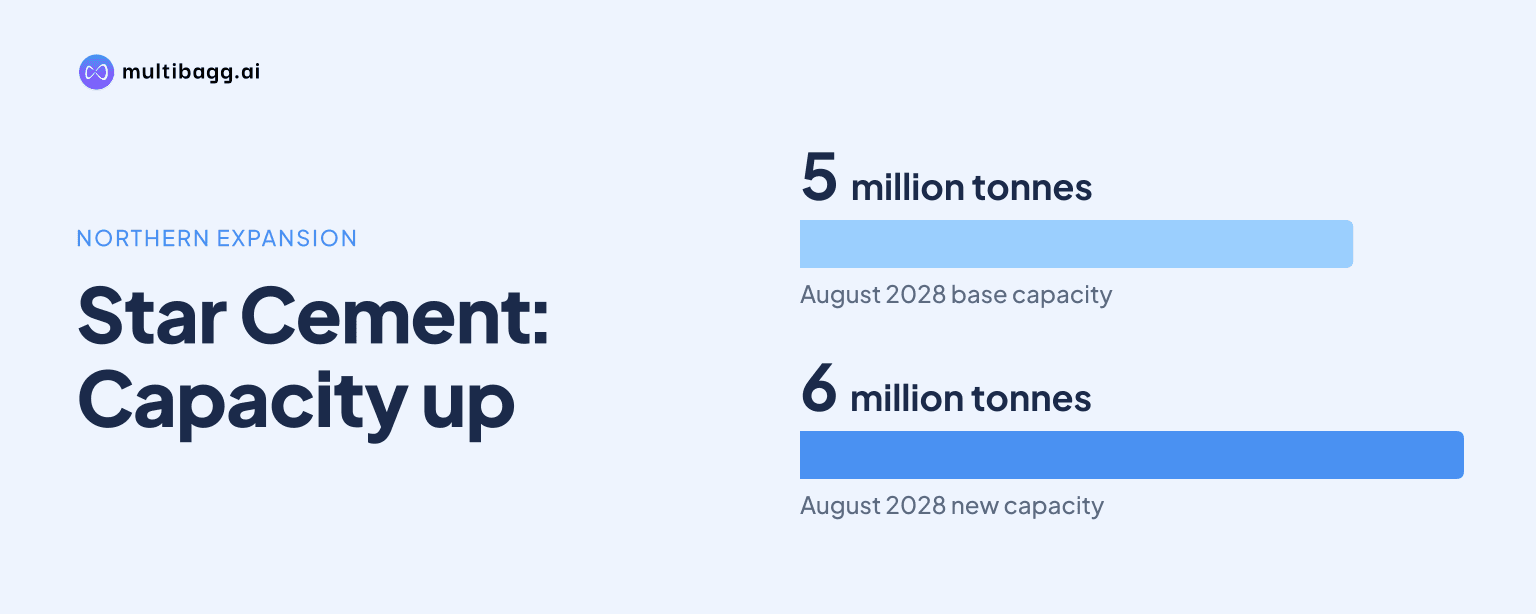
Star Cement Limited plans to commission a 6 million-tonne northern grinding build-out around July or August 2028, after raising the project from 5 million tonnes. Management said on November 12, 2026 that the project should remain within Rs 3,000 crore and that Nimbol groundbreaking would begin on December 1, 2026.
Know Star Cement inside out
Results, valuation, peers and who's buying, in one view.
What is Star Cement building in northern India?
Star Cement is building 6 million tonnes of annual cement grinding capacity in northern India through 3 million-tonne units at Nimbol and Jhajjar, supported by a 3.3 million-tonne rated clinker unit at Nimbol. Management said the project scope increased from the earlier 5 million-tonne northern plan, contributing to higher overall capital expenditure.
The Nimbol clinker unit has a rated capacity of 3.3 million tonnes, although management said it can produce about 3.6 million tonnes at full capacity. Star Cement selected a 3 million-tonne grinding configuration because the additional capital cost was lower and the larger unit could serve a subsequent expansion phase.
The new clinker line follows mixed production trends in the quarter ended September 30, 2026. Cement production increased to 11.56 lakh tonnes from 10.83 lakh tonnes a year earlier, while clinker production fell to 9.08 lakh tonnes from 9.18 lakh tonnes.
When will Star Cement start and commission the northern project?
Star Cement expects the full 6 million-tonne northern project to come on stream around July or August 2028. Management linked that timeline to a planned December 1, 2026 groundbreaking at Nimbol, making the commissioning date a target rather than a completed milestone.
Management said the required Expert Appraisal Committee, or EAC, meeting for Nimbol had been completed successfully and its minutes received. It expected environmental clearance, or EC, within one or two weeks of the November 12, 2026 call, after which it planned to begin groundwork.
The interval between the December 2026 start and the July-August 2028 target is about 19 to 20 months. Star Cement did not provide separate construction schedules for the Nimbol clinker plant, Nimbol grinding unit and Jhajjar grinding unit, or identify which facility would begin operations first.
How much will Star Cement spend on the northern project?
Star Cement said the 6 million-tonne northern project should be within Rs 3,000 crore, while noting that the final figure was sensitive and subject to optimisation. Management said it would give a more accurate capital-expenditure breakup in an investor presentation as execution progresses.
An analyst referred to Rs 560 crore of capital expenditure in the current year, Rs 1,910 crore in the following year and Rs 610 crore in financial year 2029, as well as Rs 3,080 crore for Nimbol. Management did not formally restate that annual allocation, but said investors could broadly use the first-quarter guidance until a revised presentation was issued.
On financing, management said it expected to fund current projects through debt and internal accruals rather than a qualified institutional placement, or QIP. It said its position of keeping net debt to earnings before interest, tax, depreciation and amortisation, or EBITDA, below 1.5 times broadly remained unchanged.
Got a follow-up? Ask IRIS
Why did Star Cement raise northern capacity to 6 million tonnes?
Star Cement raised the northern build-out to 6 million tonnes because management considered the incremental cost of a larger grinding unit relatively limited and saw use for that capacity in a later phase. The revision takes the Jhajjar grinding unit from the 2 million-tonne size discussed by the analyst to 3 million tonnes.
The larger project comes after management described the first half of financial year 2027 as subdued because of elections and floods in Assam, Star Cement's major market. Management forecast 12% to 13% year-on-year volume growth in the third and fourth quarters and said October growth was above 12%.
Sales outside the Northeast grew faster than sales within the region in the September 2026 quarter. Star Cement sold 3.27 lakh tonnes of cement outside the Northeast, up from 2.88 lakh tonnes a year earlier, while Northeast sales increased to 7.96 lakh tonnes from 7.84 lakh tonnes.
Total cement sales rose to 11.23 lakh tonnes in the September 2026 quarter from 10.72 lakh tonnes a year earlier, while clinker sales declined to 0.74 lakh tonnes from 1.01 lakh tonnes. Management said its full-year cement-volume growth target of 7% to 8% could largely remain intact.
What other eastern expansion is Star Cement considering?
Star Cement is considering a separate 2 million-tonne grinding unit in either East Bihar or Siliguri, West Bengal, and said it would provide location clarity on the next call. The proposed eastern unit is distinct from the 6 million-tonne northern project targeted for July or August 2028.
Management estimated capital expenditure of about Rs 350 crore for Siliguri and about Rs 550 crore for Bihar. It said Siliguri has existing land and railway access and an EC application in place, whereas a greenfield Bihar project would require land, a railway siding and a wagon tippler.
Star Cement said West Bengal's industrial policy appeared attractive and that it had applied for EC at Siliguri beside its existing plant. Management said a grinding unit would come up in East Bihar or West Bengal within the next two years, but it did not set a commissioning date or make a final site selection.
The Rs 350 crore to Rs 550 crore estimates should not be treated as committed additions to the Rs 3,000 crore northern-project indication. The site remains undecided, although management said it had pursued permissions where possible to avoid delays if Siliguri is selected.
Conclusion
Star Cement has expanded its northern plan from 5 million tonnes to 6 million tonnes of grinding capacity, backed by a 3.3 million-tonne rated clinker unit at Nimbol. The July-August 2028 target and the Rs 3,000 crore cost indication give the project a clearer scale and timetable, while funding is expected to come through debt and internal accruals.
The next developments to watch are the expected EC following the EAC process, the December 1, 2026 Nimbol groundbreaking and the investor presentation that management said would provide a more accurate capital-expenditure split. Management also said the next call should clarify whether the separate 2 million-tonne eastern grinding unit will be located in Siliguri or East Bihar.