










Star Cement sees no Northeast margin pressure for two years
Key highlights
- Star Cement expects no Northeast margin problem for the next two years as rival kilns may need at least 2.5 years to build.
- Outside suppliers account for 15%-16% of Northeast cement demand, or about 2.4 million tonnes in a roughly 15 million-tonne market.
- Management cited 1 million-tonne clearances for Shree Cement and JK Lakshmi and an announced 4 million-tonne Adani project without a timeline.
- Star Cement expects Northeast industry growth of 7%-8% in the second half after flooding and an approximately 25% demand decline in Manipur-affected markets.
powered by IRIS
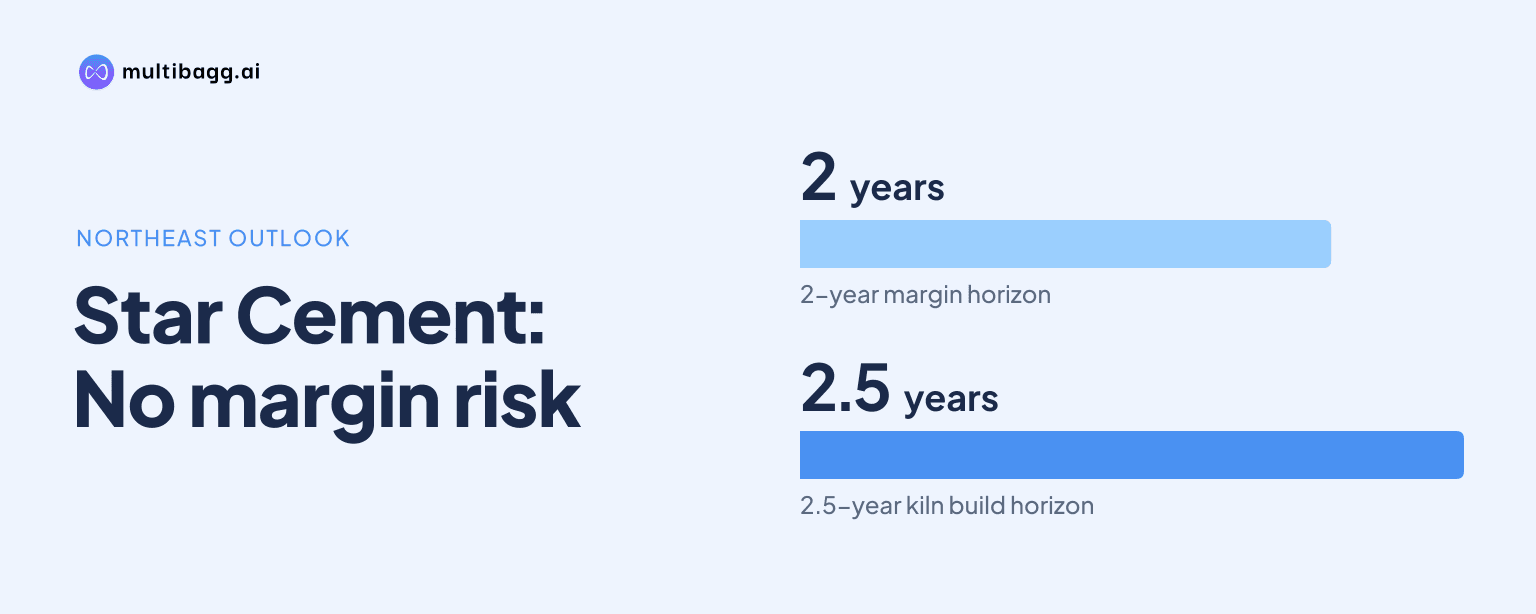
Star Cement expects Northeast cement margins to face no pressure for the next two years because management estimates rival kilns will need at least two-and-a-half years to be built, while 15%-16% of the region’s roughly 15 million-tonne cement market is supplied from outside the region.
Know Star Cement inside out
Results, valuation, peers and who's buying, in one view.
Why does Star Cement expect Northeast margins to avoid pressure?
Star Cement expects no Northeast margin problem for the next two years because announced competitor capacity has not yet translated into operating supply, according to management. Tushar Bhajanka said new plants in Assam or Meghalaya would take two to three years to develop, and estimated at least two-and-a-half years to build a kiln, partly because construction stops for four to five months during the regional rainy season.
Management’s view is that margin pressure should remain limited until the new capacities arrive and begin ramping up. Bhajanka said there could be some short-term pricing pressure, but he expected pricing to stabilise over the longer term because companies entering Northeast are seeking returns on their capital expenditure. He said the attraction of Northeast is margin rather than asset turnover, since the regional market is smaller than North or East India.
Star Cement also cited its route to market as a factor supporting incumbents. The company reported a 77% trade share for the quarter discussed on the call, and management said most of its Northeast sales are handled through its trade network. Bhajanka said entry by new producers would lead to market sharing and might cause inefficient smaller producers to close, but he expected incumbents to retain dominance even after the initial two-to-three-year period.
When could rival Northeast cement plants start production?
Star Cement estimates that the JK Lakshmi and Ambuja projects could take at least two-and-a-half years to build, while management said it had no clear view of Shree Cement’s project status. Bhajanka said he did not believe Shree Cement had started or announced a groundbreaking at the time of the call, making any project-specific commissioning date uncertain.
Management referred to a 1 million-tonne environmental clearance for Shree Cement and a 1 million-tonne environmental clearance for JK Lakshmi. It also referred to Adani’s announced 4 million-tonne capacity, but said it did not know the timing of that project. Bhajanka’s assessment was that the market could adjust to a 1 million-tonne kiln, because it was expanding by about 1.5 million tonnes a year.
An analyst suggested that Shree Cement could deliver in FY28 or FY29 if its clearances stayed on track, while other projects could arrive later, around FY29. Star Cement did not confirm those dates. Instead, management emphasised the region’s construction constraints and said project owners would have better knowledge of their own on-ground timelines, meaning announcements and environmental clearances should not be treated as commissioning dates.
Got a follow-up? Ask IRIS
How could outside supply make room for new local capacity?
Star Cement says 15%-16% of Northeast cement demand is currently supplied from outside the region, representing about 2.4 million tonnes annually at the 16% end of the range. Management described the total Northeast market as about 15 million tonnes. This imported supply is central to its argument that incoming local capacity could first displace external volumes rather than immediately take sales from established regional producers.
Management said outside cement generally arrives by rail rakes from Chhattisgarh and West Bengal. The material is commonly sold on a consignment basis rather than through a locally built dealer network, with demand concentrated near rail-linked markets such as Guwahati, Silchar and surrounding areas. Bhajanka said such suppliers send more rakes when margins are favourable and reduce flows when conditions become harder.
That mechanism gives Star Cement a basis for expecting local supply additions to be partly absorbed without immediate broad-based price disruption. Management said the 15%-16% outside share is a market gap that could reduce as competition increases, particularly in the off-season, when excess capacity in eastern markets can be directed to Northeast. Star Cement did not give a three-year demand forecast, so the volume ultimately absorbed remains management’s expectation rather than formal guidance.
What demand trends could change Star Cement’s margin outlook?
Star Cement’s outlook depends on a recovery in Northeast demand after a weak first half. Management said Assam, the region’s largest market, and Nagaland experienced flooding during the quarter, with about one-and-a-half months affected. It also cited an approximately 25% decline in demand in Manipur-affected markets, where political unrest reduced consumption and contributed to slower regional growth.
For the second half, management expects Northeast cement industry growth of 7%-8%. Star Cement expects its own growth to be in double digits, while putting overall company growth at about 12%-13%, supported by expected higher-teen growth in West Bengal. Manoj Agarwal said Star Cement and Dalmia had capacity headroom while other producers were operating with fuller capacity, which management said could allow Star Cement to grow faster than the regional industry.
Star Cement is also adjusting clinker sales from the third quarter. It sold 126,000 tonnes of clinker in the first half, largely to smaller non-branded grinding units and to markets that could include Siliguri, Nepal and other areas outside Northeast. Management said it increased clinker prices from the third quarter to sell selectively, seek better realisation and avoid excess clinker supply in the market.
Conclusion
Star Cement’s position is that new Northeast capacity announcements should not immediately change cement margins because rival kilns may take at least two-and-a-half years to be built. Management also sees room for local capacity to replace part of the 15%-16% of regional demand, or about 2.4 million tonnes in a 15 million-tonne market, currently served from outside Northeast.
The next factors to watch are construction and commissioning milestones for the 1 million-tonne projects cited for Shree Cement and JK Lakshmi, and a timeline for Adani’s announced 4 million-tonne capacity. Management’s thesis also depends on the expected 7%-8% second-half Northeast industry growth materialising after flooding and the approximately 25% demand decline in Manipur-affected markets.