










JNK India sees Q2 deferral recovery weighted to March quarter
Key highlights
- JNK India deferred about Rs 30 crore-Rs 40 crore of Q2 FY27 revenue because of logistics delays and monsoon disruption.
- JNK India’s Q2 FY27 operating revenue rose 3.4% year on year to Rs 187.5 crore.
- JNK India expects limited recovery in October-November and the maximum recovery in January-March.
- JNK India’s order book was Rs 1,662 crore on September 30, 2026, before the approximately Rs 500 crore Nigeria order.
powered by IRIS
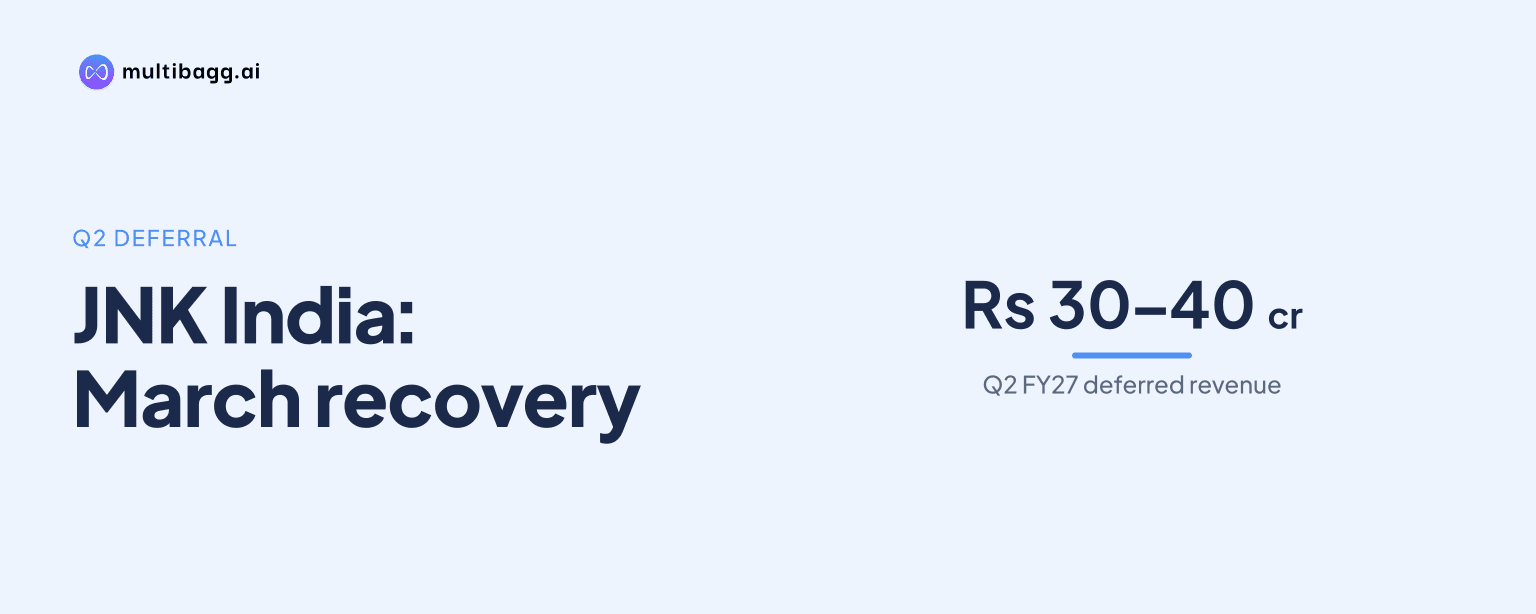
JNK India Limited said Rs 30 crore-Rs 40 crore of Q2 FY27 revenue was deferred by logistics disruptions and severe monsoon conditions, with management expecting the largest recovery in the January-March quarter rather than October-November. Q2 operating revenue still rose 3.4% year on year to Rs 187.5 crore.
Know JNK India inside out
Results, valuation, peers and who's buying, in one view.
How much Q2 FY27 revenue did JNK India defer?
JNK India deferred about Rs 30 crore-Rs 40 crore of Q2 FY27 revenue because it could not dispatch that amount amid logistical delays and rains. Chairperson Arvind Kamath quantified the impact during the earnings call, linking it directly to delayed shipments rather than a cancellation of project work.
JNK India reported Q2 FY27 operating revenue of Rs 187.5 crore, up 3.4% from Rs 181.4 crore in Q2 FY26. The stated deferred range was therefore a meaningful amount relative to quarterly revenue, although management did not provide a revised revenue figure, customer-level exposure or a split between logistics and monsoon effects.
Chief Executive Officer Dipak Bharuka said part of the interruption stemmed from logistical challenges related to the geopolitical situation. He also said severe monsoon conditions in parts of India affected fabrication and site-erection progress, two activities that influence dispatches and project milestone completion.
Why did logistics and rain shift JNK India’s revenue?
JNK India said revenue recognition in its project business is tied to project progress, material supplies and execution milestones. Delays in shipments, fabrication or site activity can therefore move revenue recognition from one quarter to a later period even when the underlying order remains in the company’s book.
The Q2 outcome was slower than the first-half result. H1 FY27 operating revenue rose 30.4% year on year to Rs 370.2 crore from Rs 283.9 crore, while EBITDA increased 50% to Rs 39.4 crore and the EBITDA margin was 10.6%. Q2 revenue growth of 3.4% was consequently below the 30.4% H1 growth rate.
JNK India said seasonality also affects this comparison. Management said H1 has historically accounted for about 30%-35% of annual revenue, and at most 40%, while H2 contributes roughly 60%-65% as projects reach supply and execution milestones.
When will JNK India recover the deferred revenue?
JNK India expects limited recovery in October and November, with the maximum recovery expected in the January-March quarter of FY27. Bharuka said activity normally begins to pick up in December and January, while the fourth quarter can sometimes produce revenue equal to, or more than, the first half.
That timing makes the recovery more concentrated than a general H2 expectation. H1 FY27 revenue was Rs 370.2 crore, and management said the material catch-up from the Rs 30 crore-Rs 40 crore Q2 deferral would not occur substantially during October or the festival-affected November period.
JNK India retained its FY27 guidance for 20%-25% operational-revenue growth and a 12%-14% EBITDA margin. The reported Q2 EBITDA margin was 11.1% and the H1 margin was 10.6%, while management attributed its confidence in the full-year range to ongoing-project progress and the usual second-half execution weighting.
Got a follow-up? Ask IRIS
What supports JNK India’s second-half execution plan?
JNK India’s order book stood at Rs 1,662 crore as of September 30, 2026, before the later order of about Rs 500 crore from JNK Global for a Nigeria heater package. Management said the available work could support execution of the remaining 60%-65% of annual revenue in FY27 and indicated about Rs 1,500 crore of revenue was available for the next financial year.
The Nigeria order covers design, engineering, manufacturing, supply and transportation of equipment, with an 18-month delivery timeline. JNK India also received domestic flare-package orders aggregating Rs 30 crore with 16-month timelines, including one contract with installation, erection, pre-commissioning, commissioning, performance testing and final handover.
JNK India said its Rs 5,000 crore bidding pipeline was broadly balanced between domestic and international opportunities, while about 50% comprised non-heater or non-combustion equipment. Management said some of those firm opportunities could be finalised in about two quarters, subject to technical evaluations, customer and licensor approvals, and commercial discussions.
What could affect JNK India’s March-quarter recovery?
JNK India’s recovery depends on dispatches, fabrication, site erection and milestone completion during December-March. These are the same execution mechanisms affected in Q2 FY27, and management did not say that all shipments underlying the Rs 30 crore-Rs 40 crore deferred amount had been completed by the call date.
The scope beyond the approximately Rs 500 crore Nigeria supply order is also unresolved. Management said site erection, commissioning and supervision work remained under discussion and described further work as a possibility, not a confirmed order; it added that JNK Global’s contractual timeline had not started because an advance-payment condition had not been met.
JNK India said Kenya refinery inquiries were expected in two to three months and potential order finalisation in four to five months. Those prospective opportunities are separate from the FY27 recovery plan, which management based on its current project progress, Rs 1,662 crore September order book and the normal H2 revenue pattern.
Conclusion
JNK India recorded a defined Q2 FY27 execution delay, with Rs 30 crore-Rs 40 crore of revenue deferred by logistics constraints and monsoon-related disruption to fabrication, site erection and dispatches. The company nevertheless maintained FY27 guidance after H1 operating revenue rose 30.4% to Rs 370.2 crore and management reiterated that 60%-65% of annual revenue is normally generated in H2.
The next period to watch is December through March, particularly the fourth quarter, after management said October-November recovery would be limited. Execution against the Rs 1,662 crore September 30 order book, progress on the 18-month Nigeria heater order and any confirmation of additional Nigeria scope remain the disclosed markers for JNK India’s stated recovery plan.