










Star Health D2C grew 137% as agency network reached 8.7 lakh
Key highlights
- Star Health’s D2C channel grew 137% year on year in H1 FY27, lifting its share of overall business to 13% from 8%.
- Star Health added 39,000 agents in H1 FY27, taking its agency network to 8.7 lakh and increasing agency productivity by 19% year on year.
- Gross written premium rose 19% year on year to Rs 9,562 crore in H1 FY27, while fresh retail-health gross written premium increased 36%.
- Star Health’s underwriting result turned to a Rs 210 crore profit in H1 FY27 from a Rs 24 crore loss a year earlier, as the Combined Insurance Service Ratio improved to 97.9%.
powered by IRIS
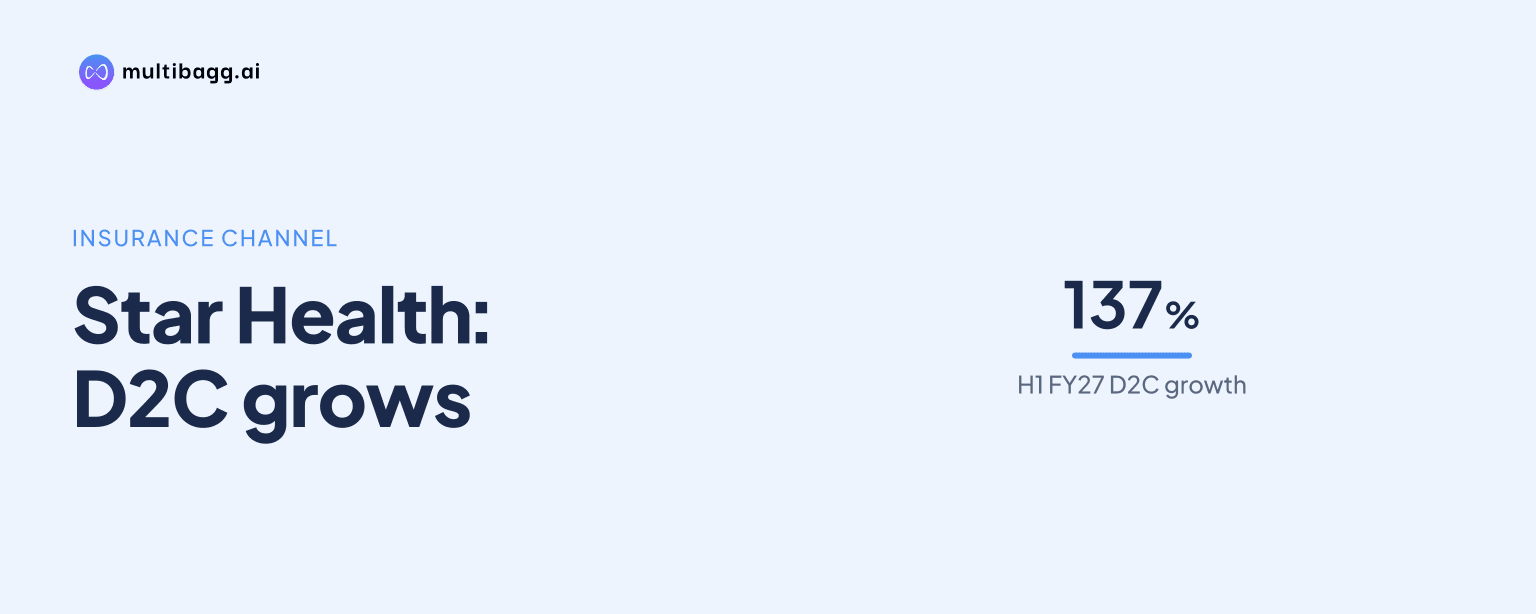
Star Health and Allied Insurance Company Limited said its direct-to-consumer, or D2C, channel grew 137% year on year in the first half of financial year 2026-27, or H1 FY27. The insurer also added 39,000 agents, taking its network to 8.7 lakh, as it sought younger, first-time insurance buyers in non-metro markets.
Know Star Health & Allied Insurance Company inside out
Results, valuation, peers and who's buying, in one view.
How fast did Star Health's D2C channel grow?
Star Health's D2C channel grew 137% year on year in H1 FY27, making it the insurer's fastest-growing proprietary channel. Management said the growth came from younger customers, higher sum insured and greater participation from non-metro and tier-2 markets. It also said D2C had superior combined ratios, without disclosing the channel's premium or customer count.
D2C's share of Star Health's overall business increased to 13% from 8%, management said during the October 28, 2026 earnings call. The agency channel remained much larger, contributing about 70% to 75% of fresh business and growing about 25% year on year in Q2 FY27. The comparison shows D2C is growing faster from a smaller base while agency remains the principal source of new sales.
How is Star Health expanding its agency network?
Star Health added 39,000 agents in H1 FY27, lifting its network to 8.7 lakh, while agency productivity rose 19% year on year. Management said agency and D2C together generated more than 90% of retail business, giving the insurer direct control over sales quality, customer selection and acquisition economics.
Fresh-business growth from semi-urban and rural areas was more than three times the rate in metro and urban locations during H1 FY27. More than 50% of active agents used Star Health's ATOM Pro platform during the quarter. The company did not disclose its active-agent count, so platform usage cannot be measured against the full 8.7 lakh-agent network.
Which customers is Star Health targeting through D2C and agency?
Star Health is targeting first-time health-insurance buyers and consumers below 40 through both proprietary channels. New-to-insurance buyers represented 93% of the fresh retail-health mix in Q2 FY27, up from 89% a year earlier. New-to-insurance policy volumes rose more than 10%, while average sum insured increased 13% year on year.
Management said the revised Young Star neo product targets sub-40 consumers. It estimated Star Health's new-to-insurance market share at about 40%, but described this as an internal estimate that could be wrong. Its reported retail-health market share was 29% in H1 FY27 and 30% in Q2 FY27, with comparability affected by the reporting treatment of long-term policies.
Got a follow-up? Ask IRIS
What is supporting Star Health's digital acquisition strategy?
Star Health upgraded its customer relationship management platform to Salesforce in Q2 FY27 to improve D2C lead management and conversion, according to management. Its artificial-intelligence, or AI, bots processed more than 7.5 million minutes of calls at less than 20% of the cost of equivalent human deployment. Management did not disclose lead volumes, conversion rates or D2C acquisition spending.
The insurer's AI-based quality assurance analysed more than 10 million minutes of customer interactions across nine languages, while service bots resolved more than 1,000 interactions each day. These measures support customer acquisition and servicing, but Star Health did not quantify their direct contribution to D2C premium or policy sales. Management said it would adapt its digital journeys once final rules on dark patterns are issued.
How does distribution growth fit Star Health's financial results?
Star Health's gross written premium grew 19% year on year to Rs 9,562 crore in H1 FY27, while fresh retail-health gross written premium increased 36%. Management attributed retail growth to a combination of policy volumes, pricing actions and higher average sum insured, rather than assigning growth to a single driver.
The underwriting result turned to a Rs 210 crore profit in H1 FY27 from a Rs 24 crore loss in H1 FY26. The Combined Insurance Service Ratio improved by 2.4 percentage points to 97.9%. Management said the vintage book represented about 80% of the portfolio and that the fresh book, at about 20%, could not by itself explain the improvement in loss ratios.
Conclusion
Star Health's 137% D2C growth and 39,000-agent addition show that it is expanding digital and agency distribution at the same time. The strategy is directed at new-to-insurance, younger and non-metro customers, while the 19% increase in agency productivity and more than 90% retail-business contribution from proprietary channels support management's focus on channel control.
The next test is whether Star Health maintains management's stated aspiration to grow fresh business by more than 20% over the long term as the GST-led growth base enters comparison periods in H2 FY27. Management also plans to keep investing in its digital strategic business unit and awaits final regulations on distribution economics and digital dark patterns.