










Star Health says proposed reforms favour proprietary model
Key highlights
- Proprietary agency and direct-to-consumer channels generated more than 90% of Star Health’s retail business.
- Star Health’s agency network reached 8.7 lakh after the company added 39,000 agents in H1 FY27.
- Star Health’s D2C business grew 137% year on year in H1 FY27, while agency productivity increased 19%.
- Star Health reported a 98% Combined Insurance Service Ratio and a Rs 99 crore underwriting profit in Q2 FY27.],
powered by IRIS
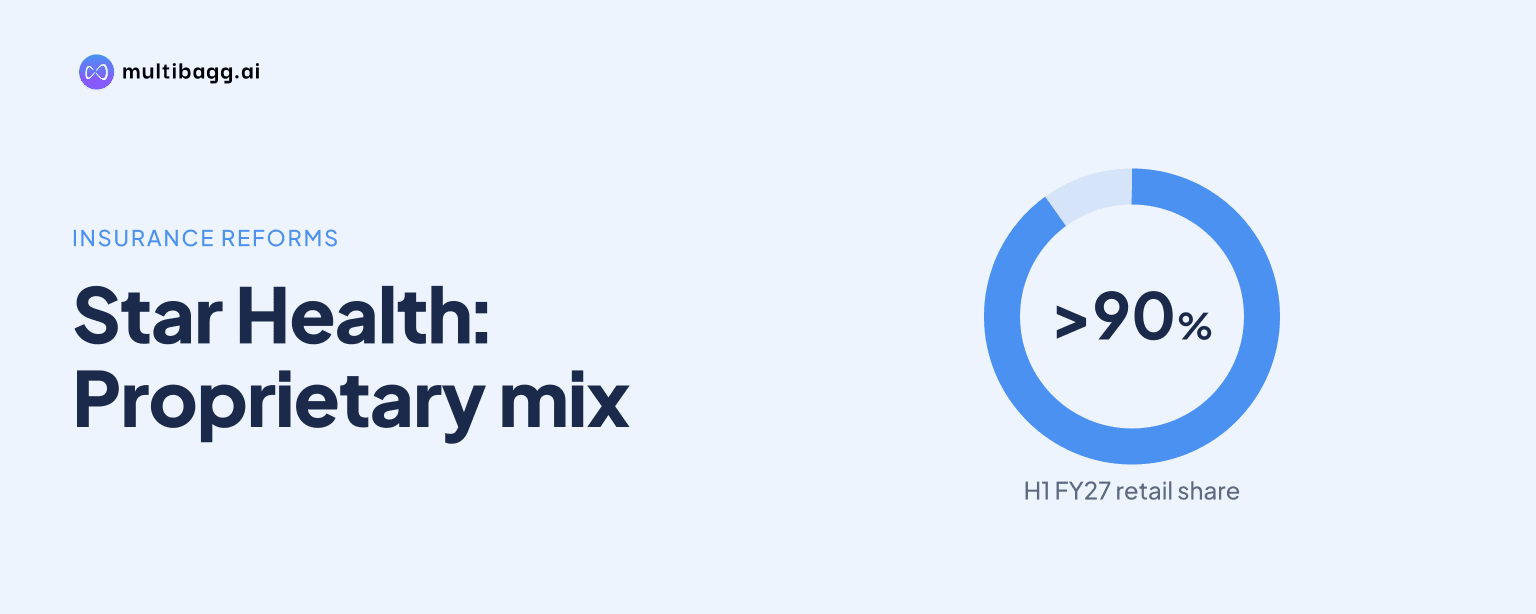
Star Health says the Insurance Regulatory and Development Authority of India’s proposed distribution reforms favour its operating model because proprietary agency and direct-to-consumer digital channels source over 90% of retail business. Management said the September 23 consultation paper’s approach to commissions, agent exclusivity and expense limits broadly aligns with its network of 8.7 lakh agents.
Know Star Health & Allied Insurance Company inside out
Results, valuation, peers and who's buying, in one view.
Why does Star Health believe the proposed distribution reforms suit it?
Star Health says the proposed framework is closely aligned with the distribution structure it has built over two decades. Management cited the company’s reliance on proprietary channels for more than 90% of retail business, rather than third-party distribution, as the central reason it considers the model resilient under the consultation paper. Star Health said it had submitted its views on the Insurance Regulatory and Development Authority of India, or IRDAI, paper, Recalibrating Economics of Insurance Distribution, released on September 23.
The proposed rules, as described by management, would make individual agents better-rewarded distributors and require an agent to represent only one insurer within a product segment. Star Health said dedicated distribution is central to the paper’s approach and fits its existing footprint. It added 39,000 agents in H1 FY27, taking its agency network to 8.7 lakh, while agency productivity increased 19% year on year during the same six-month period.
Management also said commission structures tied to renewal rates could reduce commission-led switching between insurers. In Star Health’s view, this would redirect distribution effort toward enrolling new customers rather than retaining business through higher commissions. The company reported that 93% of its new-to-insurance mix in Quarter 2 FY27 consisted of first-time buyers, up from 89% in Quarter 2 FY26, and said more than nine in 10 fresh customers were new to insurance.
How could agent commissions and exclusivity change competition?
Star Health says higher proposed commissions for smaller towns and rural areas match the geographic expansion of its agency network. Fresh business growth from semi-urban and rural geographies was more than three times that of metro and urban geographies in H1 FY27. The company therefore sees the proposal as supporting markets where it is already expanding rather than relying on a shift in intermediaries’ commercial incentives.
The exclusivity proposal could matter because Star Health already uses a dedicated-agent structure for a large part of its retail sales. Management said that when commercials no longer differentiate insurers as much, competition would increasingly turn on product proposition, claims experience, service, brand and distribution. That is management’s assessment of the consultation paper, not a final regulatory outcome, and Star Health said it is awaiting final regulations.
The contrast with externally sourced sales is visible in Star Health’s reported channel mix. Its agency and direct-to-consumer, or D2C, channels together generated over 90% of retail business, while bancassurance and alternate channels remained focused on profitable segments. The D2C business grew 137% year on year in H1 FY27, led by younger customers, higher sums insured and greater participation from non-metro and tier 2 markets.
Can Star Health meet proposed expense-of-management limits?
Star Health says it has a credible path to proposed expense-of-management, or EOM, limits through operating leverage, expense discipline, digitisation and automation. Management said Star Health has a consistent record of complying with EOM requirements and is operating under EOM regulations already among standalone health insurers. It did not disclose a numerical estimate of required reductions in commissions or other operating expenses, saying it would give more detail once the final rules are clearer.
In the analyst discussion, management said it believed the consultation paper currently proposed a common EOM structure for general insurers and standalone health insurers. It argued that mandated products, including motor third-party insurance, crop insurance and government-sponsored health programmes, should be excluded from the calculation base so that the measure better reflects consumer-facing distribution costs. That was Star Health’s stated position, rather than an indication that the regulator will adopt such exclusions.
The operating measures cited by management include customer-service and sales automation. During the quarter, artificial-intelligence bots processed more than 7.5 million minutes of calls at less than 20% of the cost of equivalent human deployment. Service bots independently resolved more than 1,000 customer interactions a day, while artificial-intelligence quality-assurance systems analysed more than 10 million minutes of interactions across nine languages.
Got a follow-up? Ask IRIS
Will the reforms force Star Health to reduce policy prices?
Star Health says it has no current plan to make a specific pricing change in response to the proposed rules. Management said pricing would continue to be determined by portfolio performance across more than 35 health insurance plans and by zoning across the country. It said it would wait for further regulation before deciding whether changes are needed, rather than assuming that the consultation paper requires an immediate reduction in prices.
Star Health said its last repricing cycle covered close to 80% of its book, with remaining business being addressed during the current year. Management added that further correction would occur where loss-ratio requirements call for it. This places pricing within Star Health’s portfolio process, alongside risk-based pricing, portfolio selection and fraud, waste and abuse controls, rather than presenting it solely as a response to distribution regulation.
Star Health reported a 98% Combined Insurance Service Ratio, or CISR, in Quarter 2 FY27, an improvement of 2.9 percentage points year on year. Its underwriting result moved to a profit of Rs 99 crore from a Rs 40 crore loss in Quarter 2 of the prior year, a Rs 139 crore positive swing. These reported changes provide the financial context for management’s view that it can pursue affordability while maintaining its portfolio-based pricing approach.
How do digital rules and the public registry affect Star Health?
Star Health says it supports the proposed Public Insurance Registry, or PIR, because a shared digital infrastructure could reduce information asymmetry, improve underwriting controls, simplify claims processing and strengthen fraud detection. Management said the registry would allow policyholders, insurers and other participants to discover, verify and exchange information consistently. Star Health said it looked forward to participating in development of the proposed platform, but disclosed no implementation timetable.
Star Health also said it recognises the regulator’s focus on dark patterns in digital customer journeys and will review its journeys for alignment with the evolving framework. This is material for a channel that grew 137% year on year in H1 FY27. Management said consent-led data collection, clear product and pricing disclosures, and transparent access to policy features could favour trusted direct brands over time.
Star Health upgraded its customer relationship management platform to Salesforce to improve D2C lead management and conversion. More than 50% of active agents also use its ATOM Pro platform. Alongside distribution technology, its partnership with Amplify Health has gone live for automated fraud, waste and abuse capabilities, which management said are being applied to billing, tariff and medical-necessity parameters.
Conclusion
Star Health’s stated case is that the proposed reform direction could reward a model already built around owned agency and digital channels, renewal-linked relationships and expansion beyond metros. Its evidence includes more than 90% of retail sales through proprietary channels, 8.7 lakh agents at the end of H1 FY27, and D2C growth of 137% during that half year. The argument remains management’s interpretation of a consultation paper, not a confirmed regulatory benefit.
The next issue to watch is the final IRDAI regulation, particularly its EOM calculation base, commission rules, agent exclusivity and digital-journey requirements. Star Health said it has plans to comply but will provide further detail after regulatory clarity. Separately, management aspires to sustain fresh-business growth above 20% over a long period, even as growth rates moderate against the GST-led base in Quarter 3 and Quarter 4.