










Star Health H1 underwriting profit reaches Rs 210 crore
Key highlights
- Star Health reported Rs 210 crore of underwriting profit in H1 FY27, compared with a Rs 24 crore loss in H1 FY26.
- Star Health's H1 FY27 underwriting profit exceeded its Rs 198 crore profit for the full FY26.
- Gross written premium rose 19% year on year to Rs 9,562 crore in H1 FY27, while fresh retail health premium grew 36%.
- Star Health's H1 FY27 profit after tax increased 57% year on year to Rs 815 crore.
powered by IRIS
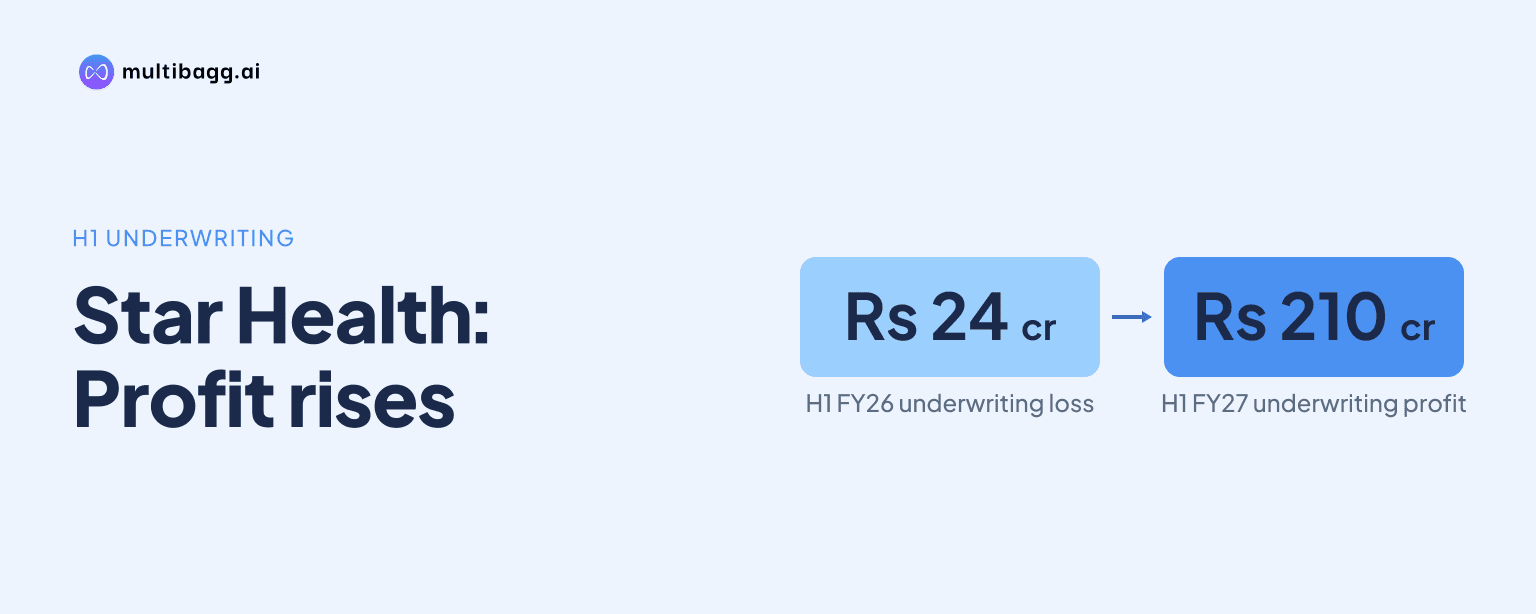
Star Health and Allied Insurance Company Limited reported underwriting profit of Rs 210 crore in H1 FY27, against a Rs 24 crore loss a year earlier, while management said the standalone renewal book had moved below a 100% combined ratio. The result exceeded Star Health's Rs 198 crore underwriting profit for all of FY26.
Know Star Health & Allied Insurance Company inside out
Results, valuation, peers and who's buying, in one view.
How much did Star Health's underwriting result improve in H1 FY27?
Star Health's underwriting result improved to a Rs 210 crore profit in H1 FY27 from a Rs 24 crore loss in H1 FY26, a Rs 234 crore positive swing. The H1 result also surpassed the Rs 198 crore underwriting profit reported for full-year FY26, meaning the first six months of FY27 produced more underwriting profit than the preceding full year.
The improvement was also evident in the second quarter. Star Health reported Rs 99 crore of underwriting profit in Q2 FY27, compared with a Rs 40 crore loss in Q2 FY26, a Rs 139 crore swing. Management described Q2 FY27 as its fifth successive quarter of improvement in loss ratios and underwriting results, with the improvement beginning in Q2 FY26.
Star Health said its Combined Insurance Service Ratio, or CISR, improved by 2.9% to 98% in Q2 FY27 and by 2.4% to 97.9% in H1 FY27. The company also reported H1 FY27 profit after tax of Rs 815 crore, up 57% year on year, while normalized profit after tax, based on an assumed annual investment yield of 8%, rose 56% to Rs 775 crore.
Is Star Health's improved loss ratio coming from renewals?
Yes. Star Health management said the sustained loss-ratio improvement is principally being delivered by the vintage portfolio rather than by the fresh book alone. The vintage book accounts for about 80% of the portfolio, whereas the fresh book is about 20%, which management said could not by itself have produced the reported overall outcome.
Management did not disclose separate fresh and renewal loss ratios, but said pricing interventions mainly work through the renewal portfolio. It also stated in response to an analyst question that the standalone renewal book is operating at a combined ratio below 100%. The company did not disclose the precise combined ratio for the renewal book.
Star Health attributed the change to risk-based pricing, portfolio selection, data analytics, claims processing, fraud, waste and abuse controls, provider negotiations and wellness programmes. In Q2 FY27, management said home healthcare and telemedicine helped manage fever- and infection-related cases, and that these initiatives contributed to lower medical claim frequency.
What drove Star Health's premium growth in H1 FY27?
Star Health's gross written premium, reported on a 1/n basis, increased 19% year on year to Rs 9,562 crore in H1 FY27, while Q2 FY27 premium also rose 19% to Rs 5,275 crore. Fresh retail health premium grew faster, by 36% in H1 and 35% in Q2 on the same reported basis.
The company said growth reflected price changes, higher volumes and higher average sum insured, without providing a numerical split among those factors. In Q2 FY27, the new-to-insurance share reached 93%, versus 89% in Q2 FY26; new-to-insurance policy volumes increased more than 10% year on year and average sum insured rose 13%.
Star Health said more than 90% of retail business came through proprietary agency and digital direct-to-consumer, or D2C, channels. It added 39,000 agents in H1 FY27, taking its agency network to 8.7 lakh, and agency productivity increased 19%. D2C premium grew 137% year on year in H1 FY27, while management said the channel's share of overall business had increased from 8% to 13%.
Got a follow-up? Ask IRIS
Why does the multi-year policy mix matter for Star Health?
Multi-year policies matter because premium is earned over the policy term, giving Star Health a portion of future earned premium that is already contracted. Management said the share of such policies has increased over recent quarters and that multi-tenure contracts also support persistency, although it did not disclose the total in-force multi-year share.
On fresh business, Star Health said multi-year policies accounted for close to 50% in Q2 FY27. For selected agents, commissions on these policies are paid upfront under Indian Generally Accepted Accounting Principles, while they are deferred over the policy period under International Financial Reporting Standards, or IFRS.
The company reported a 102% renewal ratio in H1 FY27, an improvement of 4% from the previous year, and a retail claim settlement ratio of 92.4%, up by more than 1%. It settled 22.5 lakh claims in H1 FY27, of which 83% were settled through cashless mode. Management also said that around 80% of claims arise from packages negotiated with hospitals.
What could affect Star Health's underwriting trajectory next?
Star Health expects headline growth to moderate in H2 FY27 because the prior-year GST-led growth will enter the comparison base, but management said it aspires to maintain fresh-business growth above 20% over a long period. It said it will report its growth outcome at the end of the quarter rather than provide an interim update.
Pricing remains an operating lever. Management said repricing completed in the last cycle covered close to 80% of the book, while the residual portion is being addressed in FY27 where required by loss-ratio needs. It also said it will continue reviewing all products and portfolios regularly, rather than target a reduction in the senior-citizen share of the portfolio.
Regulatory outcomes remain unresolved. Star Health has submitted views on the Insurance Regulatory and Development Authority of India consultation paper on distribution economics, released on September 23, and said it awaits final regulations and clarification on whether years two and three of multi-year policies would count as fresh or renewal for distribution rules. The company said it has plans to comply with expense-of-management requirements once the framework is final.
Conclusion
Star Health's H1 FY27 underwriting profit of Rs 210 crore, compared with a Rs 24 crore loss in H1 FY26, coincided with a 97.9% CISR and management's statement that the renewal book is below a 100% combined ratio. Because the vintage portfolio represents about 80% of the book, the company argues that the improvement reflects wider portfolio actions, not only the 36% H1 growth in fresh retail health premium.
The next indicators are H2 FY27 growth after the GST-led comparison base, the outcome of repricing on the remaining portion of the book, and the final distribution regulations. Star Health also plans to continue adding agents and scaling D2C, which grew 137% in H1 FY27, while it awaits regulatory clarity on commissions for the second and third years of multi-year policies.