










Storage Technologies & Automation Board Reviews H1 FY27 Results
Key highlights
- STOA's board is scheduled to review H1 FY27 financial statements on 11 November 2026.
- FY26 total revenue was ₹84.97 crore, down 15.35% from ₹100.38 crore in FY25.
- FY26 gross profit declined to ₹31.02 crore from ₹37.43 crore in FY25.
- STOA reported an order-book backlog of about ₹35 crore and targets revenue growth above 20% in FY27.
powered by IRIS
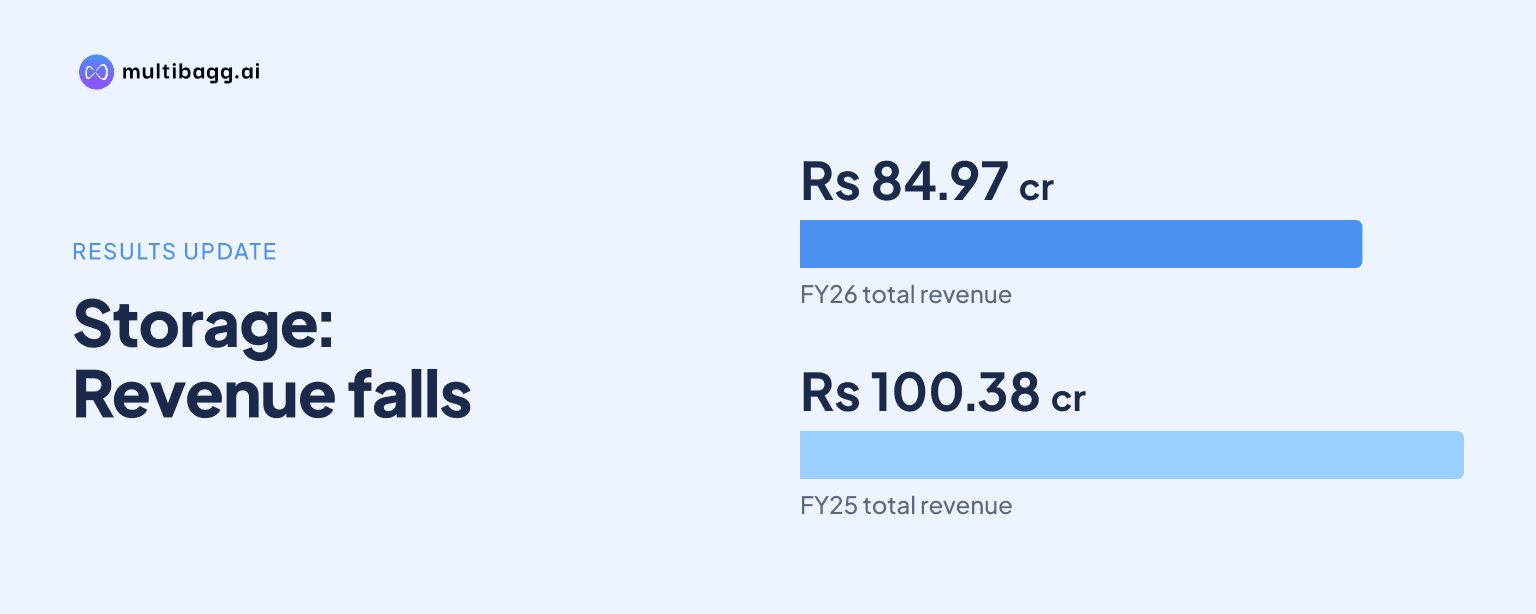
Storage Technologies & Automation Ltd is scheduled to review its H1 FY27 standalone and consolidated financial statements on 11 November 2026, following a 15.35% decline in FY26 revenue to ₹84.97 crore. The board meeting matters because investors are awaiting updated financial disclosures, including the limited review report, after the company reported lower annual revenue and a pre-tax loss in FY26.
Know Storage Technologies & Automation inside out
Results, valuation, peers and who's buying, in one view.
Why is Storage Technologies & Automation meeting on 11 November 2026?
Storage Technologies & Automation Ltd has informed BSE that its board will meet on 11 November 2026 to consider and approve the standalone and consolidated financial statements for the half year ended 30 September 2026. The board will also consider the limited review report for the period and any other business that may be required.
The notice was disclosed on 4 November 2026. It identifies the H1 FY27 accounts as the central agenda item, but the supplied information does not include the financial results approved at the meeting. Therefore, the intimation should be treated as a scheduled results-review event rather than confirmation of H1 revenue, profit, margins, or cash-flow performance.
The company is referred to as STOA in its financial-data listings. Its latest half-year disclosure will give investors a current view of operations after FY26, when revenue declined from the prior year according to the annual income-statement data.
What do STOA's FY26 financial figures show?
STOA's annual income-statement data shows total revenue of ₹84.97 crore for the year ended 31 March 2026, compared with ₹100.38 crore in FY25, a decline of 15.35%. Gross profit fell to ₹31.02 crore from ₹37.43 crore in the preceding year.
The directors' report separately states that total revenue was ₹84.97 crore in FY26, compared with ₹94.42 crore in the prior year, while expenditure including depreciation was ₹89.54 crore, versus ₹89.33 crore. The report also recorded a loss before extraordinary items and tax of ₹4.22 crore for FY26, against a profit before extraordinary items and tax of ₹5.27 crore in the comparative period.
Differences between the prior-year revenue figures shown in the income-statement table and the directors' report mean investors should refer to the audited standalone and consolidated statements for the exact basis of comparison. The available disclosures nonetheless show that FY26 involved lower revenue and pressure on profitability.
What is STOA's current order-book and growth plan?
STOA reported an order-book backlog of about ₹35 crore in May 2026, with approximately ₹5 crore of near-term order closures identified in a 1 September 2026 update. The company indicated a target of more than 20% year-on-year revenue growth for FY27, with potential upside of 10% to 15%.
The order book is relevant because it represents work that may support future revenue, subject to execution and customer schedules. But backlog is not the same as reported revenue, and the information provided does not specify the timing of conversion, margin profile, or the split between standalone and consolidated operations.
The H1 FY27 results review will be the next formal opportunity to assess whether the business has begun translating this order pipeline into revenue. It may also provide information on costs, project execution, working capital, and profitability after the FY26 loss.
Got a follow-up? Ask IRIS
How could the H1 FY27 review affect STOA investors?
The H1 FY27 review gives STOA investors an official update on the company's financial position following a year in which reported revenue declined and gross profit was lower. The annual figures indicate that expenses including depreciation remained elevated even as revenue fell, contributing to the pre-tax loss reported in the directors' report.
For investors, the main factual areas to monitor are H1 revenue, the movement in gross and operating profitability, the status of the stated order book, and management's comments on the FY27 growth target. These disclosures can help establish whether the company is seeing a recovery in execution and whether its financial performance is moving closer to its stated growth objective.
The board has not recommended a dividend for FY26, according to the directors' report. This means the immediate focus remains on operating performance and financial results rather than shareholder distributions.
What broader context should investors consider?
STOA's revenue had increased for several years before FY26. The income-statement data shows total revenue rising from ₹69.87 crore in FY22 to ₹81.32 crore in FY23, ₹93.74 crore in FY24, and ₹100.38 crore in FY25. FY26 was therefore a reversal from that reported multi-year growth trend.
Gross profit followed a similar pattern through FY25, increasing from ₹19.34 crore in FY22 to ₹37.43 crore in FY25, before declining to ₹31.02 crore in FY26. The H1 FY27 accounts will provide a more recent data point on whether the company has stabilised its revenue base and cost structure.
No H1 FY27 results, dividend decision, or revised full-year financial guidance is included in the supplied board-meeting intimation. Any assessment beyond the disclosed order book and growth target will depend on the financial statements and limited review report considered by the board.
Conclusion
The 11 November board meeting is an important reporting event for STOA because it covers the first-half FY27 financial statements after FY26 revenue fell 15.35% to ₹84.97 crore and the directors' report recorded a pre-tax loss of ₹4.22 crore. The available information points to an order backlog of about ₹35 crore, but it does not confirm how much of that pipeline has been converted into H1 revenue.
Investors should watch for the approved H1 FY27 standalone and consolidated results, the limited review report, and any update on the company's stated goal of more than 20% revenue growth in FY27. Particular attention will be on profitability, costs and the execution timeline for the disclosed order pipeline.