










Storage Technologies and Automation Limited swings to H1 profit
Key highlights
- STAL reported Rs 1.60 crore standalone H1 FY27 profit, compared with a Rs 1.55 crore loss in H1 FY26.
- STAL's H1 FY27 standalone revenue rose 22.4% to Rs 57.57 crore, the highest of five displayed half-years.
- STAL's gross margin fell 520 basis points to 18.7% as materials consumed increased 35.3% to Rs 40.62 crore.
- STAL's employee cost fell 30.6% to Rs 4.49 crore and other expenses declined 26.3% to Rs 3.00 crore.
powered by IRIS
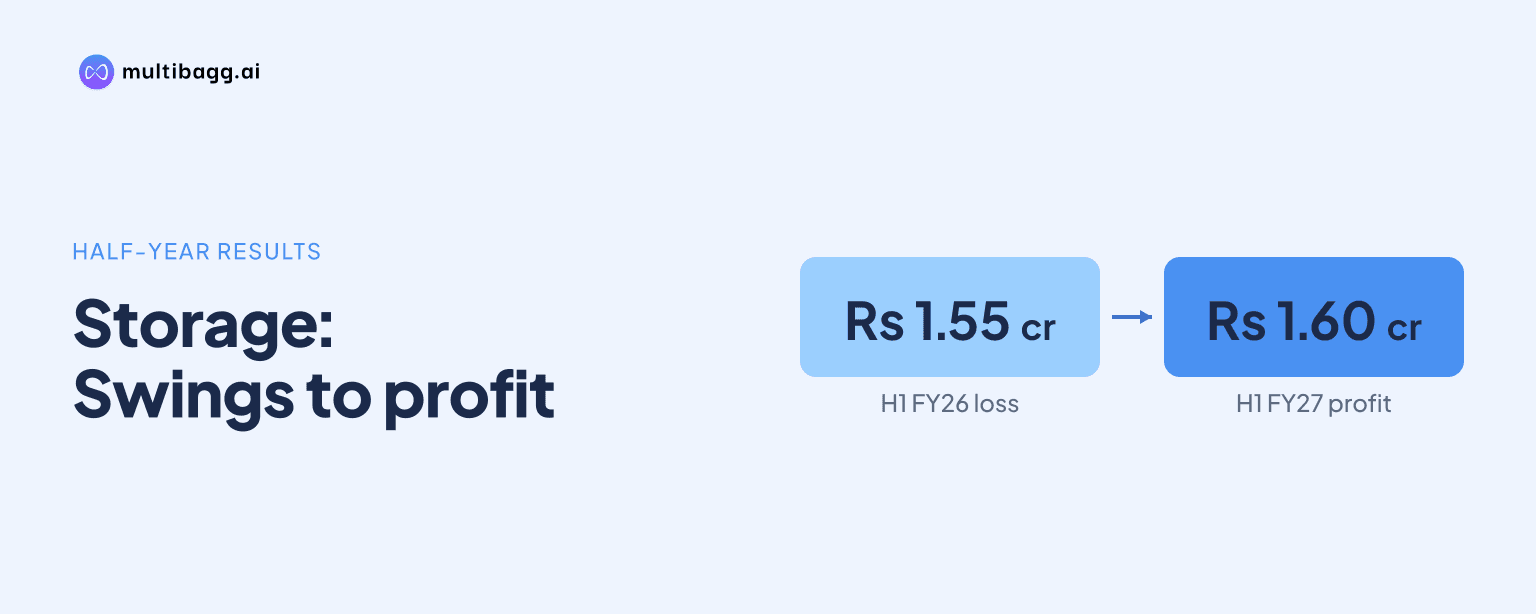
Storage Technologies and Automation Limited swung to a Rs 1.60 crore standalone profit after tax in H1 FY27 ended 30 September 2026, from a Rs 1.55 crore loss a year earlier. Revenue rose 22.4% to Rs 57.57 crore, while lower delayed-project labour and rental costs outweighed a 520-basis-point gross-margin decline.
Know Storage Technologies & Automation inside out
Results, valuation, peers and who's buying, in one view.
How did STAL return to profit in H1 FY27?
STAL returned to profit because employee cost and other expenses fell sharply after costs associated with a delayed project in H1 FY26 did not recur. Standalone profit after tax was Rs 1.60 crore in H1 FY27, against a Rs 1.55 crore loss in H1 FY26, while profit before tax changed to Rs 1.61 crore from a Rs 1.49 crore loss. Earnings per share moved to Rs 1.25 from negative Rs 1.21.
Revenue from operations increased by Rs 10.52 crore year on year to Rs 57.57 crore, but gross profit fell by Rs 0.48 crore to Rs 10.76 crore as cost of goods sold rose faster than sales. Employee cost then declined by Rs 1.98 crore to Rs 4.49 crore, while other expenses declined by Rs 1.07 crore to Rs 3.00 crore. These expense reductions were central to the turnaround despite lower gross profit.
STAL reported earnings before interest, tax, depreciation and amortisation, or EBITDA, of Rs 3.52 crore, compared with Rs 47 lakh in H1 FY26. EBITDA margin increased to 6.1% from 1.0%, a 510-basis-point change. The presentation defines EBITDA as profit before tax plus finance cost and depreciation and amortisation, including other income.
How did STAL revenue compare with earlier half-years?
STAL recorded Rs 57.57 crore of standalone revenue in H1 FY27, the highest level among the five half-years shown in the presentation. The figure was 22.4% above Rs 47.05 crore in H1 FY26 and 52.5% above Rs 37.75 crore in H2 FY26.
H1 FY27 revenue exceeded the previous high of Rs 50.80 crore in H2 FY25 by Rs 6.77 crore. It was also Rs 20.82 crore above H2 FY26, following the dip reported in that half. The presentation identifies these figures as standalone revenue from operations and does not provide product, customer, geographic or segment-level revenue splits.
Direct expenses rose 6.9% to Rs 6.19 crore in H1 FY27, compared with revenue growth of 22.4%. Consequently, direct expenses represented 10.7% of revenue, down from 12.3% in H1 FY26. That reduction in the share of sales contrasted with the rise in materials as a proportion of revenue.
Got a follow-up? Ask IRIS
What caused STAL gross margin to decline?
STAL's gross margin declined to 18.7% in H1 FY27 from 23.9% in H1 FY26, a reduction of 520 basis points, because material costs rose faster than revenue. Cost of goods sold increased 30.7% to Rs 46.81 crore, while revenue increased 22.4% to Rs 57.57 crore, reducing gross profit to Rs 10.76 crore from Rs 11.24 crore.
Materials consumed, net of changes in inventories, increased 35.3% to Rs 40.62 crore and represented 70.6% of H1 FY27 revenue, compared with 63.8% a year earlier. STAL attributed the increase in raw-material prices to the geopolitical situation and identified higher steel costs as the main reason for the lower gross margin.
The H1 FY27 result therefore combined a lower gross-profit contribution with lower operating expense lines. Materials' share of revenue rose by 6.8 percentage points, whereas direct expenses' share declined by 1.6 percentage points. STAL did not quantify the change in steel prices, disclose a procurement hedge, or give a gross-margin target.
Which delayed-project costs did STAL avoid and how did cash change?
STAL said H1 FY26 included contract manpower for a delayed project, which did not recur in H1 FY27. Employee cost consequently declined 30.6% to Rs 4.49 crore from Rs 6.47 crore, reducing its share of revenue to 7.8% from 13.8%. Other expenses fell 26.3% to Rs 3.00 crore from Rs 4.07 crore, as the earlier period had included machinery rental on the delayed project.
Cash conversion remained affected by working capital. Operating cash flow was Rs 80 lakh in H1 FY27, versus Rs 1.16 crore in H1 FY26, after Rs 2.53 crore of working-capital outflow. STAL reported that growth tied up cash in receivables and inventory, while suppliers partly funded this requirement.
Net cash outflow narrowed to Rs 72 lakh from Rs 1.56 crore in H1 FY26, and closing cash was Rs 3.63 crore compared with Rs 3.80 crore. Capital expenditure was Rs 2.71 crore, partly funded by Rs 1.59 crore from a machinery sale and leaseback, leaving investing cash outflow at Rs 1.01 crore versus Rs 2.24 crore a year earlier.
Conclusion
STAL's H1 FY27 turnaround reflected both higher revenue and the removal of identifiable delayed-project costs from the comparison period. Revenue reached Rs 57.57 crore, the highest of the five displayed half-years, and lower employee and other expenses helped turn a Rs 1.55 crore loss into a Rs 1.60 crore profit despite gross margin falling to 18.7%.
The next disclosure should clarify whether raw-material and steel costs continue to pressure margins, as materials accounted for 70.6% of H1 FY27 revenue. It should also show whether higher receivables and inventory continue to absorb cash after the Rs 2.53 crore H1 FY27 working-capital outflow.